- Animals
- ›Chordates
- ›Vertebrates
- ›Mammals
- ›Therians
- ›Placental Mammals
- ›Primates, Rodents, and Allies
- ›Rodents
- ›Mice, Rats, and Hamsters
- ›Muroids
- ›Hamsters, Voles, Lemmings, and Allies
- ›South American Mice and Rats
- ›Pericotes
- ›Loxodontomys
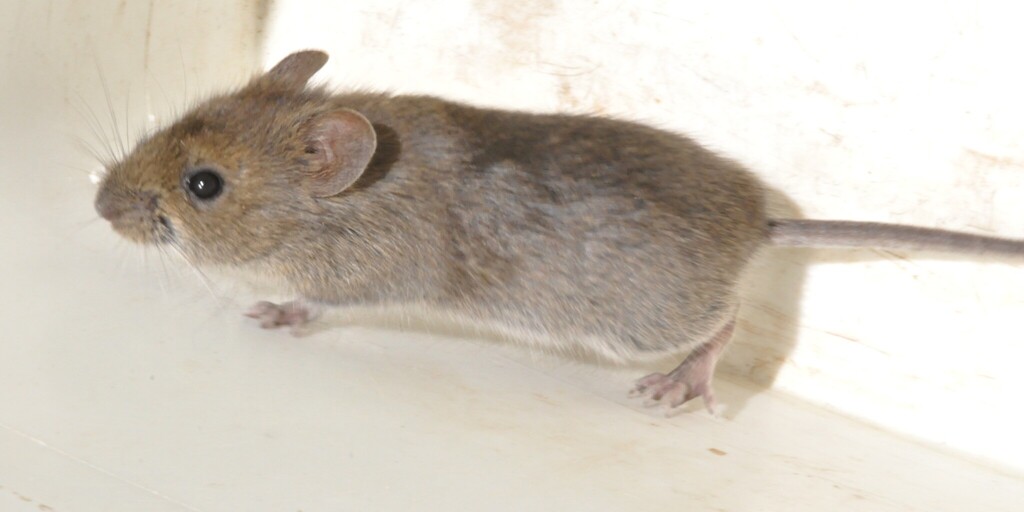
southern big-eared mouse
Loxodontomys micropus
The southern big-eared mouse (Loxodontomys micropus), also known as the southern pericote, is a species of rodent in the family Cricetidae. It is found in Argentina and Chile, and is one of only two species in its genus. The type specimen was captured by Charles Darwin in 1834 along the Santa Cruz River in Argentina, during the voyage of the HMS Beagle, and was subsequently described by George Robert Waterhouse.
From the article Southern big-eared mouse on Wikipedia (CC BY-SA), quoted section by section
Description
The southern big-eared mouse has a relatively heavy build for a mouse, accentuated by its thick fur. Fully grown adults of both sexes range from 237 to 242 millimetres (9.3 to 9.5 in) in total length, including the tail, and weigh between 45 and 105 grams (1.6 and 3.7 oz). It is however, not unusual for individuals to reach sexual maturity long before they reach the full adult size. The fur is dull greyish-brown over most of the body, with paler greyish or yellowish underparts. As its name suggests. it has larger ears than many other local species of mouse, although they are not dramatically so. The feet are sturdy, and the fifth toe on the hind feet is unusually long. The tail is about three-quarters the length of the body, and is covered with sparse fur. It can most readily be distinguished from other nearby mouse species by its robust build, relatively long tail, and the absence of hair on the feet. Females have four pairs of teats, running from the axillary region down to the groin.
Range & habitat
The southern big-eared mouse is found in the Andean foothills of southern Chile and south-western Argentina, from about 38°S down to the Straits of Magellan. A few isolated populations are also known from hilly regions of south-central Argentina, and the species is also found on Chiloé Island in Chile. It inhabits environments with heavy vegetation and good ground cover at elevations up to 3,000 metres (9,800 ft). It is most commonly found in forests dominated by southern beech trees, with dense undergrowth of South American bamboo. However, it can also be found in bushy scrub, such as that formed by barberries and Colletia, and in humid grasslands.
Subspecies. Three subspecies are currently recognised, and can be distinguished by subtle variations in the colour of the coat and feet:
Loxodonta micropus micropus Loxodonta micropus alsus Loxodonta micropus fumipes - Chiloé Island
Wikipedia: “Distribution and habitat”
Listen
Looking for field recordings…
Where it lives
Recorded sightings
—
geo-referenced records in GBIF, from museums, herbaria and field observers.
Drag the globe to turn it. Dots are where records exist, not a range map; darker means more records.
In the stacks
Searching the stacks…
Every page naming Loxodontomys micropus in the Biodiversity Heritage Library →
This page is assembled live from iNaturalist, GBIF, Wikipedia, the Source Library and the Internet Archive. It is not yet part of the hand-edited codex. iNaturalist taxon 74527.