- Animals
- ›Chordates
- ›Vertebrates
- ›Mammals
- ›Therians
- ›Placental Mammals
- ›Ungulates, Carnivorans, and Allies
- ›Pangolins
- ›Pangolins
- ›Manis
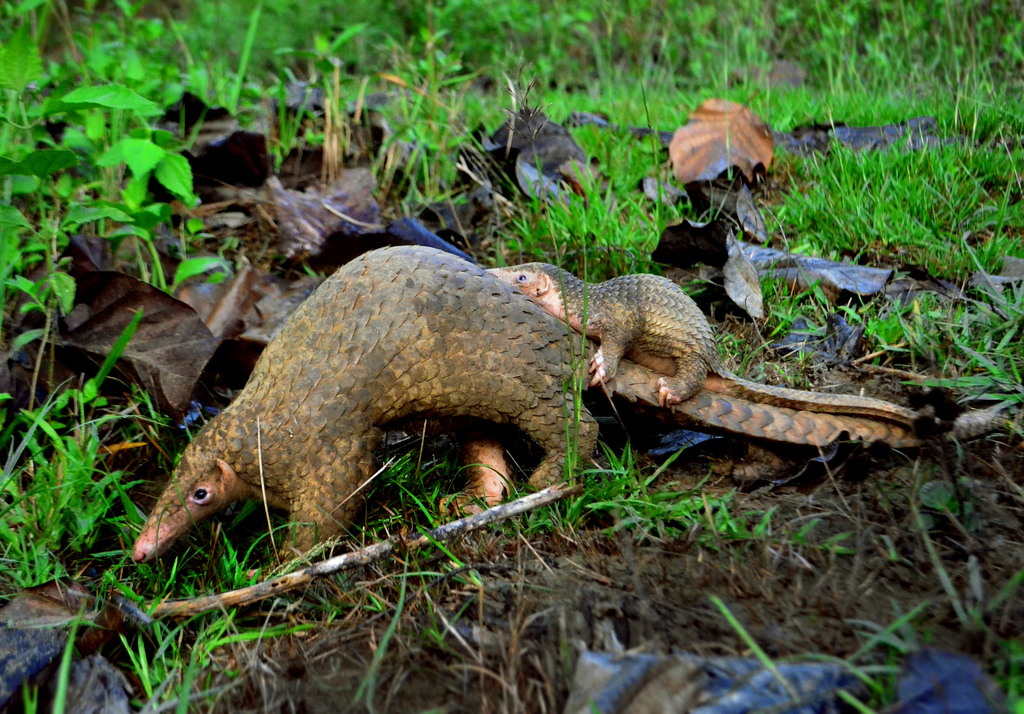
Palawan pangolin
Manis culionensis
The Philippine pangolin or Palawan pangolin (Manis culionensis), also locally known as balintong, is a pangolin species endemic to the Palawan province of the Philippines. Its habitat includes primary and secondary forests, as well as surrounding grasslands. This species is moderately common within its limited range, but is at risk due to heavy hunting because of its valued scales and meat. This species is distinguished from the closely related Sunda pangolin by its smaller body-to-tail ratio, smaller scales, and a shorter head. It is listed as Critically Endangered by the IUCN, and Critically Endangered by the Palawan Council for Sustainable Development (PCSD).
From the article Philippine pangolin on Wikipedia (CC BY-SA), quoted section by section
Description
The Philippine pangolin is roughly 60 to 89 centimetres (24 to 35 in) long, plus a 36 to 59 centimetres (14 to 23 in) tail. It weighs 2.2 to 7.3 lb (1 to 3 kg). Philippine pangolins in captivity can live up to about 20 years. It is covered in small triangular scales made of keratin everywhere except the underbelly and face, making up at least 20% of its body weight. It regrows new scales when they are lost and always has the same number of scales throughout their lifespan. The scales come in shades of brown, yellow, and olive, making for adequate camouflage at night. Newer offspring have much softer scales than adults and tend to weigh about 90–500 grams (3–18 oz). Areas of the body without scales are covered in a layer of hair. The Philippine pangolin has five sharp claws per foot and powerful appendages used for digging. However, these claws are not used as weapons for attacking or defending against other animals. Pangolins can also run solely on their hind legs for a duration, using their tail for balance. Its tail is prehensile, allowing it to grab onto branches or stand on its hind legs, despite being covered in scales. …
What it does
The Philippine pangolin is a myrmecophage, so has a diet consisting mainly of but not limited to termites and ants. It has in incredible sense of smell that it uses to find its food. The Philippine pangolin is seem to have strong preferences when it comes to the insects they eat, selectively consuming a certain species of ant or termite they like, or even actively avoiding certain species when there is enough of a food abundance to be picky. Its forefeet are used to dig into mounds and logs while its tongue harvests insects. The pangolin will only ever eat a portion of a termite or ant colony, leaving most of the mound/hill intact for the colony to regrow and act as a continuous food source for the pangolin later down the line. It consumes sand and small stones to help grind food in their stomachs.
Wikipedia: “Diet”
Listen
Looking for field recordings…
Where it lives
Recorded sightings
—
geo-referenced records in GBIF, from museums, herbaria and field observers.
Drag the globe to turn it. Dots are where records exist, not a range map; darker means more records.
In the stacks
Searching the stacks…
Every page naming Manis culionensis in the Biodiversity Heritage Library →
This page is assembled live from iNaturalist, GBIF, Wikipedia, the Source Library and the Internet Archive. It is not yet part of the hand-edited codex. iNaturalist taxon 74544.