- Animals
- ›Chordates
- ›Vertebrates
- ›Mammals
- ›Therians
- ›Placental Mammals
- ›Ungulates, Carnivorans, and Allies
- ›Even-toed Ungulates and Cetaceans
- ›Ruminants
- ›Deer
- ›Plesiometacarpal Deer
- ›Muntjacs and Tufted Deer
- ›Muntiacus
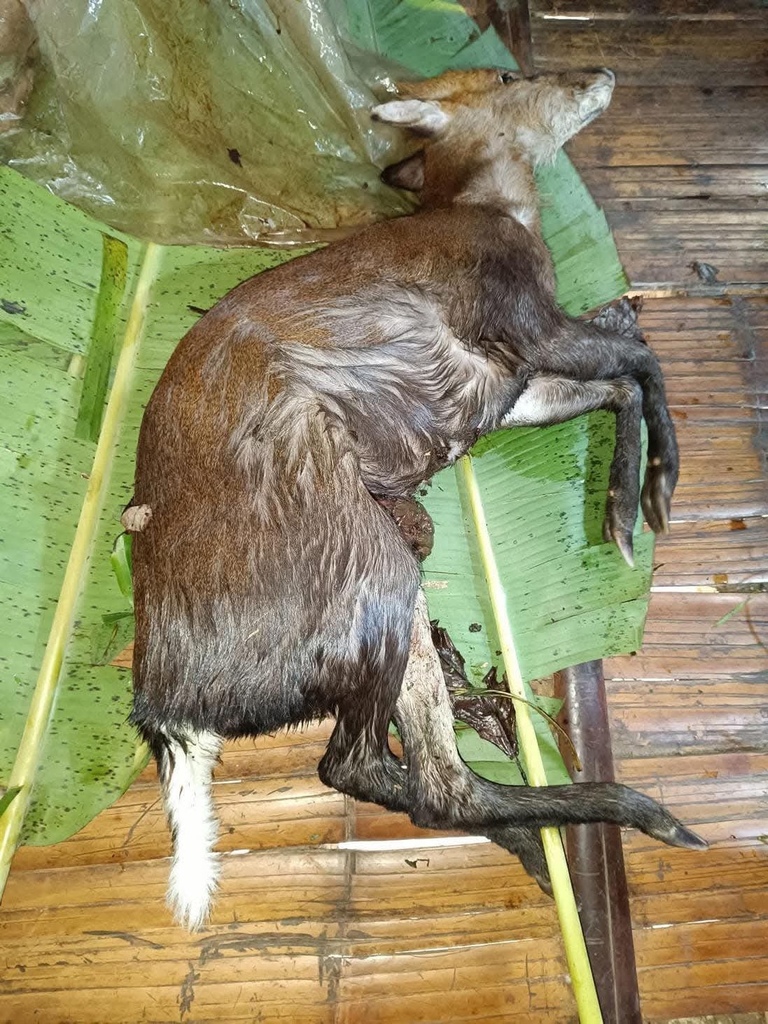
Leaf Muntjac
Muntiacus putaoensis
The leaf muntjac, leaf deer, or Putao muntjac (Muntiacus putaoensis) is a small species of muntjac. It was documented in 1997 by biologist Alan Rabinowitz during his field study in the isolated Nogmung Township in Myanmar. Rabinowitz discovered the species by examining the small carcass of a deer that he initially believed was the juvenile of another species; however, it proved to be the carcass of an adult female. He managed to obtain specimens, from which DNA analysis revealed a new cervid species. Local hunters knew of the species and called it the leaf deer because its body could be completely wrapped by a single large leaf. It is found in Myanmar and India.
From the article Leaf muntjac on Wikipedia (CC BY-SA), quoted section by section
Description
An adult leaf deer stands at just 20 inches (50 cm) high at the shoulder and weighs less than 25 pounds (11 kg). They are light brown. Males have unbranched antlers that are about 1 inch (2.5 cm) in height. Other than this, the male and female deer are identical. This species is unusual among other deer because their offspring do not bear any spots. It also differs from other muntjacs because both the male and female have pronounced canine tusks. The leaf deer species characteristics of being small, preferring to roam alone, and living in habitats of dense forests in the mountains resembles the characteristics of ancient species of deer.
Range & habitat
The leaf muntjac is uniquely found in dense forests of Myanmar, in the Hukawng Valley region to the Northeast of Putao, hence its scientific epithet, and to the south of the Nam Tamai branch of the Mai Hka River. It is found at an altitude of 450 to 600 m; the transition zone between tropical forests and temperate ones. Its existence in India was first reported from the Lohit district in eastern Arunachal Pradesh. In 2002, it was also reported to exist in Namdapha Tiger Reserve and eastern Arunachal Pradesh, India. It has also been noted from the Lohit and Changlang region and near Noklak in Nagaland. It probably inhabits suitable habitat over the entire junction of the Pātkai Bum and the Kumon Taungdan ranges. In 2008 and 2009, its presence was reported in several new areas of Arunachal Pradesh.
Wikipedia: “Distribution and habitat”
Listen
Looking for field recordings…
Where it lives
Recorded sightings
—
geo-referenced records in GBIF, from museums, herbaria and field observers.
Drag the globe to turn it. Dots are where records exist, not a range map; darker means more records.
In the stacks
Searching the stacks…
Every page naming Muntiacus putaoensis in the Biodiversity Heritage Library →
This page is assembled live from iNaturalist, GBIF, Wikipedia, the Source Library and the Internet Archive. It is not yet part of the hand-edited codex. iNaturalist taxon 74656.