- Animals
- ›Chordates
- ›Vertebrates
- ›Mammals
- ›Therians
- ›Placental Mammals
- ›Ungulates, Carnivorans, and Allies
- ›Carnivorans
- ›Mustelids
- ›Weasels
- ›Mustela
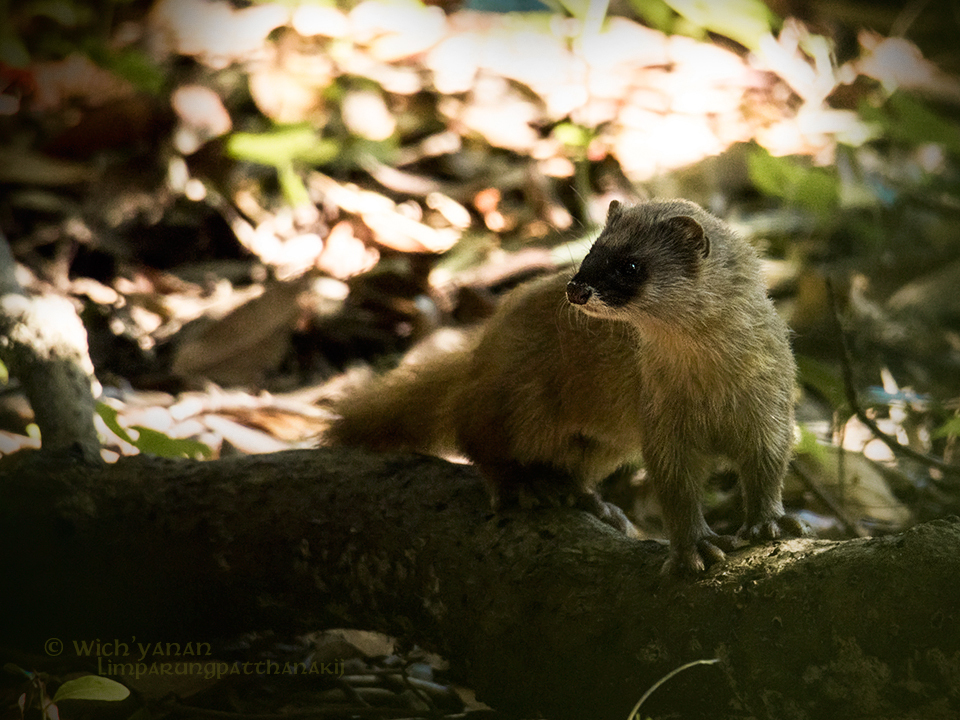
Japanese Weasel
Mustela itatsi
The Japanese weasel (Mustela itatsi) is a carnivorous mammal belonging to the genus Mustela in the family Mustelidae. The most closely related Mustela species is the Siberian weasel (Mustela sibirica). Its taxonomic species name, itatsi, is based on the Japanese word for weasel, itachi (イタチ). It is native to Japan where it occurs on the islands of Honshū, Kyūshū and Shikoku. It has been introduced to Hokkaidō and the Ryukyu Islands to control rodents and has also been introduced to Sakhalin Island in Russia.
It has an orange-brown coloured fur coat with darker markings on the head and varies in size depending on its gender. They have a long slender body, a long tail, relatively short legs and sharp claws. It is often confused with the Siberian weasel which has a different ratio of tail to head and body length. Unlike other species of weasels, their coat does not change colour in winter. Average lifespan of a Japanese weasel is highly dependent on the availability of food and to a lesser extent other factors that affect its life. In the wild it can live for 2 to 3 years with the highest in the range living to about 5 years. The Japanese weasel has a tail ratio of 36–50% while the Siberian weasel has a ratio greater than 50%. The population of the Japanese weasel has seen a decline of 25% over the last 3 generations which has been used to justify its status as near threatened on the IUCN Red List. The government of Japan has prevented the hunting of female Japanese weasels as a measure to conserve the species.
From the article Japanese weasel on Wikipedia (CC BY-SA), quoted section by section
Range & habitat
As they have thin fur and long bodies, the selection of a nest is important to Japanese weasels. There is variation between males and females in the way they select their nests as females require habitats with higher quality food than males. This is due to the need to feed both themselves and their offspring. The Japanese weasel is found to inhabit grasslands, shrublands, forests and plantations. They are not affected greatly by altitude and have an upper elevation limit of 336 metres (1,000 ft). Of the forests they live in, they inhabit both natural and secondary forests. They are found widespread throughout Japan but have evacuated most of western Japan and lowlands which the introduced Siberian weasel has taken over as the dominant weasel. The co-existence of villages and Japanese weasels pose a risk to the life of the weasel as many dead Japanese weasels are found to be killed on roads. Further, they are not typically found within big cities. They are not at all found within urban Tokyo. A decrease in human activity in rural areas leads to the return of Japanese weasels to that area. This was seen in the rural regions of Oita, Japan. The area that sees the greatest decline of Japanese weasels is western Japan.
Wikipedia: “Distribution and habitat”
What it does
Japanese weasels are sexually dimorphic with the males weighing approximately three times that of females. Despite this, there is no significant observable difference of tail-ratios between the sexes. Both sexes are capable of creating a smelly excretion known as musk from an anal gland used to repel predators which is employed by rubbing this secretion on rocks, branches and other natural obstacles. They are sexually mature before they are a year old and give birth to four to five offspring. The offspring are weaned in 8 weeks. Japanese weasels have been responsible for the protection of tree saplings in winter as they hunt the rodents that chew on the roots when hibernating snakes and owls can't control the rodent population.
Diet. The diet of the Japanese weasel involves a mix of animals including mice, reptiles, crayfish, and frogs. They eat some non-meat food such as berries, seeds, and fruits, but generally only when hungry. Additionally, there is a difference between the diets of males and females due to their sexual dimorphism. Males tend to eat more mammals and crustaceans while females tend to eat a more varied diet of insects, fruit and earthworms. …
Wikipedia: “Ecology”
In human culture
The Japanese weasel has been embedded in everyday Japanese vernacular. In Japanese itachi gokko ("weasel play") defines the vicious cycle of repeating the same message. The scent of their excreted musk gives rise to the saying itachi no saigo-pei ("the weasel's final fart"), which is used metaphorically to describe an extreme or desperate final measure. An individual who acts with bravado only when they have no formidable opponents can be labelled "itachi" or "weasel". Despite the everyday use of these phrases, they do not reflect the true temperament of Japanese weasel.
Folklore. A countryside Japanese legend states that after reaching the age of 100, a Japanese weasel will transform into ten Japanese martens (Martes melampus). Though not originally depicted as a weasel, the yokai to explain the phenomenon of cutting winds was eventually represented as a Japanese weasel. Named kamaitachi (鎌鼬), the yokai is depicted as having long, sharp nails similar in shape to sickles. It is a highly recognisable yokai found throughout Japan though most commonly in the snowy north of Honshu. The characterisation of the yokai varies slightly across Japan. For example, it is recognised as a trio of three weasels each with their own characteristic action. …
Wikipedia: “In Japanese culture”
Listen
Looking for field recordings…
Where it lives
Recorded sightings
—
geo-referenced records in GBIF, from museums, herbaria and field observers.
Drag the globe to turn it. Dots are where records exist, not a range map; darker means more records.
In the stacks
Searching the stacks…
Every page naming Mustela itatsi in the Biodiversity Heritage Library →
This page is assembled live from iNaturalist, GBIF, Wikipedia, the Source Library and the Internet Archive. It is not yet part of the hand-edited codex. iNaturalist taxon 74671.