- Animals
- ›Chordates
- ›Vertebrates
- ›Mammals
- ›Therians
- ›Placental Mammals
- ›Ungulates, Carnivorans, and Allies
- ›Even-toed Ungulates and Cetaceans
- ›Ruminants
- ›Bovids
- ›Antelopes, Goats, and Sheep
- ›Typical Antelopes
- ›Nanger
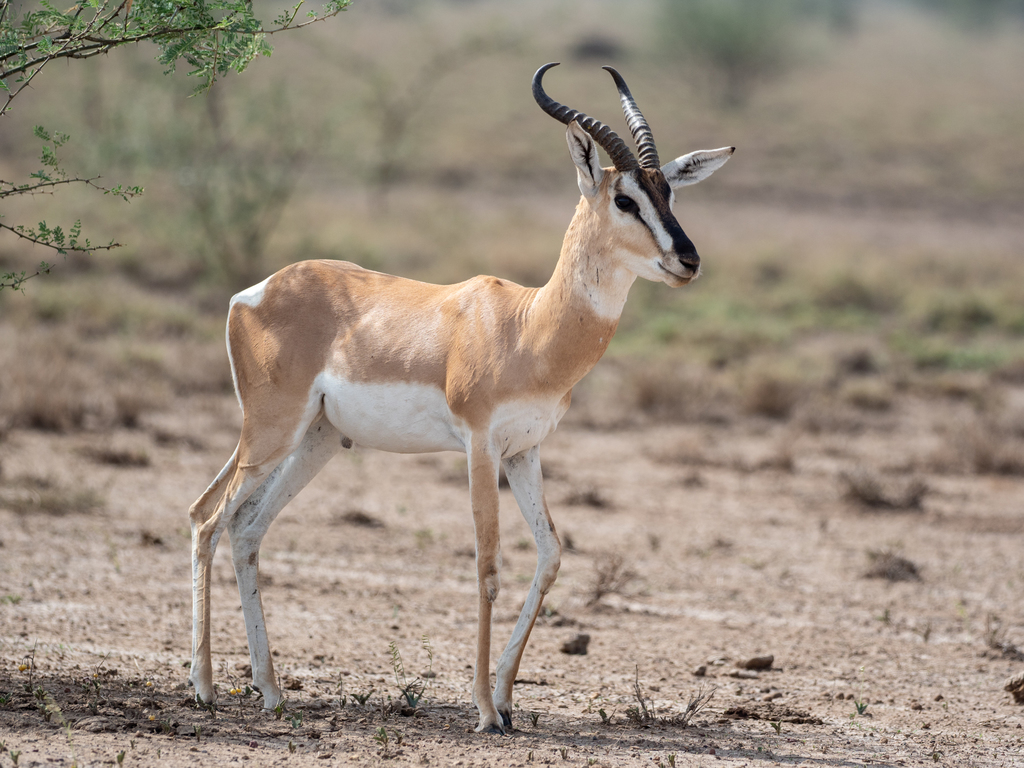
Sömmerring's Gazelle
Nanger soemmerringii
Soemmerring's gazelle (Nanger soemmerringii), also known as the Abyssinian mohr, is a gazelle species native to the Horn of Africa (Djibouti, Eritrea, Ethiopia, Somalia and South Sudan). The species was first described and given its scientific name by German physician Philipp Jakob Cretzschmar in 1828. Three subspecies are recognized. It is possibly no longer present in Sudan.
Since 1986, Soemmerring's gazelle has been classified as Vulnerable by the International Union for Conservation of Nature (IUCN).
From the article Soemmerring's gazelle on Wikipedia (CC BY-SA), quoted section by section
Range & habitat
Soemmerring's gazelles is native to the Horn of Africa. It lives in Djibouti, Eritrea, Ethiopia, Somalia and South Sudan. However, it is extinct in Sudan. They inhabit open steppes with brush and acacia, as well as steppes with few trees. At some point in history, a Soemmerring's gazelle population became isolated on Dahlak Kebir island in the Dahlak Archipelago, where the gazelle actually developed a dwarf form of the larger mainland races.
Wikipedia: “Distribution and habitat”
What it does
Scientists suggest the males are temporarily territorial. The lifespan for this animal is up to 14 years.
Wikipedia: “Reproduction”
Listen
Looking for field recordings…
Where it lives
Recorded sightings
—
geo-referenced records in GBIF, from museums, herbaria and field observers.
Drag the globe to turn it. Dots are where records exist, not a range map; darker means more records.
In the stacks
Searching the stacks…
Every page naming Nanger soemmerringii in the Biodiversity Heritage Library →
This page is assembled live from iNaturalist, GBIF, Wikipedia, the Source Library and the Internet Archive. It is not yet part of the hand-edited codex. iNaturalist taxon 74725.