- Animals
- ›Chordates
- ›Vertebrates
- ›Mammals
- ›Therians
- ›Placental Mammals
- ›Ungulates, Carnivorans, and Allies
- ›Even-toed Ungulates and Cetaceans
- ›Ruminants
- ›Bovids
- ›Antelopes, Goats, and Sheep
- ›Dwarf Antelopes
- ›Nesotragus
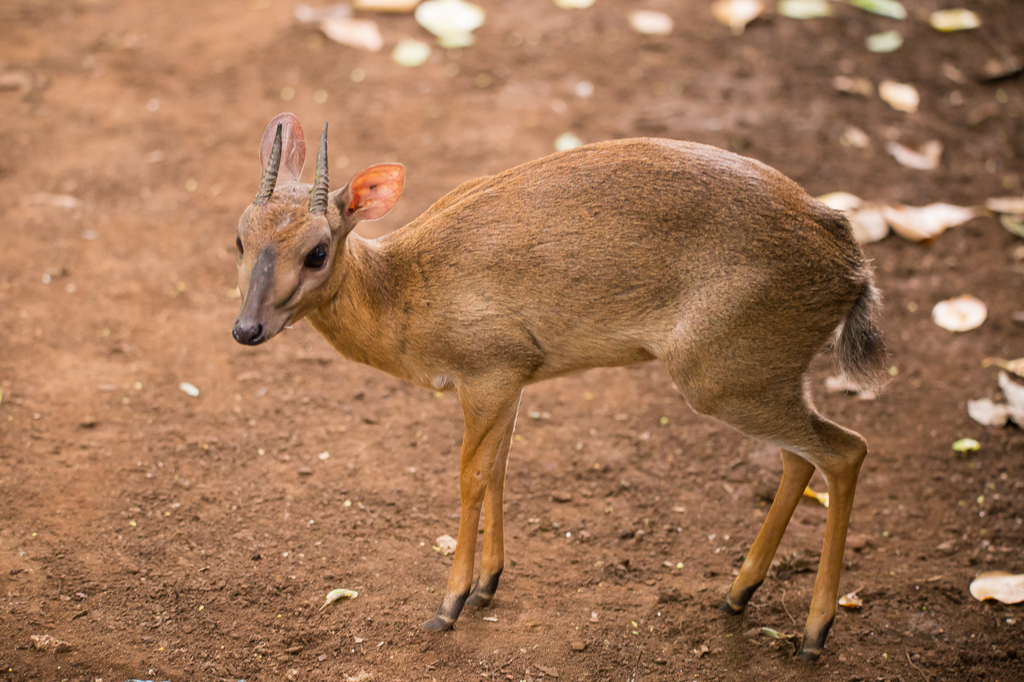
Suni
Nesotragus moschatus
The suni (Nesotragus moschatus) is a small antelope of the family Bovidae, and one of the smallest ungulates on earth. It occurs in dense underbrush from central Kenya to KwaZulu-Natal in South Africa. It is also found on the island of Zanzibar off of Tanzania.
Suni are around 30 to 43 centimetres (12 to 17 inches) high at the shoulder and weigh 4.5 to 5.4 kilograms (9 lb 15 oz to 11 lb 14 oz). They are usually reddish brown, darker on their back than their sides and legs. The belly, chin, throat and insides of legs are white. The nostrils are prominent red, and there are black rings around the eyes and above the hooves. Males have horns 8–13 cm (3–5 in) long, that are ridged most of their length and curve backwards close to their heads. Females do not have horns. Suni can make weak barking and whistling sounds.
From the article Suni on Wikipedia (CC BY-SA), quoted section by section
Description
The suni is a small antelope, but larger than the other two species of its genus. This antelope resembles Bates's pygmy antelope in terms of cranial measurements. The suni stands 33–38 centimetres (13–15 in) at the shoulder; the head-and-body length is typically between 57 and 62 cm (22 and 24 in). Both sexes weigh between 4.5 and 7 kg (9.9 and 15.4 lb). Horns are present only on males; sexual dimorphism in the suni is less marked than in Bates's pygmy antelope.
In human culture
The scientific name of the suni is Nesotragus moschatus; the species is in the genus Nesotragus, formerly with the Bates' pygmy antelope (Nesotragus batesi). The common name suni (/ˈsünē/) is the Swahili name for this antelope in southeastern Africa. Four subspecies are identified, though these are sometimes considered to be independent species:
Coastal suni — N. m. moschatus (Von Dueben, 1846) — found on the Zanzibar Archipelago (Changuu and Chapwani islands; Jozani, Kendwa, Kizimkazi and Nungwi, Unguja) and coastal Kenya (Arabuko Sokoke Park, Mombasa, Watamu). Livingstone's suni — N. m. livingstonianus (Kirk, 1865) — South Africa (KwaZulu-Natal), Malawi, inland Mozambique, Zambia and Zimbabwe. Mountain suni — N. m. kirchenpaueri (Pagenstecher, 1885) — Kenya (Aberdare Range, Karura Forest, Mount Kenya, Nairobi National Park) and Tanzania (Arusha National Park). Southern suni — N. m. zuluensis (Thomas, 1898) — South Africa (KwaZulu-Natal, Hluhluwe-Imfozoli, iSimangaliso Wetland Park), Eswatini (Mkhaya Game Reserve), and coastal southern Mozambique (Ponta do Ouro and surrounding areas).
Wikipedia: “Taxonomy and etymology”
Listen
Looking for field recordings…
Where it lives
Recorded sightings
—
geo-referenced records in GBIF, from museums, herbaria and field observers.
Drag the globe to turn it. Dots are where records exist, not a range map; darker means more records.
In the stacks
Searching the stacks…
Every page naming Nesotragus moschatus in the Biodiversity Heritage Library →
This page is assembled live from iNaturalist, GBIF, Wikipedia, the Source Library and the Internet Archive. It is not yet part of the hand-edited codex. iNaturalist taxon 74770.