- Animals
- ›Chordates
- ›Vertebrates
- ›Mammals
- ›Therians
- ›Placental Mammals
- ›Primates, Rodents, and Allies
- ›Primates
- ›Monkeys, Apes, and Tarsiers
- ›Monkeys and Apes
- ›Apes and Old World Monkeys
- ›Apes
- ›Gibbons
- ›Nomascus
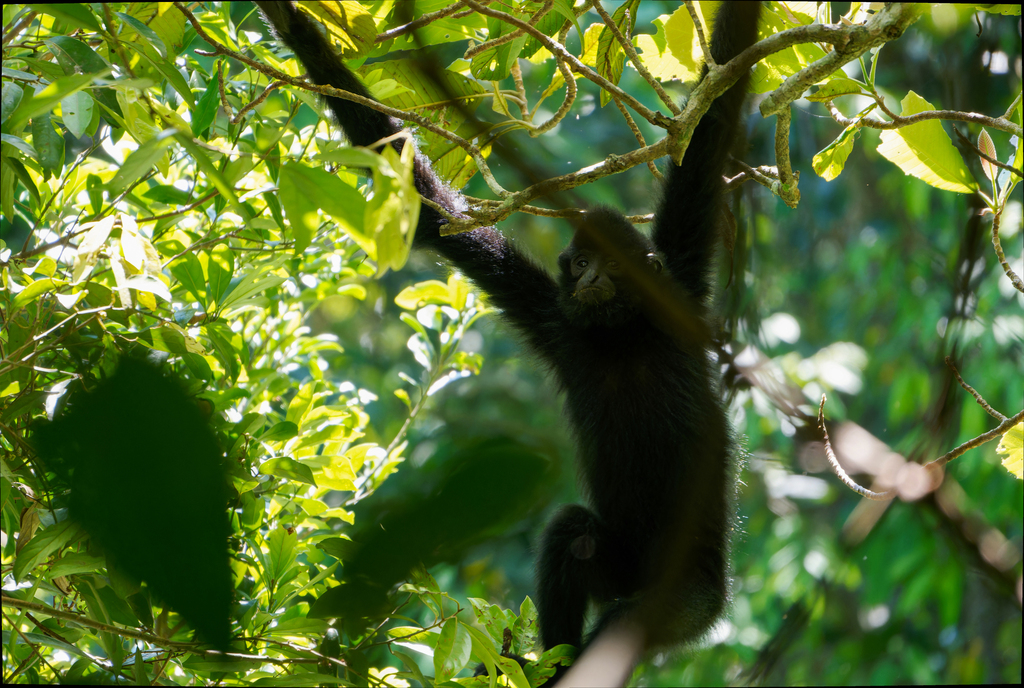
Hainan Gibbon
Nomascus hainanus
The Hainan black-crested gibbon or Hainan gibbon (Nomascus hainanus), is a species of gibbon found only on Hainan Island, China. It was formerly considered a subspecies of the eastern black crested gibbon (Nomascus nasutus) from Hòa Bình and Cao Bằng provinces of Vietnam and Jingxi County in Guangxi Zhuang Autonomous Region, China. Molecular data, like morphology and call differences, suggest it is a separate species. Its habitat consists of broad-leaved forests and semideciduous monsoon forests. It...
From the article Hainan black crested gibbon on Wikipedia (CC BY-SA), quoted section by section
Range & habitat
The Hainan gibbons reside in three different types of forests on the island. Their main area of occupancy is known as the primary forest (Old-growth forest). Within the primary forest the gibbons typically live in trees that are ten meters or taller. Along with offering sources of shelter and trees for singing rituals, the primary forests are also home to at least six species of plants eaten by the gibbons. When primary forests are destroyed, it takes the trees an extensive amount of time to regenerate to a state that is suitable as a home for the gibbons. In the 1960s, much of Hainan's lowlands were deforested to make way for rubber plantations and commercial logging, causing a dramatic decline in their population. These actions forced gibbon communities to higher elevations. By 1999, only 4% of the gibbons' original habitat remained on the island. Aside from primary forest, the gibbons split their time between two areas known as secondary forests and dwarf forests. The secondary forests are less suitable for the Hainan gibbons than the primary forests. Their trees are shorter in height, and they severely lack resources, such as food and shelter, needed by the gibbons to survive. The dwarf forest is even less favorable for the gibbons and a study by Fan et al. found that gibbons spent only 0.5% of the 13-month study period in dwarf forests. …
Wikipedia: “Habitat selection”
What it does
The breeding characteristics for the Hainan gibbon do not lend themselves to rapid population growth. The breeding females have a single offspring every two years and the newborn has a dependence period of roughly a year and a half. Furthermore, there are currently no Hainan gibbons in captivity and all previous attempts to breed them in captivity have failed.
Wikipedia: “Reproduction limitations”
Listen
Looking for field recordings…
Where it lives
Recorded sightings
—
geo-referenced records in GBIF, from museums, herbaria and field observers.
Drag the globe to turn it. Dots are where records exist, not a range map; darker means more records.
In the stacks
Searching the stacks…
Every page naming Nomascus hainanus in the Biodiversity Heritage Library →
This page is assembled live from iNaturalist, GBIF, Wikipedia, the Source Library and the Internet Archive. It is not yet part of the hand-edited codex. iNaturalist taxon 74780.