On eBird ↗
Gray-barred Wren
Live sightings near you, the range map, bar charts of when it is seen, and Macaulay Library photos and recordings.
Gray-barred Wren
Campylorhynchus megalopterus
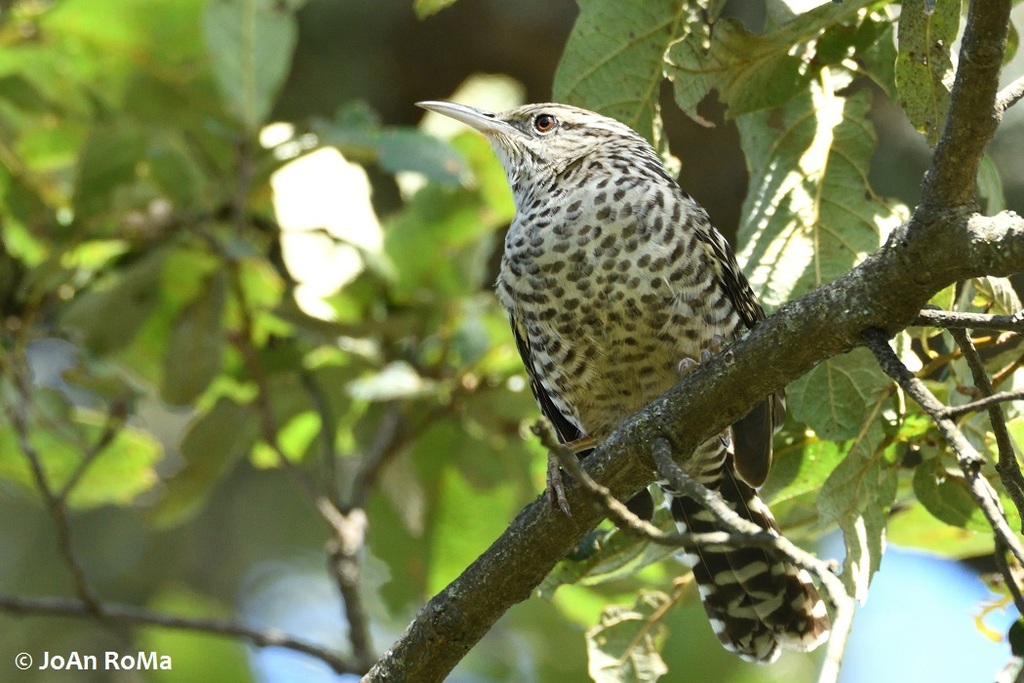
The gray-barred wren (Campylorhynchus megalopterus) is a species of bird in the family Troglodytidae. It is endemic to Mexico. Its natural habitat is subtropical or tropical moist montane forests.
From the article Gray-barred wren on Wikipedia (CC BY-SA), quoted section by section
Description
The gray-barred wren is 17 to 19.5 cm (6.7 to 7.7 in) long and weighs 32.8 to 33.5 g (1.16 to 1.18 oz). Both sexes of the nominate have a grayish crown with a black center, a black and white striped nape, and black shoulders and back barred with white. Their throat and chest are white with black spots and the flanks buff with blackish bars. C. m. nelsoni is the smaller of the subspecies and its underparts' spots and bars are grayish brown. The juvenile has a solid brown cap and is buff and brownish overall with no bars on the back and no spots on the chest.
Range & habitat
The ranges of the two subspecies of gray-barred wren do not meet. The nominate is found in the Trans-Mexican Volcanic Belt from Jalisco and Michoacán east to western Puebla. C. m. nelsoni is found in the southern Sierra Madre Oriental from west-central Veracruz through eastern Puebla into northern Oaxaca. It inhabits several types of montane forest including humid pine-oak and stands of Abies fir. It occurs in both primary and secondary forest. In elevation it ranges between 2,100 and 3,150 m (6,890 and 10,330 ft).
Wikipedia: “Distribution and habitat”
What it does
Though the gray-barred wren's diet has not been documented, it is probably small invertebrates. It does not forage on the ground but probes epiphytes, mosses, and lichens.
Wikipedia: “Feeding”
Listen
Looking for field recordings…
Where it lives
Recorded sightings
—
geo-referenced records in GBIF, from museums, herbaria and field observers.
Drag the globe to turn it. Dots are where records exist, not a range map; darker means more records.
In the stacks
This page is assembled live from iNaturalist, GBIF, Wikipedia, the Source Library and the Internet Archive. It is not yet part of the hand-edited codex. iNaturalist taxon 7479.