- Animals
- ›Chordates
- ›Vertebrates
- ›Mammals
- ›Therians
- ›Placental Mammals
- ›Primates, Rodents, and Allies
- ›Rodents
- ›Mice, Rats, and Hamsters
- ›Muroids
- ›Hamsters, Voles, Lemmings, and Allies
- ›South American Mice and Rats
- ›Rice Rats
- ›Oryzomys
Jamaican Rice Rat
Oryzomys antillarum
Oryzomys antillarum, also known as the Jamaican rice rat, is an extinct rodent of Jamaica. A member of the genus Oryzomys within the family Cricetidae, it is similar to O. couesi of mainland Central America, from where it may have dispersed to its island during the last glacial period. Oryzomys antillarum is common in subfossil cave faunas and is also known from three specimens collected live in the 19th century. Some historical records of Jamaican rats may pertain to it. The species probably became extinct late in the 19th century, perhaps due to the introduction of the small Indian mongoose, competition with introduced rodents such as the brown rat, and habitat destruction.
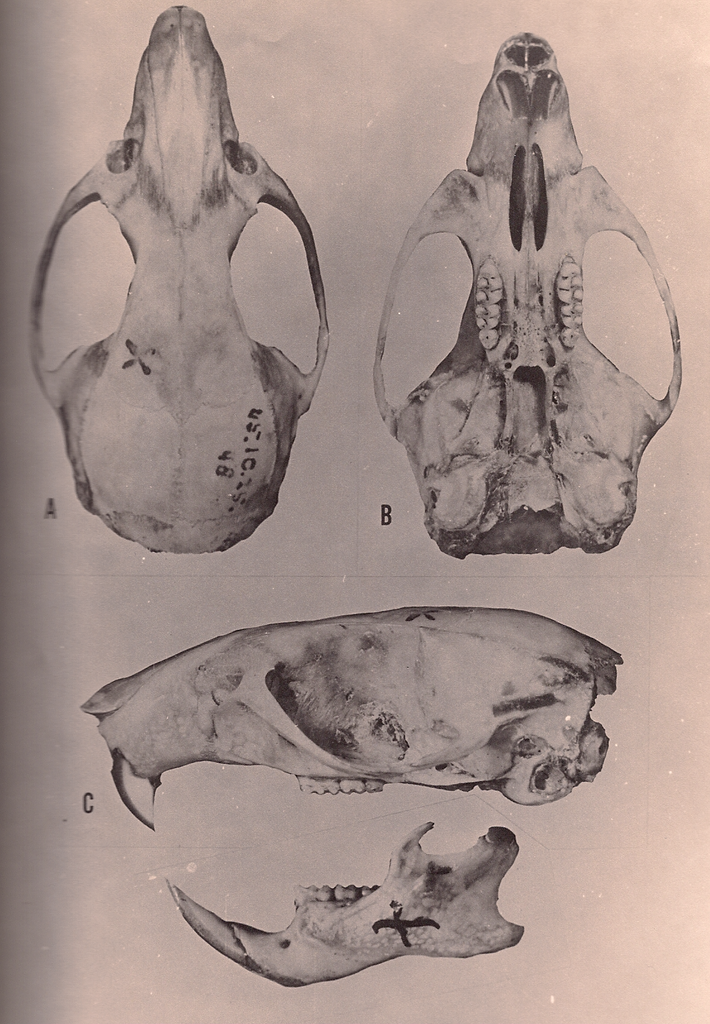
Oryzomys antillarum was a medium-sized rat, similar in most respects to O. couesi. The head and body length was 120 to 132 mm (4.7 to 5.2 in) and the skull was about 30 mm (1.2 in) long. The upperparts were reddish and graded into the yellowish underparts. The tail was about as long as the head and body, sparsely haired, and darker above than below. The species differed from O. couesi in having longer nasal bones, shorter incisive foramina (perforations of the front part of the palate), and more robust zygomatic arches (cheekbones).
From the article Oryzomys antillarum on Wikipedia (CC BY-SA), quoted section by section
Description
Oryzomys antillarum was a medium-sized rodent, about as large as O. couesi. According to Thomas's description, the upperparts were reddish, slightly brighter on the rump and more grayish on the head. The color of the upperparts graded into that of the underparts, which were yellowish. The hairs of the underparts were grayish at the bases. The small ears were black on the outer and yellow on the inner side and the upper surfaces of the hands and feet were whitish. The tail was nearly naked and was light brownish above and lighter below. Goldman wrote that the specimens in the USNM were rather more reddish, but their color may have been altered because they had been preserved in alcohol. Coues had described these as rusty brown above and washed with the same color below. Andrew Arata compared the USNM specimens with examples of the reddish Florida subspecies of the marsh rice rat, Oryzomys palustris natator, for Ray and found that they were more reddish than even the most strongly colored animals from Florida.
The skull was generally similar to that of O. couesi, as were the teeth. It was robust and bore well-developed supraorbital ridges (located above the eyes) on the braincase. The interparietal bone, part of the roof of the braincase, was small and narrow. The bony palate extended beyond the third molars. …
Listen
Looking for field recordings…
Where it lives
Recorded sightings
—
geo-referenced records in GBIF, from museums, herbaria and field observers.
Drag the globe to turn it. Dots are where records exist, not a range map; darker means more records.
In the stacks
Searching the stacks…
Every page naming Oryzomys antillarum in the Biodiversity Heritage Library →
This page is assembled live from iNaturalist, GBIF, Wikipedia, the Source Library and the Internet Archive. It is not yet part of the hand-edited codex. iNaturalist taxon 74816.