On eBird ↗
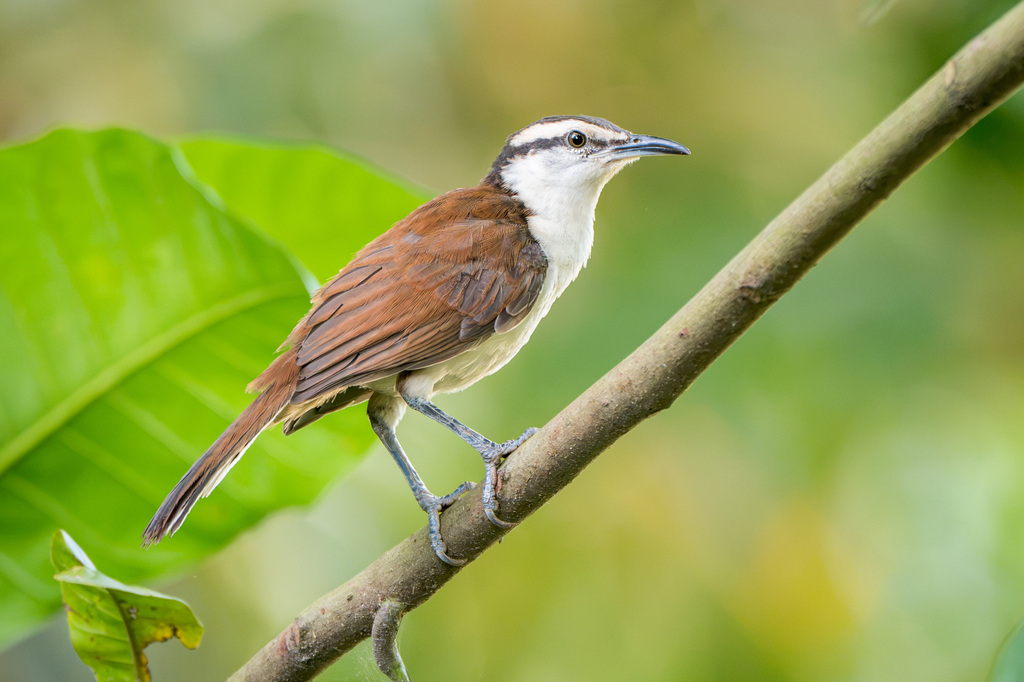
Bicolored Wren
Live sightings near you, the range map, bar charts of when it is seen, and Macaulay Library photos and recordings.
Bicolored Wren
Campylorhynchus griseus
The bicolored wren (Campylorhynchus griseus) is a species of bird in the family Troglodytidae. It is found in Colombia, Venezuela, Guyana, and far-northern Brazil.
From the article Bicolored wren on Wikipedia (CC BY-SA), quoted section by section
Description
The bicolored wren is the largest South American wren and second in size only to the giant wren overall in the family. It is 21 to 22 cm (8.3 to 8.7 in) long and weighs 37 to 46.5 g (1.31 to 1.64 oz). The sexes are similar. The nominate adults have dark chocolate crowns and napes and their upperparts a paler chocolate. An off-white supercilium separates a dark brown stripe through the eye from the crown and the rest of the face is also white. Their tail is dark brown; all of the tail feathers except the middle pair have a white band near the end. The throat and the entire underparts are white. C. g. albicilius is rustier than the nominate; so is bicolor but its rump is lighter. C. g. minor is smaller and its nape and upper back are blackish brown. C. g. pallidus is paler and more gray than the nominate and has a darker crown. The juveniles are grayer than the adults; their caps are mottled gray-brown and their underparts are grayish white.
Range & habitat
The subspecies of bicolored wren are distributed thus:
C. g. albicilius, northern Colombia and northwestern Venezuela with a few records in far eastern Panama C. g. bicolor, western Colombia's upper Magdalena Valley and west slope of the Eastern Andes C. g. griseus, eastern Venezuela through western and southwestern Guyana into extreme northern Brazil C. g. minor, northern Venezuela and eastern Colombia C. g. pallidus, southern Venezuela's Amazonas State C. g. zimmeri, central Colombia's Huila and Tolima Departments The bicolored wren inhabits areas with scattered trees and bushes and is completely absent from forests and wide open areas. C. g. bicolor occurs in arid thorn scrub and the other subspecies in significantly more humid areas. In elevation it ranges up to 2,100 m (6,900 ft) in Colombia and 1,600 m (5,200 ft) in Venezuela.
Wikipedia: “Distribution and habitat”
What it does
The bicolored wren forages in trees and on the ground. Its diet is primarily invertebrates, but it also eats vegetable matter such as berries.
Wikipedia: “Feeding”
Listen
Looking for field recordings…
Where it lives
Recorded sightings
—
geo-referenced records in GBIF, from museums, herbaria and field observers.
Drag the globe to turn it. Dots are where records exist, not a range map; darker means more records.
In the stacks
Searching the stacks…
Every page naming Campylorhynchus griseus in the Biodiversity Heritage Library →
This page is assembled live from iNaturalist, GBIF, Wikipedia, the Source Library and the Internet Archive. It is not yet part of the hand-edited codex. iNaturalist taxon 7483.