- Animals
- ›Chordates
- ›Vertebrates
- ›Mammals
- ›Therians
- ›Placental Mammals
- ›Ungulates, Carnivorans, and Allies
- ›Even-toed Ungulates and Cetaceans
- ›Ruminants
- ›Bovids
- ›Antelopes, Goats, and Sheep
- ›Duikers
- ›Philantomba
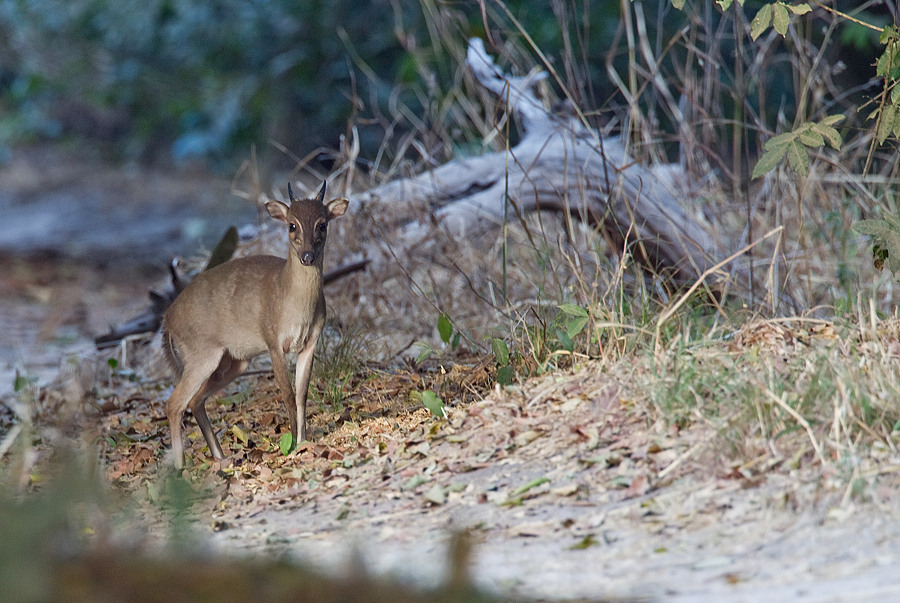
Maxwell's Duiker
Philantomba maxwellii
The Maxwell's duiker (Philantomba maxwellii) is a small antelope found in western Africa.
From the article Maxwell's duiker on Wikipedia (CC BY-SA), quoted section by section
Description
Maxwell's duiker is a small antelope, as are the others in its genus. It is characterised by a slightly elevated back, short legs, a small head and short, round ears. According to measurements by Haltenorth, the head-and-body length is typically between 63 and 100 centimetres (25 and 39 in), and between 55 and 90 centimetres (22 and 35 in) excluding the head. It reaches 35–38 centimetres (14–15 in) at the shoulder, and weighs around 8–10 kilograms (18–22 lb). The tail, 8–10 centimetres (3.1–3.9 in) long, is bushy and lined with white. The species exhibits sexual dimorphism, as the females are slightly larger than the males. The coat is grayish brown, sometimes with a bluish tinge; the colour varies with individuals. A short tuft of hair circles the base of the horns and covers the area between them. The underbelly, in contrast with the dorsal parts, is generally white. Four teats are present. Males, and sometimes females, possess straight, short, spiky horns. Heavily ringed and thick at the base, these measure 3.5–6 centimetres (1.4–2.4 in) in length. The length of the horns of the subspecies P. m. maxwelli rises from east to west, though this is not apparent in Ghana and the longest horns are observed in the western extremes of the range. The proportion of horned females reduces sharply from 100 percent in Nigeria and Togo to 5 out of 80 in Liberia. P. m. …
Range & habitat
The Maxwell duiker prefers areas with fresh and dense growth of shrubs and other plants. It inhabits the warm, moist lowland forests prevalent in western African countries such as Benin, Burkina Faso, Côte d'Ivoire, Ghana, Guinea, Guinea-Bissau, Liberia, Nigeria, Senegal, Sierra Leone and Togo. The habitat also includes forest fringes, secondary, scrub and gallery forests and farmlands. The western limits of the range lie in southwestern Senegal and western Gambia, from where it extends as far east as the Cross River in Nigeria.
Wikipedia: “Habitat and distribution”
What it does
The Maxwell duiker's diet mostly consists of fruits, seeds, secondary vegetation and shrubs. Maxwell's duiker and other duikers present in the same geographical area were found to have similar diets. Diets are subject to seasonal changes, with a shift towards vegetation and parts of flowers at the beginning of winter. The animal's small size is reflected in its food choices. Due to its smaller mouth, body anatomy, and masseter muscle, it tends to concentrate on food items up to 3 cm in diameter, while larger species eat items up to 6 cm in diameter.
Wikipedia: “Diet”
Listen
Looking for field recordings…
Where it lives
Recorded sightings
—
geo-referenced records in GBIF, from museums, herbaria and field observers.
Drag the globe to turn it. Dots are where records exist, not a range map; darker means more records.
In the stacks
Searching the stacks…
Every page naming Philantomba maxwellii in the Biodiversity Heritage Library →
This page is assembled live from iNaturalist, GBIF, Wikipedia, the Source Library and the Internet Archive. It is not yet part of the hand-edited codex. iNaturalist taxon 74869.