- Animals
- ›Chordates
- ›Vertebrates
- ›Mammals
- ›Therians
- ›Placental Mammals
- ›Primates, Rodents, and Allies
- ›Primates
- ›Lemurs, Lorises, and Allies
- ›Lemurs
- ›Lemurs
- ›Typical Lemurs
- ›Prolemur
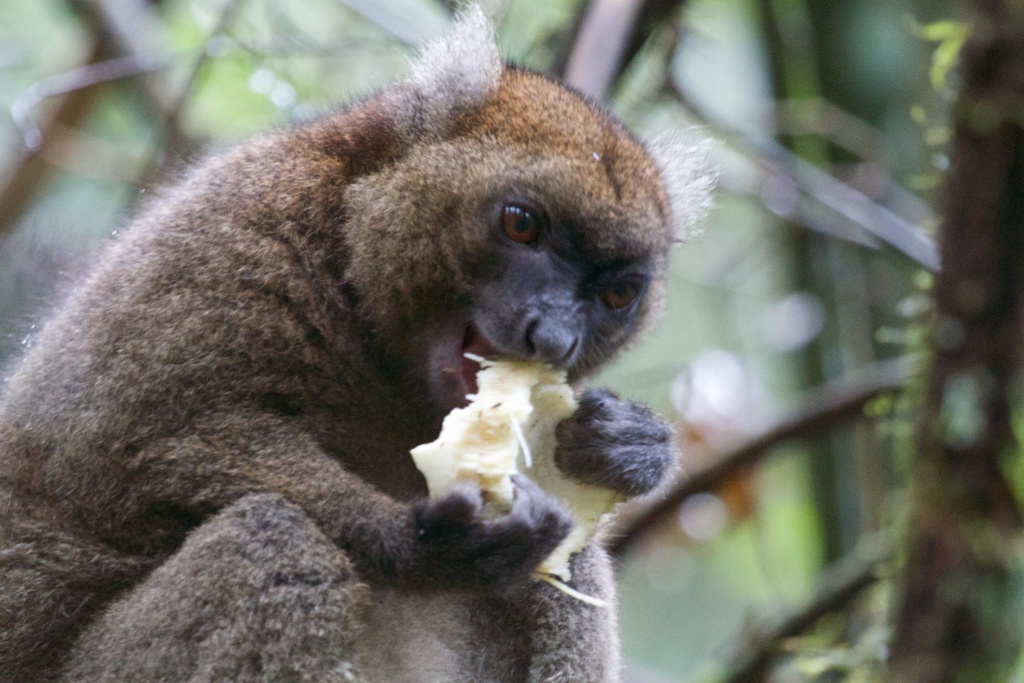
Greater Bamboo Lemur
Prolemur simus
The greater bamboo lemur (Prolemur simus), also known as the broad-nosed bamboo lemur and the broad-nosed gentle lemur, is a species of lemur endemic to bamboo forests in eastern Madagascar. As the largest of the bamboo lemurs, the greater bamboo lemur can have a head-body length between 40 and 42 centimetres (16 and 17 in) and a tail length of 45–48 cm (18–19 in), with body weights averaging 2.75 kg (6.1 lb) in males and 2.61 kg (5.8 lb) in females. It is distinguishable from other bamboo lemurs by its truncated muzzle, white-tufted ears, neck gland in males, and gray-brown pelage, of which two color morphs are exhibited. It is the only member of genus Prolemur.
The greater bamboo lemur is a bamboo specialist; woody bamboos comprise up to 95% of an individual's diet, though it is also known to consume fruits, flowers, and other grasses. Because of its reliance on bamboo, its diet contains high levels of cyanide. It is a cathemeral species, as it can be active during the day and at night. It lives in gregarious social groups of up to 28 individuals that share home ranges of at least 60 hectares (150 acres), which typically expand during the austral summer. Females usually give birth to a singleton infant annually, which is weaned by 7–10 months of age. High rates of infant mortality affect the greater bamboo lemur, with 40–50% of infants dying within their first 2 weeks of life. Females give birth to their first offspring at 2–3 years of age, while males disperse from their natal ranges at 3–4 years of age.
From the article Greater bamboo lemur on Wikipedia (CC BY-SA), quoted section by section
Description
The greater bamboo lemur is the largest of the bamboo lemurs, having a head-body length of 40–42 cm (16–17 in) and a tail length of 45–48 cm (18–19 in), amounting to a total length of 85–90 cm (33–35 in). Males, weighing between 2.15 and 3.55 kg (4.7 and 7.8 lb) with an average weight of 2.75 kg (6.1 lb), are slightly heavier than females, who weigh between 2.2 and 3.25 kg (4.9 and 7.2 lb) with an average weight of 2.61 kg (5.8 lb). The intermembral index is 65, with the arms being shorter and thinner than the legs. The somatic number of the greater bamboo lemur is 2n = 60, wherein 4 autosomal chromosomes and the X chromosome are metacentric, and 54 autosomal chromosomes and the Y chromosome are acrocentric. The muzzle is truncated, which is a trait that is associated with an increase in bite force, possibly to aid in the mastication of difficult-to-process food items such as bamboo. The ears are small and rounded. The breadth of the interorbital constriction is greater than half the width of the postorbital constriction. The dental formula is 2.1.3.32.1.3.3 × 2 = 36. The maxillary incisors (I1–2) are small in size and are clustered closely to the maxillary canine (C–), with the lateral maxillary incisor (I2) being considerably reduced compared to the central maxillary incisor (I1). …
Range & habitat
Greater bamboo lemurs are known to occur at elevations between 20 and 1,600 meters (66 and 5,249 ft) above sea level across 13 isolated subpopulations in eastern Madagascar, although its range might extend beyond these identified groups. The known latitudinal extents the greater bamboo lemur's range are 14°47' S in the north and 22°26' S in the south. In 2007, only five subpopulations were known, those being in Ranomafana National Park, a coffee plantation in the municipality of Kianjavato, Andringitra National Park, Torotorofotsy Harmonious Protected Landscape, and the Karianga-Ivato region. Subsequent surveys identified eight more subpopulations: that of the Andriantantely forest, that of the Ankeniheny-Zahamena Corridor, Zahamena National Park, the municipalities of Mahalina and Vohiposa, the regions of Nosivolo-Marolambo and Midongy-Vondrozo, and an eastern subpopulation in Ranomafana National Park. In 2022, three greater bamboo lemurs were observed in Makira Natural Park, and are believed to be representatives of an extremely small subpopulation endemic to that area. It primarily occurs outside of protected areas. The distribution of the greater bamboo lemur is tied to that of its food items. In Ranomafana National Park, the greater bamboo lemur is associated with the distribution of Madagascar giant bamboo. …
Wikipedia: “Distribution”
What it does
Greater bamboo lemurs live in gregarious groups of up to 28 individuals, with the mean group size being eight individuals. Groups can be either multimale-multifemale, or one male-multifemale. It is possible that the sizes of groups fluctuate throughout the year and across different locations. These groups live in home ranges of at least 60 hectares (150 acres), which tend to grow in size during the austral summer. The greater bamboo lemur is the only known male-dominated lemur species; males have been observed to take bamboo pith from females. The greater bamboo lemur changes its locomotive preference throughout the year, being more terrestrial during the austral summer and more arboreal during the austral winter. While arboreal, it travels via vertical clinging and leaping. This locomotor method is an adaptation to the abundance of vertical substrates and dearth of horizontal substrates in the species' preferred habitat of bamboo thickets. Despite this pattern of behavior, the greater bamboo lemur is not morphologically dependent on vertical clinging and leaping, as is the case with some other vertical clinger and leaper species. 25–30% of a greater bamboo lemur's time is spent consuming food on the ground. It is cathemeral with a preference for nighttime activity. …
Wikipedia: “Behavior”
In human culture
The greater bamboo lemur is alternatively known as the broad-nosed bamboo lemur or the broad-nosed gentle lemur. The term "gentle lemur" is derived from an English translation of the species' former genus, Hapalemur, which is itself derived from the Greek word ἁπαλός (hapalos), meaning "gentle." Hapalemur was coined by French zoologist Isidore Geoffroy Saint-Hilaire in 1851 because the lemurs reminded him of marmosets, which were then known by the generic name Hapale. The term "bamboo lemur" gradually eclipsed "gentle lemur" following the 1987 discovery of the golden bamboo lemur (Hapalemur aureus) and the usage of the former term in the 1994 first edition of Lemurs of Madagascar. The common name "greater bamboo lemur" was nearly unanimously adopted after a 1988 description of the species, when "broad-nosed lemur" variants were largely abandoned. …
Wikipedia: “Etymology”
Listen
Looking for field recordings…
Where it lives
Recorded sightings
—
geo-referenced records in GBIF, from museums, herbaria and field observers.
Drag the globe to turn it. Dots are where records exist, not a range map; darker means more records.
In the stacks
Searching the stacks…
Every page naming Prolemur simus in the Biodiversity Heritage Library →
This page is assembled live from iNaturalist, GBIF, Wikipedia, the Source Library and the Internet Archive. It is not yet part of the hand-edited codex. iNaturalist taxon 74956.