- Animals
- ›Chordates
- ›Vertebrates
- ›Mammals
- ›Therians
- ›Marsupials
- ›Kangaroos, Possums, Wombats, and Allies
- ›Gliders, Ring-tailed Possums, and allies
- ›Ring-tailed Possums and Greater Gliders
- ›Typical Ring-tailed Possums
- ›Pseudocheirus
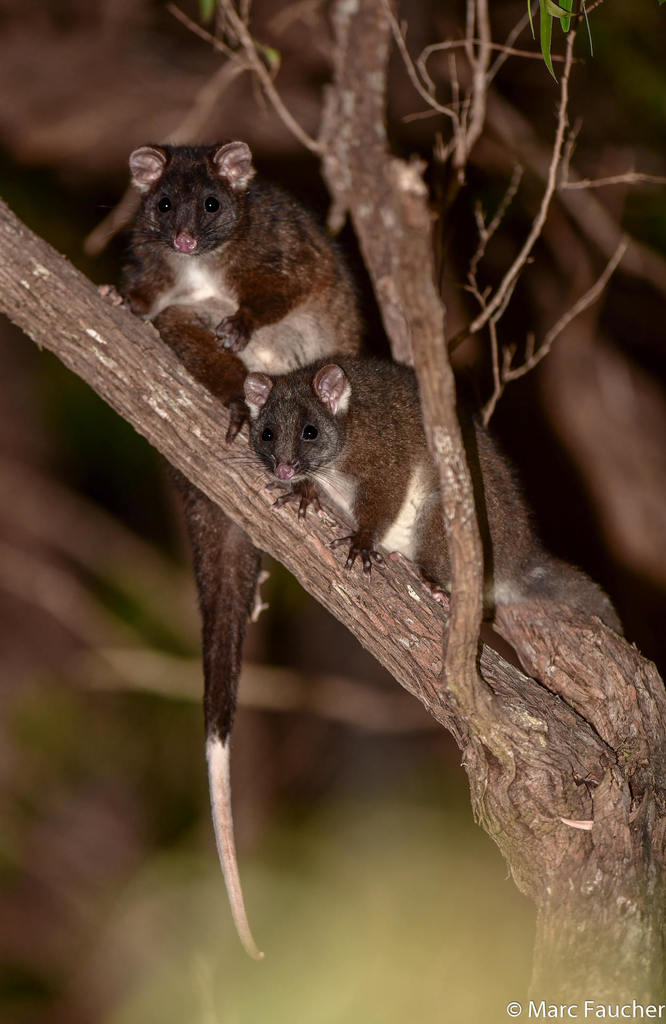
Western Ring-tailed Possum
Pseudocheirus occidentalis
The western ringtail possum or ngwayir (Pseudocheirus occidentalis) is a species of possum found in a small area of Southwest Australia. They are a cat-sized marsupial with a stocky build, dark greyish-brown fur, pale underparts and a long prehensile tail with a whitish tip. Ngwayir forage at night through the upper canopy of trees, feeding on young leaves, flowers and fruit, especially in groves of the weeping peppermint Agonis flexuosa. Breeding occurs mainly during the winter, the single juvenile emerging from the pouch after about three months. The population has declined by more than 95% since British settlement, due to clearing of habitat, fire and the introduction of the red fox Vulpes vulpes, and is classified as Critically Endangered. The population in most areas has catastrophically declined or become locally extinct, but strongholds remain in the urbanised areas near Busselton and Albany.
From the article Western ringtail possum on Wikipedia (CC BY-SA), quoted section by section
Description
Western ringtails are largely-arboreal marsupials smaller than the size of a domestic cat, with stocky bodies, grasping feet and a strong, prehensile tail. The profile of the black back and rump slopes toward a prehensile tail that tapers to a fine white point. The species has a head and body length of 320–400 mm, a tail length of 300–400 mm, and a weight of 750 to 1350 g. Pseudocheirus occidentalis has dark grey-brown-black fur with light patches behind the ears and a creamy white, sometimes greyish, colour at the underside of the body that extends to the chest and throat. It differs from the common ringtail possum found on the east of the continent, by lacking any rufous colouration in the fur.
Range & habitat
The western ringtail is endemic to south-western Western Australia where it is now found in three main areas; the Swan Coastal Plain, Southern Forests around Manjimup, and the South Coast between Walpole and Cheynes Beach. In the Swan Coastal Plain and South Coast, the species favours habitat dominated by Peppermint, as well as Tuart, marri, jarrah, karri, Bullich, Albany blackbutt, Allocasuarina, Banksia, Kunzea, Nuytsia, and Xylomelum. In the Southern Forests, peppermint is generally absent and the western ringtails live in jarrah-dominated eucalypt forests. Western ringtails also frequent many urban and peri-urban gardens, where they feed on a variety of native and introduced plants. Urban populations surveyed in the city of Albany have revealed an average individual range of 0.88 hectares, moving from their dreys in the day to their preferred night-time habitat in eucalypts. The study demonstrated that populations varied in their use of habitat and the size of the range was dependent on qualities such as the extent and connections of the canopy cover in its favoured tree species. Since colonial settlement it has undergone a substantial range contraction, up to 90 per cent of the predicted original range. …
Wikipedia: “Distribution and habitat”
What it does
The western ringtail is an arboreal and nocturnal herbivore with a relatively small home range of 0.5-6 ha, dependent on habitat type. It uses tree hollows and builds dreys for shelter in tree canopies, their nest-like drey is an assemblage of shredded bark, twigs and leaves. They are primarily arboreal, but will move through understorey or open ground to feed or gain shelter when the tree canopy is unconnected. Sheltering at ground level is recorded, though not usual, more frequently be found at hollows and the upper story of a forest; the species has occasionally be seen to occupy rabbit burrows. Western ringtails are folivorous; their diet includes leaves, shoots, fruit and flowers of a range of plants, both native and introduced. Favoured food trees include jarrah, marri, and Peppermint. The quality of food sources vary across time and space, and in particular are related to the availability of water and the intensity of recent fire. Young leaves are preferred, avoiding the lignin content of mature plant matter. The species is coprophagic, re-consuming faecal matter digested during the day to increase the nutrients derived from their food. Births occur mainly in winter to spring, where usually one young is raised to maturity, although twins may be present in the pouch. …
Wikipedia: “Behaviour”
Listen
Looking for field recordings…
Where it lives
Recorded sightings
—
geo-referenced records in GBIF, from museums, herbaria and field observers.
Drag the globe to turn it. Dots are where records exist, not a range map; darker means more records.
In the stacks
Searching the stacks…
Every page naming Pseudocheirus occidentalis in the Biodiversity Heritage Library →
This page is assembled live from iNaturalist, GBIF, Wikipedia, the Source Library and the Internet Archive. It is not yet part of the hand-edited codex. iNaturalist taxon 74968.