- Animals
- ›Chordates
- ›Vertebrates
- ›Mammals
- ›Therians
- ›Placental Mammals
- ›Ungulates, Carnivorans, and Allies
- ›Even-toed Ungulates and Cetaceans
- ›Ruminants
- ›Deer
- ›Plesiometacarpal Deer
- ›Typical Old World Deer
- ›Rusa
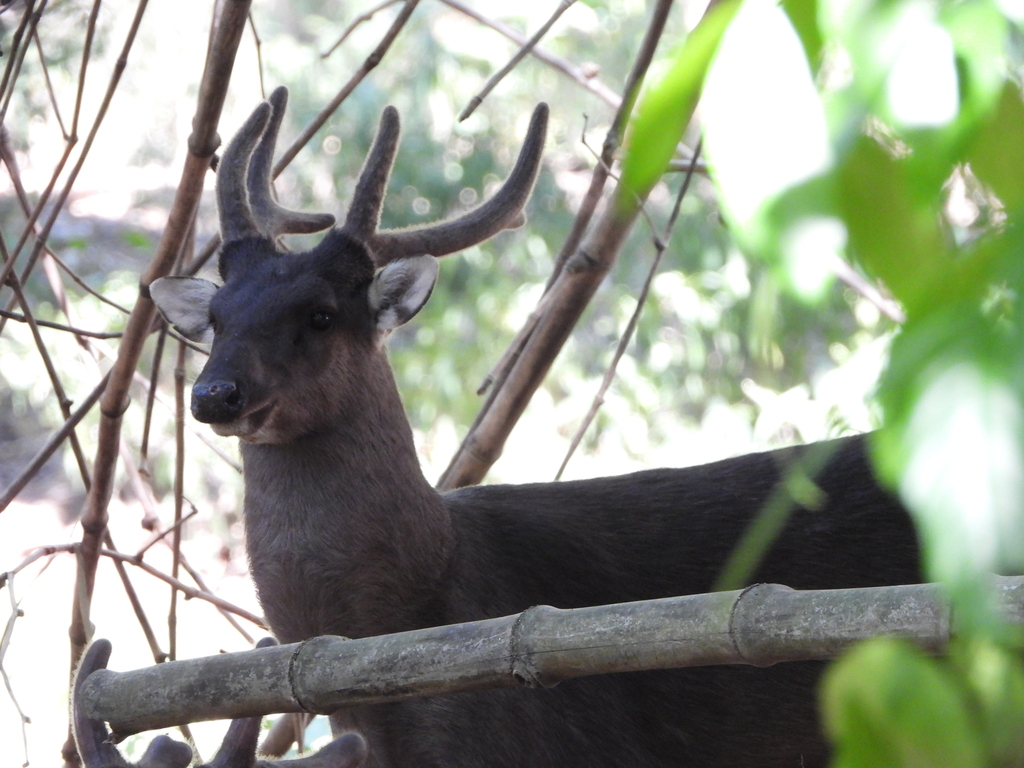
Philippine Brown Deer
Rusa marianna
The Philippine brown deer (Rusa marianna) also known as Philippine sambar or simply Philippine deer, is a species of deer endemic in the islands of the Philippines. It was previously known as Cervus mariannus in reference to the Sambar deer (C. unicolor) in Guam, Mariannas Islands where the deerwas also first described. Currently, four subspecies are known which includes: R. m. marianna in Luzon biogeographic region, R. m. barandana in Mindoro, R. m. Nigella in isolated...
From the article Philippine deer on Wikipedia (CC BY-SA), quoted section by section
Description
The Philippine brown deer is relatively smaller than its relative, the sambar deer. Its head-and-body length and shoulder height measures 100 to 151 cm (39 to 59 in), and 55 to 70 cm (22 to 28 in), respectively. Its weight usually ranges from 40 to 60 kg. Generally, its color is brown with a white tail underside. Antlers are common among males which measure 20 to 40 cm. Variations in morphology were observed especially in Mindanao populations, but are still unknown at present.
Wikipedia: “Characteristics”
Range & habitat
The Philippine deer is endemic to the Philippines, where it occurs in the islands of Luzon, Polillo and Catanduanes, Mindoro, Samar, Mindanao and Leyte. It is possibly extinct in Biliran and Bohol, and was considered to be possibly extinct in Marinduque until local sightings were confirmed in 2022, 2023, and 2026. It has also been declared extinct in Dinagat and Siargao Islands. Across the country, its population is severely fragmented and reduced. The Philippine brown deer generally thrives in a terrestrial environment from sea level up to at least 2,900 m (9,500 ft). It prefers to forage in grasslands under primary and secondary forests. However, due to forest denudation and excessive hunting, they are driven uphill to hide in the remaining patches of forests. It was introduced to Guam by Mariano Tobias sometime around 1771 to 1772 to be used in recreational hunting. The deer subsequently populated other neighboring locales in Micronesia, including the islands of Rota, Saipan and Pohnpei. However, in the absence of a natural predator, its population is rapidly expanding in Guam, posing serious threats to the native ecosystem and agricultural lands due to overgrazing. Hence, management programs are imposed to significantly reduce the deer population. …
Wikipedia: “Distribution and habitat”
What it does
The mating season of the Philippine deer is usually from September to January. During this time, females gather in small groups, composed of at most eight deer; males are drawn to them by the females' pheromones. During these intense few months, males are virile, more vocal (to call females), and aggressively solitary. The two males will huff, scrape the ground and lock antlers. Fights do not often lead to bloodshed or death, but hormones are nonetheless heightened at this time. Many tense encounters between males result in nothing more than bluff charges, and the loser willingly retreats or is chased off of the boundaries of the territory. These boundaries are constantly updated through urinating, defecating in key spots, and rubbing oil scent glands on surrounding plants. Any other male setting foot within another's range is seen as a potential threat.
Wikipedia: “Behaviour and ecology”
In human culture
The Bagobo-Tagabawa tribe in Barangay Sibulan, Toril, Davao City identified the Philippine brown deer as a "cultural keystone species". This means that the deer play a vital role in their culture. As a matter of fact, the tribesmen claimed that their tribe would be incomplete without the deer. To preserve their cultural pride by avoiding over-hunting, the tribe has declared hunting and non-hunting zones in the forest. The Obu Manuvu indigenous community declared the Philippine deer as a "Pusaka" species, which means that it has an inherent value to the community's culture, life and history, and the community is committed to protect, manage and conserve the deer population within its ancestral domain. The Mandaya people in Davao Oriental also regard the deer as " Gift from the Creator"; it is a sacred species in their ancestral landscapes.
Wikipedia: “In culture”
Listen
Looking for field recordings…
Where it lives
Recorded sightings
—
geo-referenced records in GBIF, from museums, herbaria and field observers.
Drag the globe to turn it. Dots are where records exist, not a range map; darker means more records.
In the stacks
Searching the stacks…
Every page naming Rusa marianna in the Biodiversity Heritage Library →
This page is assembled live from iNaturalist, GBIF, Wikipedia, the Source Library and the Internet Archive. It is not yet part of the hand-edited codex. iNaturalist taxon 75051.