- Animals
- ›Chordates
- ›Vertebrates
- ›Mammals
- ›Therians
- ›Placental Mammals
- ›Ungulates, Carnivorans, and Allies
- ›Even-toed Ungulates and Cetaceans
- ›Ruminants
- ›Deer
- ›Plesiometacarpal Deer
- ›Typical Old World Deer
- ›Rusa
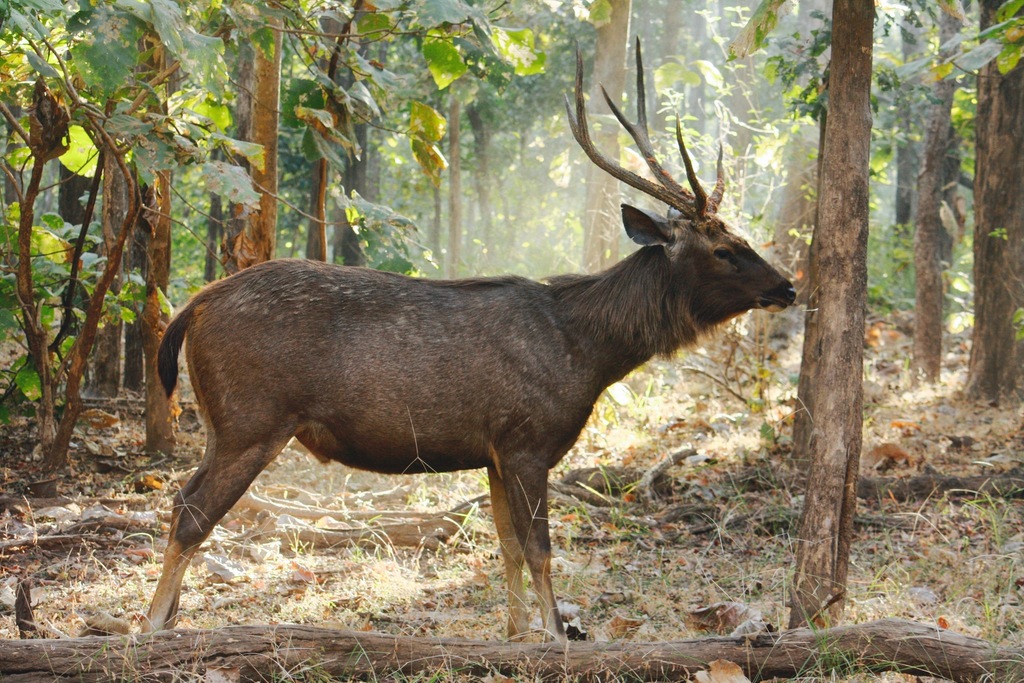
Sambar
Rusa unicolor
The sambar (Rusa unicolor) is a large deer native to the Indian subcontinent, South China and Southeast Asia. It has been listed as a vulnerable species on the IUCN Red List since 2008, as populations have declined substantially due to hunting, local insurgency, and industrial exploitation of habitat.
From the article Sambar deer on Wikipedia (CC BY-SA), quoted section by section
Description
The appearance and the size of the sambar vary widely across its range, which has led to considerable taxonomic confusion in the past; over 40 different scientific synonyms have been used for the species. In general, they attain a height of 102 to 160 cm (40 to 63 in) at the shoulder and may weigh as much as 546 kg (1,204 lb), though more typically 100 to 350 kg (220 to 770 lb). Head and body length varies from 1.62 to 2.7 m (5.3 to 8.9 ft), with a 22 to 35 cm (8.7 to 13.8 in) tail. Individuals belonging to western subspecies tend to be larger than those from the east, and females are smaller than males. Among all living cervid species, only the moose and the elk can attain larger sizes.
The large, rugged antlers are typically rusine, the brow tines being simple and the beams forked at the tip, so they have only three tines. The antlers are typically up to 110 cm (43 in) long in fully adult individuals. As with most deer, only the males have antlers. The shaggy coat can be from yellowish brown to dark grey in colour, and while it is usually uniform in colour, some subspecies have chestnut marks on the rump and underparts. Sambar also have a small but dense mane, which tends to be more prominent in males. …
Range & habitat
The sambar is distributed from the south-facing slopes of the Himalayas in Nepal, Bhutan and India to Myanmar, Thailand, Malaysia, Indochina, southern China and in Indonesia on the islands of Sumatra and Borneo. It ranges up to elevations of 3,500 m (11,500 ft) in tropical dry forests, tropical seasonal forests, subtropical mixed forests with stands of conifers and montane grasslands, broadleaved deciduous and broadleaved evergreen trees, to tropical rainforests, and seldom moves far from water sources. It prefers the dense cover of deciduous shrubs and grasses, although the exact nature of this varies enormously with the environment because of its wide Asian range. Home range sizes are probably equally variable, but have been recorded as 1,500 ha (3,700 acres) for males and 300 ha (740 acres) for females in India. On Sumatra, the sambar is generally more abundant in the lowlands. It is also native to Singapore, but was thought to have been extirpated following World War II due to hunting and deforestation; it was rediscovered in the 1970s near Mandai. Despite the city-state's high level of urbanisation, the sambar population has rebounded and reached about 120 individuals in 2026, an eight-fold increase over the preceding five years. Individuals sometimes cross the border from India into Pakistan.
Wikipedia: “Distribution and habitat”
What it does
Sambar are nocturnal or crepuscular. The males live alone for much of the year, and the females live in small herds of up to 16 individuals. Indeed, in some areas, the average herd consists of only three or four individuals, typically consisting of an adult female, her most recent young, and perhaps a subordinate, immature female. This is an unusual pattern for deer, which more commonly live in larger groups. They often congregate near water, and are good swimmers. Sambar feed on a wide variety of vegetation, including grasses, foliage, browse, fruit, and water plants, depending on the local habitat. They also consume a great variety of shrubs and trees. Sambar have been seen congregating in large herds in protected areas such as national parks and reserves in India, Sri Lanka, and Thailand. In Taiwan, sambar along with sika deer, have been raised on farms for their antlers, which they drop annually in April to May and are highly prized for use as knife handles and as grips for handguns.
Stags wallow and dig their antlers in urine-soaked soil, and then rub against tree trunks. Sambar are capable of remarkable bipedalism for a deer species, and stags stand and mark tree branches above them with their antlers. A stag also marks himself by spraying urine on his own face with a highly mobile penis. …
Wikipedia: “Ecology and behaviour”
Listen
Looking for field recordings…
Where it lives
Recorded sightings
—
geo-referenced records in GBIF, from museums, herbaria and field observers.
Drag the globe to turn it. Dots are where records exist, not a range map; darker means more records.
In the stacks
Searching the stacks…
Every page naming Rusa unicolor in the Biodiversity Heritage Library →
This page is assembled live from iNaturalist, GBIF, Wikipedia, the Source Library and the Internet Archive. It is not yet part of the hand-edited codex. iNaturalist taxon 75053.