On eBird ↗
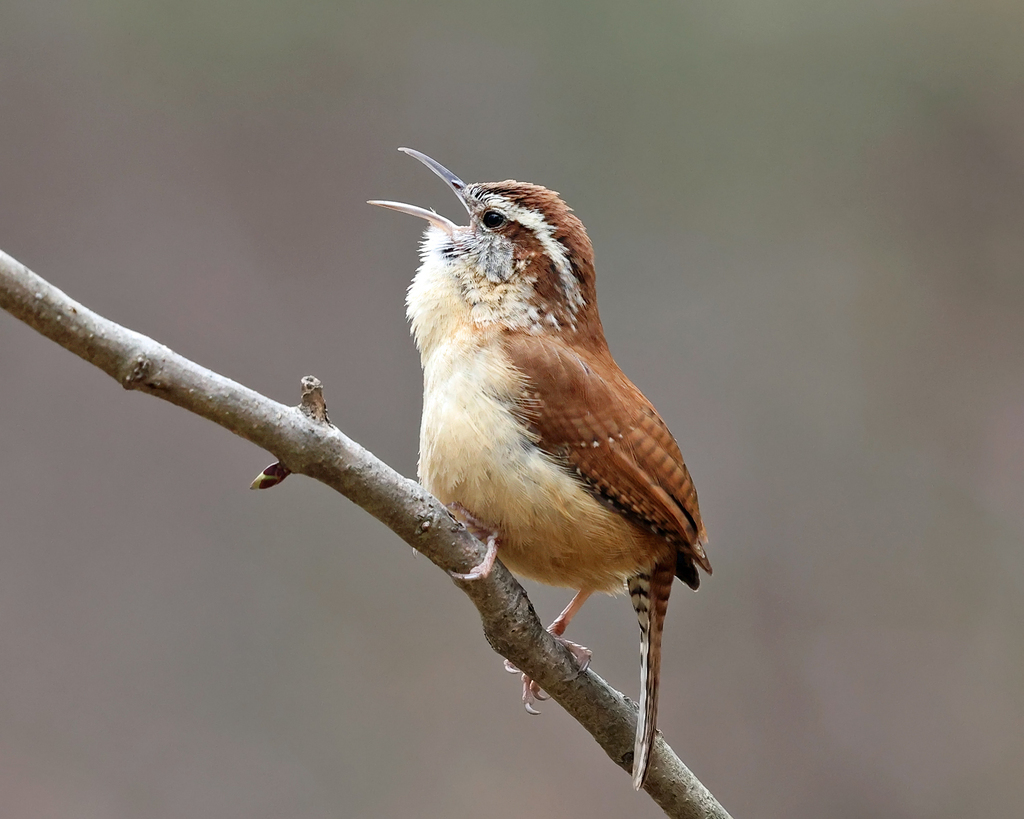
Carolina Wren
Live sightings near you, the range map, bar charts of when it is seen, and Macaulay Library photos and recordings.
Carolina Wren
Thryothorus ludovicianus
The Carolina wren (Thryothorus ludovicianus) is a species of wren common in the eastern United States, the extreme south of Ontario, Canada, the northeast and southeast of Mexico, and into northern Central America. Severe winters restrict the northern limits of their range, while favorable weather conditions lead to a northward extension of their breeding range. Their preferred habitat is in dense cover in forest, farm edges, and suburban areas. This wren is the state bird of South Carolina.
Ten subspecies are recognized, occurring across the range of the species; they differ slightly in song and appearance. It is generally inconspicuous, avoiding the open for extended periods of time. When out in the open, they energetically investigate their surroundings and are rarely stationary. After finding a mate, pairs maintain a territory and stay together for several years. Both males and females give out alarm calls, but only males sing to advertise territory. Carolina wrens raise multiple broods during the summer breeding season but can fall victim to brood parasitism by brown-headed cowbirds, among other species.
From the article Carolina wren on Wikipedia (CC BY-SA), quoted section by section
Description
At 12.5 to 14 cm (4.9 to 5.5 in) long, with a 29 cm (11 in) wingspan and a weight of about 18 to 23 g (0.63 to 0.81 oz), the Carolina wren is a fairly large wren; the second largest in the United States species after the cactus wren. Among standard measurements, the wing chord is 5.4 to 6.4 cm (2.1 to 2.5 in), the tail is 4.5 to 5.6 cm (1.8 to 2.2 in), the culmen is 1.4 to 1.8 cm (0.55 to 0.71 in) and the tarsus is 2 to 2.3 cm (0.79 to 0.91 in). Sexual dimorphism is slight with males being larger than their mates. A study indicated that of 42 mated pairs, every male but one was larger than the female of the pair. The males were on average 11 percent heavier along with having longer wing chords. For T. l. ludovicianus, the crown is rich brown that appears more chestnut-colored on its rump and upper tail coverts. Shoulders and greater coverts are a rich brown, with a series of small white dots on the lesser primary coverts. The secondary coverts are rich brown with a darker brown barring on both webs; the bars on the primaries are on the outerwebs only, but darker and more noticeable. The rectrices are brown with 18 to 20 bars that span across the tail. The white supercilious streak borders thinly with a black above and below, and extends above and beyond its shoulders. The ear coverts are speckled gray and grayish-black. …
Range & habitat
These birds are largely resident, and will only disperse beyond their range after mild winters. Carolina wrens sporadically breed as far north as Maine and Quebec after mild winters. In certain parts of their range, such as most of Iowa, prolonged periods of snow can curtail potential expansion. Permanent breeding locations range from eastern Nebraska, southern Michigan, southeast Ontario and the New England states to Mexican states such as Coahuila, Nuevo León, San Luis Potosí and Tamaulipas and the Gulf Coast of the United States. Local occurrences with infrequent and likely breeding locations include southeast South Dakota, central Kansas, eastern Colorado, western Oklahoma and Texas as far as Maine and New Brunswick. There have been occasional vagrants spotted in Colorado, New Mexico, and Arizona, Wyoming, South Dakota, Manitoba, Nova Scotia, and the Gulf of St. Lawrence. The range of the wrens increased northward and westward in several regions over the past few centuries. In Massachusetts, the wrens had expanded westward and northeastward from its former southeastern location in approximately 35 years, in New York the population increased three-fold in roughly 25 years, while in the midwest states of Ohio and Michigan, numbers have increased since the mid-1800s and early 1900s, respectively. Expansion around Ontario occurred since early reports in 1890 and 1905. …
Wikipedia: “Habitat and distribution”
What it does
Carolina wrens spend the majority of their time on or near the ground searching for food, or in tangles of vegetation and vines. They also probe bark crevices on lower tree levels, or pick up leaf-litter in order to search for prey. Their diet consists of invertebrates, such as beetles, true bugs, grasshoppers, katydids, spiders, ants, bees, and wasps. Small lizards and tree frogs also make up the carnivorous portion of their diet. Vegetable matter, such as fruit pulp and various seeds, makes up a small percentage of their diet. In the northern portion of their range, they frequent bird feeders.
Wikipedia: “Feeding”
In human culture
The genus name Thryothorus is of Greek origin from the combination of the noun θρύον : thrýon ("rush, reed") and the adjective θοῦρος : thoũros ("rushing, impetuous"; derivative of verb θρῴσκειν : thrōskein to leap up, spring, jump at). Thus, Thryothorus means 'reed jumper'. Its specific name ludovicianus is a post-classical Latin term for Ludovicus (derivative from Louis XIV) meaning 'of Louisiana' that identifies the locality of the specimen collected near New Orleans.
Wikipedia: “Etymology”
Listen
Looking for field recordings…
Where it lives
Recorded sightings
—
geo-referenced records in GBIF, from museums, herbaria and field observers.
Drag the globe to turn it. Dots are where records exist, not a range map; darker means more records.
In the stacks
Searching the stacks…
Every page naming Thryothorus ludovicianus in the Biodiversity Heritage Library →
This page is assembled live from iNaturalist, GBIF, Wikipedia, the Source Library and the Internet Archive. It is not yet part of the hand-edited codex. iNaturalist taxon 7513.