- Animals
- ›Chordates
- ›Vertebrates
- ›Mammals
- ›Therians
- ›Placental Mammals
- ›Ungulates, Carnivorans, and Allies
- ›Even-toed Ungulates and Cetaceans
- ›Ruminants
- ›Chevrotains
- ›Tragulus
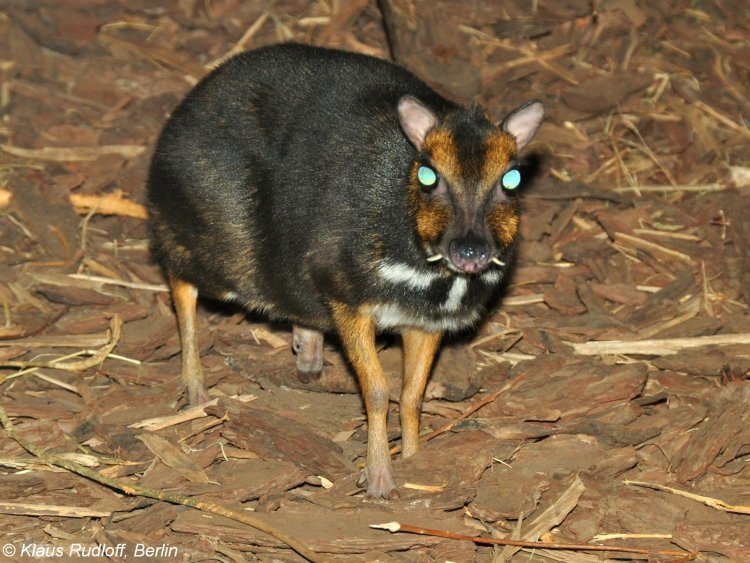
Balabac Chevrotain
Tragulus nigricans
The Philippine mouse-deer (Tragulus nigricans), also known as the Balabac chevrotain or pilandok (in Filipino), is a small, nocturnal ruminant, which is endemic to Balabac and nearby smaller islands (Bugsuk and Ramos) southwest of Palawan in the Philippines. The genus Tragulus means 'little goat' and the Philippine mouse-deer has been named so due to the horizontal pupils of the eyes. This position of the pupil allows for an increase in peripheral depth perception. It has traditionally been considered a subspecies of the greater mouse-deer (T. napu). In 2004, though, T. nigricans was separated from T. napu as its own species due to differences in skull morphology (skull measurements). Contrary to its common name, the Philippine mouse-deer does not belong to the true deer family (Cervidae); it is a member of the chevrotain family, a grouping of some of the world's smallest hoofed mammals.
From the article Philippine mouse-deer on Wikipedia (CC BY-SA), quoted section by section
Description
It has a black and brown coat with white stripes on the throat and chest. Each individual hair has sections of different colors - the base is generally light (ranging from white to ashy brown), with a tawny, orange, or brown midsection, and a long black tip. The most striking markings of the Balabac chevrotain are on the throat, with three narrow white stripes beginning from a white patch under the chin and extending down towards the chest. In intense contrast to these white stripes (and sharply defining them), the rest of the throat is jet black; in some specimens the black coloration even overtakes and obscures the stripes. Towards the chest, these black and white markings disappear into a broad brown band which crosses the lower throat. The head itself is generally darker in color than the rest of the body. Broad rufous or fulvous 'eyebrow' stripes extend from the anterior corners of the eyes to the base of ears. The bridge of the nose and forehead are dark brown, becoming increasingly infused with black towards the crown of the head. The sides of the head are more fulvous. A naked glandular patch on the underside of the jaw is bordered with white, which runs into the white patch at the top of the throat. Its slender legs and arched back are covered by brown fur, with a white base. A dark line runs from each ear past the eye toward the nose. …
Wikipedia: “Morphology”
What it does
It is a solitary, nocturnal animal, but has on occasion been seen in pairs for short periods of time. The Philippine mouse-deer's main diet consists of leaves, flowers, and other vegetation in the dense forest undergrowth. During the day, it takes shelter in the dense primary and secondary forests and avoids movement. At sundown, it will wander into mangroves and more open areas to feed. They have also been spotted along the seashore.
Wikipedia: “Behavior and ecology”
In human culture
The Philippine mouse-deer is usually portrayed as a trickster in Philippine folklore. In a Maranao tale, the Philippine mouse-deer tricks a prince into giving up his bag of gold and facing a hive of angry bees. He is depicted as a clever guardian of the environment, using his wisdom as an advantage against those who destroy forests, seas, and wildlife. Due to this, Filipino Muslims, notably the Molbog people of southern Palawan, consider the mouse-deer as sacred.
Wikipedia: “In culture”
Listen
Looking for field recordings…
Where it lives
Recorded sightings
—
geo-referenced records in GBIF, from museums, herbaria and field observers.
Drag the globe to turn it. Dots are where records exist, not a range map; darker means more records.
In the stacks
Searching the stacks…
Every page naming Tragulus nigricans in the Biodiversity Heritage Library →
This page is assembled live from iNaturalist, GBIF, Wikipedia, the Source Library and the Internet Archive. It is not yet part of the hand-edited codex. iNaturalist taxon 75194.