- Animals
- ›Chordates
- ›Vertebrates
- ›Mammals
- ›Therians
- ›Placental Mammals
- ›Ungulates, Carnivorans, and Allies
- ›Even-toed Ungulates and Cetaceans
- ›Ruminants
- ›Chevrotains
- ›Tragulus
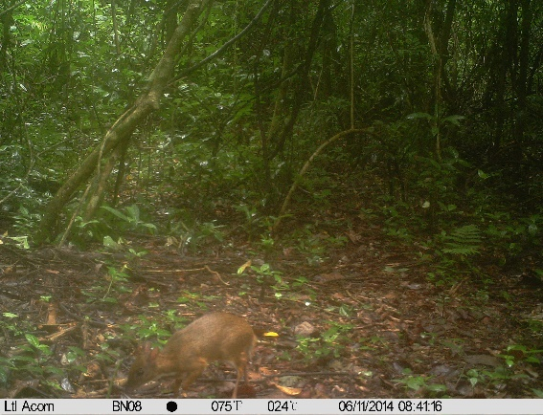
Williamson's Chevrotain
Tragulus williamsoni
Williamson's mouse-deer (Tragulus williamsoni), also called the northern mouse-deer and Williamson's chevrotain, is a species of even-toed ungulate in the family Tragulidae. It is found in Thailand and southern China. The species is named after the collector Walter James Franklin Williamson.
From the article Williamson's mouse-deer on Wikipedia (CC BY-SA), quoted section by section
Description
Williamson's mouse-deer is a tawny colored ungulate with a darker head and a white underbelly. It has a white triangular patch on the throat with a tawny border. Williamson's mouse-deer measures around 0.47 m (1 ft 7 in) long and weighs around 3.5 kg (7.7 lb) making it significantly larger than most other mouse-deer.
Wikipedia: “Morphology”
Range & habitat
Williamson's mouse-deer is found in Thailand and in the Yunnan province of southern China. It favors low-altitude habitats with dense foliage along the banks of rivers or streams. Williamson's mouse-deer demonstrates a preference for areas populated by fig trees, Burmese grapes, Alpinia kwangsiensis, and Phrynium capitatum. Williamson's mouse-deer is crepuscular. This may enable it to avoid competition with larger herbivores such as boars, muntjacs, sambars, and serows, all of which are more active nocturnally than the mouse-deer.
Wikipedia: “Habitat and ecology”
Listen
Looking for field recordings…
Where it lives
Recorded sightings
—
geo-referenced records in GBIF, from museums, herbaria and field observers.
Drag the globe to turn it. Dots are where records exist, not a range map; darker means more records.
In the stacks
Searching the stacks…
Every page naming Tragulus williamsoni in the Biodiversity Heritage Library →
This page is assembled live from iNaturalist, GBIF, Wikipedia, the Source Library and the Internet Archive. It is not yet part of the hand-edited codex. iNaturalist taxon 75196.