- Animals
- ›Chordates
- ›Vertebrates
- ›Mammals
- ›Therians
- ›Placental Mammals
- ›Primates, Rodents, and Allies
- ›Rodents
- ›Ctenohystricans
- ›Hystricognaths
- ›Degus, Hutias, Tuco-tucos, and Allies
- ›Spiny Rats and Hutias
- ›Atlantic Spiny Rats
- ›Trinomys
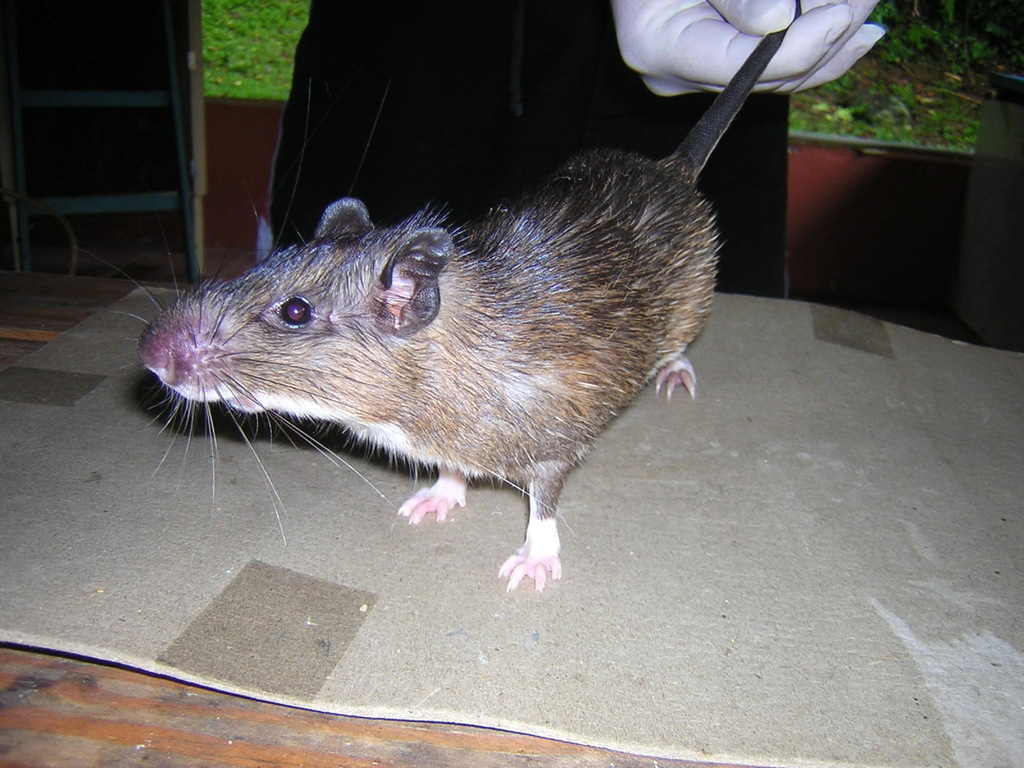
Ihering's Spiny Rat
Trinomys iheringi
Ihering's Atlantic spiny-rat (Trinomys iheringi), is a spiny rat species from South America. It is endemic to Brazil, and was named in honor of Hermann von Ihering.
From the article Ihering's Atlantic spiny rat on Wikipedia (CC BY-SA), quoted section by section
Description
Trinomys iheringi is a medium-sized rat, with an average head and body length of 191 millimetres (7.5 in) with a 171 millimetres (6.7 in) tail. They weigh about 209 grams (7.4 oz). The fur on the top of the body is "cinnamon-buff", which lightens to white on the stomach. The tail has a brown base and white tip. Like other spiny rats, the coat is mixed with long stiff furs, or spines, about 21 millimetres (0.83 in) in length along the back. T. iheringi has 30 pairs of standard chromosomes, as well as a variable number of additional "dot-like" supernumerary chromosomes. It is found in Atlantic rainforest in Brazil, near the coasts, in the states of Sao Paulo and Rio de Janeiro. The Rio de Janeiro population, located on the island of Ilha Grande, is genetically distinct, and may represent a separate species. The two populations diverged about 0.6 million years ago, possibly due to glacial cycling occurring at the time. They have unusually large home ranges for rodents of their size, an average of 1.37 hectares (13,700 m2) for males and 0.86 hectares (8,600 m2) for females. The females reach full maturity at approximately eight months, and the lifespan is up to 30 months. They can reproduce year-round, but more commonly do so during the rainy season. …
Listen
Looking for field recordings…
Where it lives
Recorded sightings
—
geo-referenced records in GBIF, from museums, herbaria and field observers.
Drag the globe to turn it. Dots are where records exist, not a range map; darker means more records.
In the stacks
Searching the stacks…
Every page naming Trinomys iheringi in the Biodiversity Heritage Library →
This page is assembled live from iNaturalist, GBIF, Wikipedia, the Source Library and the Internet Archive. It is not yet part of the hand-edited codex. iNaturalist taxon 75205.