On eBird ↗
Mountain Wren
Live sightings near you, the range map, bar charts of when it is seen, and Macaulay Library photos and recordings.
Mountain Wren
Troglodytes solstitialis
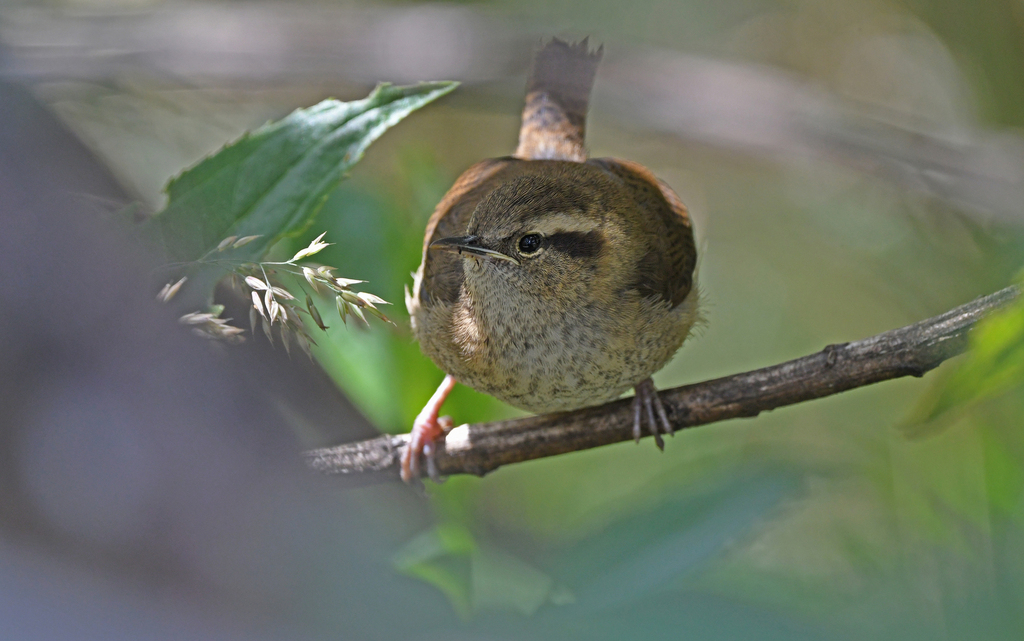
The mountain wren (Troglodytes solstitialis) is a species of bird in the family Troglodytidae. It is found in the Andes or north-west Argentina, Bolivia, Colombia, Ecuador, Peru, and western Venezuela. Its natural habitat is subtropical or tropical moist montane forests.
From the article Mountain wren on Wikipedia (CC BY-SA), quoted section by section
Description
The mountain wren is 10.5 to 11.5 cm (4.1 to 4.5 in) long and has a mean weight of 11.8 g (0.42 oz). The adult of the nominate subspecies has a rufous brown forehead and crown, a less reddish brown nape, shoulders, back, and rump, and a rufous brown tail with narrow black bars. The folded wings also appear barred. It has a buffy brown supercilium with a darker brown line behind the eye and warm buff cheeks. The throat and chest are also warm buff, the belly a paler buff, the flanks buffy brown with darker bars, and the vent grayish, also with darker bars. The juvenile's supercilium and upperparts are less warm and its underparts dull gray brown with darker speckles. Subspecies T. s. solitarius differs from the nominate with darker upperparts and cheeks, a paler throat, and less reddish flanks. T. s. macrourus is larger than the nominate and has a longer tail, and the middle of its breast is white. T. s. frater is similar to macrourus but has a whitish supercilium. T. s. auricularis is similar to frater but has a shorter tail and its upperparts are not as reddish.
Range & habitat
The subspecies of mountain wren are found thus:
T. s. solitarius, mountains of Colombia (except in the extreme south) and western Venezuela T. s. solstitialis, extreme southern Colombia through Ecuador into northwestern Peru T. s. macrourus, eastern slope of the Peruvian Andes from the Department of San Martín south T. s. frater, extreme southeastern Peru and western Bolivia T. s. auricularis, northwestern Argentina south to Tucumán Province The mountain wren inhabits humid montane forest, cloud forest, and their edges up to tree line. It is also sometimes found in bamboo thickets. In elevation it mostly ranges between 1,700 and 3,500 m (5,600 and 11,500 ft) but is found as low as 700 m (2,300 ft) in Argentina.
Wikipedia: “Distribution and habitat”
What it does
The mountain wren usually forages in pairs or family groups and occasionally joins mixed species foraging flocks. It hunts mostly in low vegetation but also climbs into mossy trees. No analysis of its diet has been published.
Wikipedia: “Feeding”
Listen
Looking for field recordings…
Where it lives
Recorded sightings
—
geo-referenced records in GBIF, from museums, herbaria and field observers.
Drag the globe to turn it. Dots are where records exist, not a range map; darker means more records.
In the stacks
Searching the stacks…
Every page naming Troglodytes solstitialis in the Biodiversity Heritage Library →
This page is assembled live from iNaturalist, GBIF, Wikipedia, the Source Library and the Internet Archive. It is not yet part of the hand-edited codex. iNaturalist taxon 7543.