On eBird ↗
Verdin
Live sightings near you, the range map, bar charts of when it is seen, and Macaulay Library photos and recordings.
Verdin
Auriparus flaviceps
The verdin (Auriparus flaviceps) is a species of penduline tit. It is the only species in the genus Auriparus and the only representative of the Old World family Remizidae to be found in North America.
From the article Verdin on Wikipedia (CC BY-SA), quoted section by section
Description
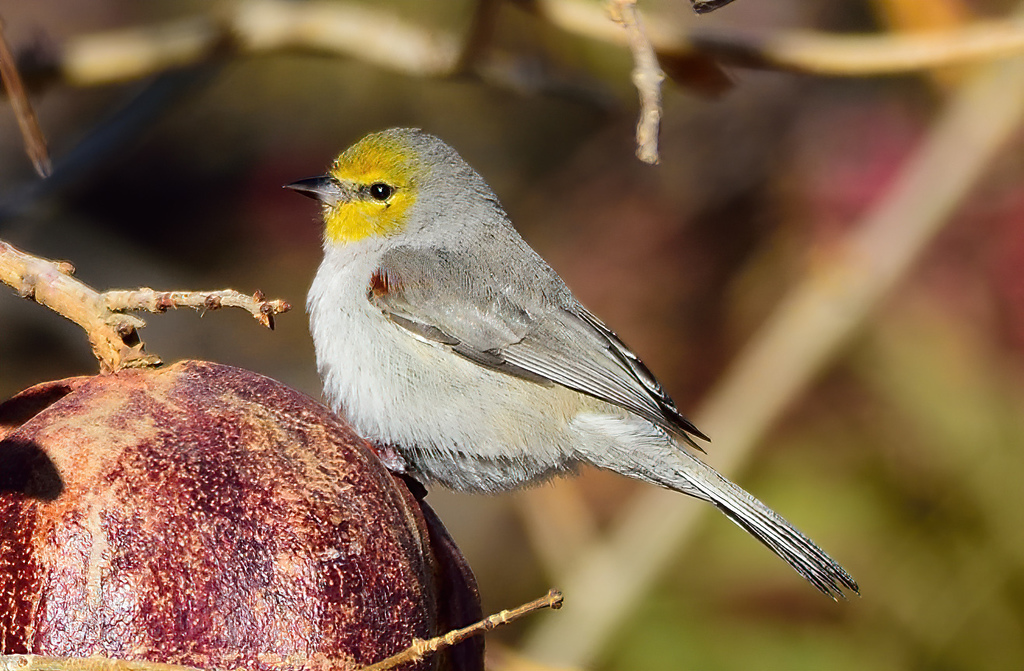
The verdin is a very small bird. At 4.5 in (11 cm) in length, it rivals the American bushtit as one of the smallest passerines in North America. It is gray overall, and adults have a bright yellow head and rufous shoulder patch (the lesser coverts). Unlike the tits, it has a sharply pointed bill. Juveniles have a light gray body without the rufous shoulder patch and yellow head. The base of the short bill is thick by the head, and draws to a sharp point at the tip.
Vocalizations. Little is known about geographic or individual variation in vocalizations. Verdins produce a variety of calls, loud for their size. The typical call note is a repetitive "tschep" sound repeated in rapid staccato. In Texas, rapid "chip-chip-chip" calls have been observed, all at the same pitch and at the same speed in each call series. The day of hatching, nestlings can produce short peep notes, faint and high-pitched. Fledglings, during their post-juvenile molt, can make soft warbling notes, similar to more complex signatures of adult calls. The verdin gives rapid "tschep" calls frequently while foraging. Unmated males sound "tseet" calls repeatedly in early spring, which may function to attract females. "Tseet" calls are also given by either sex of a mated pair, by solitary foraging birds, and by older nestlings. …
Range & habitat
Two subspecies nest in the United States. The subspecies A. f. acaciarum is resident from southern California, Nevada, and Utah southward into Mexico; it is associated mostly with the Sonoran Desert. The subspecies A. f. ornatus is found from New Mexico and Oklahoma southward into Mexico and is associated with the Chihuahuan Desert and its scrublands. The remaining 4-5 subspecies are resident to Mexico, and aren't known to migrate into the United States. Verdins nest in shrubs and thorny thickets with few trees. Their nests are best described as spherical masses of bulky twigs and branches that are then lined with grasses, feathers, and hair. The entrance to the nest is about 1" in diameter, and is usually at the bottom of the sphere. They feed in shrub-land and scrubby outcrops where insects are hosted and berries and seeds are plentiful.
Wikipedia: “Distribution and habitat”
What it does
Verdins are insectivorous, continuously foraging among the desert trees and scrubs. Verdins occasionally try to obtain sugar water from hummingbird feeders. They feed on many kinds of tiny insects, both adults and larvae, and also consume hard and soft mast of many trees and shrubs.
Wikipedia: “Food and feeding”
Listen
Looking for field recordings…
Where it lives
Recorded sightings
—
geo-referenced records in GBIF, from museums, herbaria and field observers.
Drag the globe to turn it. Dots are where records exist, not a range map; darker means more records.
In the old herbals & bestiaries


In the stacks
Searching the stacks…
Every page naming Auriparus flaviceps in the Biodiversity Heritage Library →
This page is assembled live from iNaturalist, GBIF, Wikipedia, the Source Library and the Internet Archive. It is not yet part of the hand-edited codex. iNaturalist taxon 7603.