On eBird ↗
Zapata Wren
Live sightings near you, the range map, bar charts of when it is seen, and Macaulay Library photos and recordings.
Zapata Wren
Ferminia cerverai
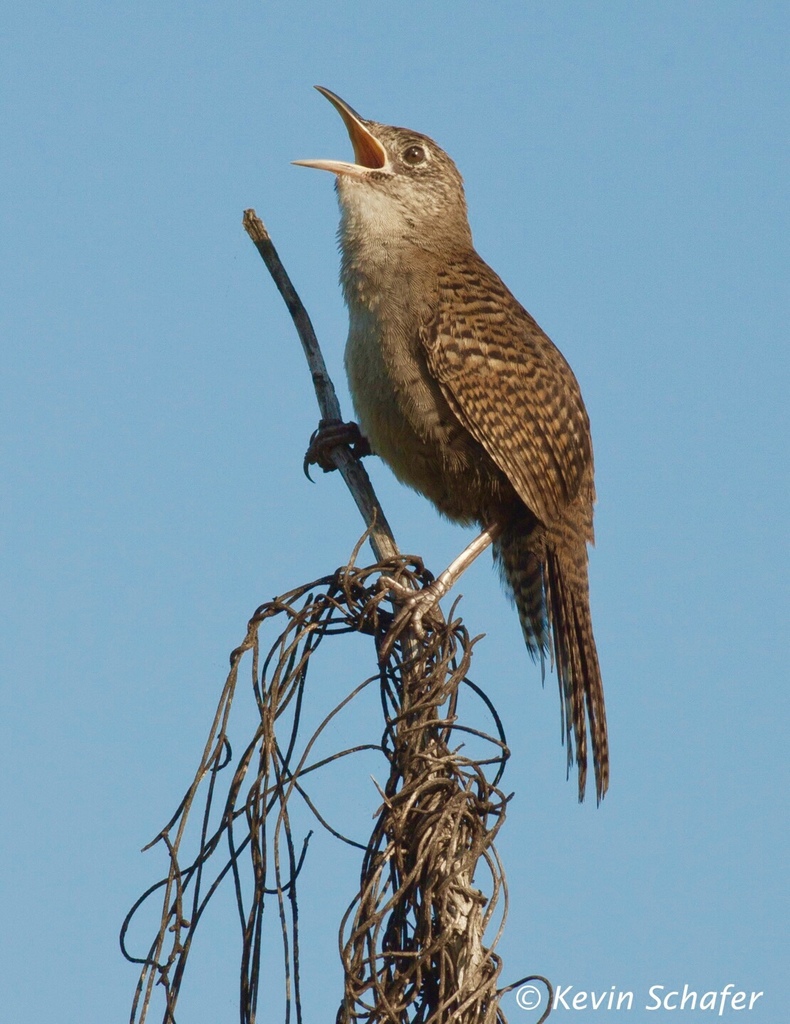
The Zapata wren (Ferminia cerverai) is a medium-sized grayish-brown bird that lives in dense shrubs of the Zapata Swamp, Cuba. It is the only member of the monotypical genus Ferminia, which is endemic to Cuba and endangered. This species was first described in 1926 by Thomas Barbour and named after its co-discoverer, Fermín Zanón Cervera.
From the article Zapata wren on Wikipedia (CC BY-SA), quoted section by section
Description
Measuring about 16 centimetres (6.3 in) in length, it is brown overall, though striped with black and with grayish underparts. Its tail is long. The bird's song is similar to that of the house wren, in that it is high-pitched and loud, described as a "musical warble preceded by guttural note, given in series of three or four phrases."
Range & habitat
The Zapata wren is confined and endemic to the Zapata Peninsula of southern Cuba. The Zapata wren's habitat is typically freshwater marsh and lowland savanna with scattered bushes and low trees. It feeds on insects, spiders, small snails, lizards and berries. The wren typically makes its nest in sawgrass tussocks. It is thought to breed between January and July. Typical threats are fires in the dry season, drainage of the wetlands, destruction due to agriculture, and predation by introduced mongooses and rats.
Wikipedia: “Habitat and conservation”
Listen
Looking for field recordings…
Where it lives
Recorded sightings
—
geo-referenced records in GBIF, from museums, herbaria and field observers.
Drag the globe to turn it. Dots are where records exist, not a range map; darker means more records.
In the stacks
Searching the stacks…
Every page naming Ferminia cerverai in the Biodiversity Heritage Library →
This page is assembled live from iNaturalist, GBIF, Wikipedia, the Source Library and the Internet Archive. It is not yet part of the hand-edited codex. iNaturalist taxon 7610.