On eBird ↗
Orange-necked Partridge
Live sightings near you, the range map, bar charts of when it is seen, and Macaulay Library photos and recordings.
Orange-necked Partridge
Arborophila davidi
The orange-necked partridge (Arborophila davidi) is a species of bird in the family Phasianidae. It is found in eastern Cambodia and southern Vietnam. Its habitats are lowland forests, shrubland, and plantations. It was described in 1927 and rediscovered in 1991. It is threatened by habitat loss, and the International Union for Conservation of Nature (IUCN) has assessed it as a near-threatened species.
From the article Orange-necked partridge on Wikipedia (CC BY-SA), quoted section by section
Description
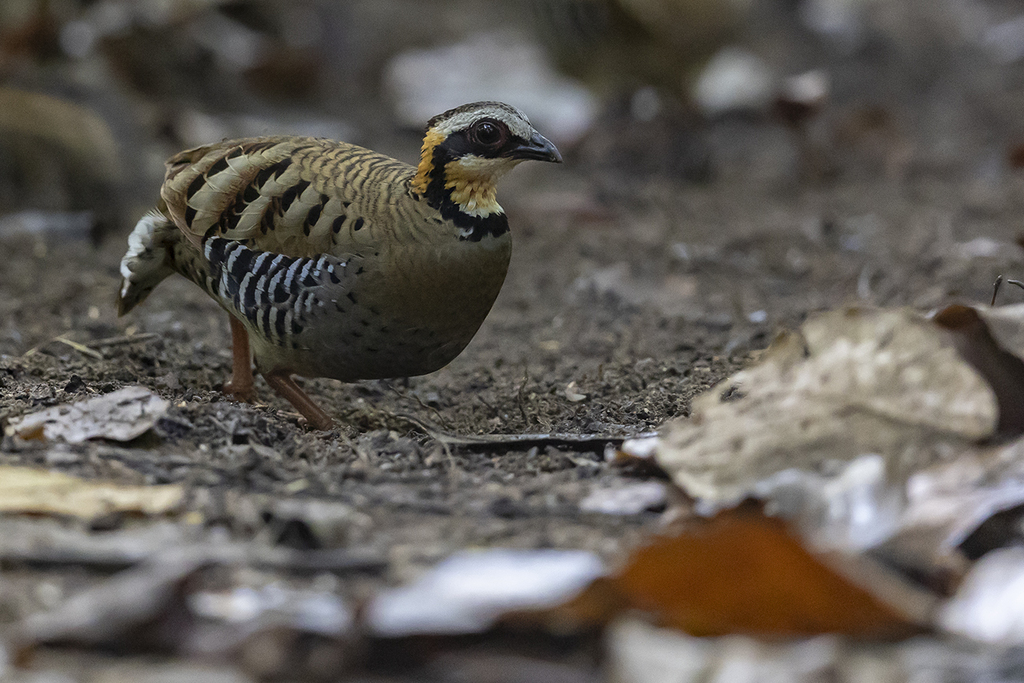
The orange-necked partridge is about 27 cm (11 in) long and weighs about 241 g (8.5 oz). The forehead and crown are dusky, and the nape is mottled brown. A black band extends from the beak to the sides of the neck, and a whitish band extends from the eye to the neck-sides, becoming orange. There is also a black breast-band. The chin is pale buff, and the throat is rusty-orange. The breast is olive-brown, and the belly is greyish and whitish. The flanks have black and white scallops. The back and rump are olive-brown, with dark brown bars. The wing coverts have black and grey bands. The eyes are brown, the beak is black, and the legs are pinkish.
Range & habitat
The orange-necked partridge is found in southern Vietnam and a small area in Mondulkiri, Cambodia. It lives in forest in hills at elevations of 120–600 m (390–1,970 ft), preferring bamboos. It also occurs in some disturbed habitats, including scrubs, bamboos and logged plantations. In Vietnam, it occurs in several national parks and state forest enterprises. All of the individuals recorded in a 2005 survey lived less than 2 km (1.2 mi) from water.
Wikipedia: “Distribution and habitat”
What it does
Little is known about this partridge's behaviour. The territorial calls are a repeated, accelerating prruu, becoming pwi at higher pitches, and also a series of fast tu notes. In duets, the other bird responds with tchew-tchew-tchew. The alarm call is a pher or phu.
Wikipedia: “Behaviour”
Listen
Looking for field recordings…
Where it lives
Recorded sightings
—
geo-referenced records in GBIF, from museums, herbaria and field observers.
Drag the globe to turn it. Dots are where records exist, not a range map; darker means more records.
In the stacks
Searching the stacks…
Every page naming Arborophila davidi in the Biodiversity Heritage Library →
This page is assembled live from iNaturalist, GBIF, Wikipedia, the Source Library and the Internet Archive. It is not yet part of the hand-edited codex. iNaturalist taxon 765.