On eBird ↗
Whistling Cisticola
Live sightings near you, the range map, bar charts of when it is seen, and Macaulay Library photos and recordings.
Whistling Cisticola
Cisticola lateralis
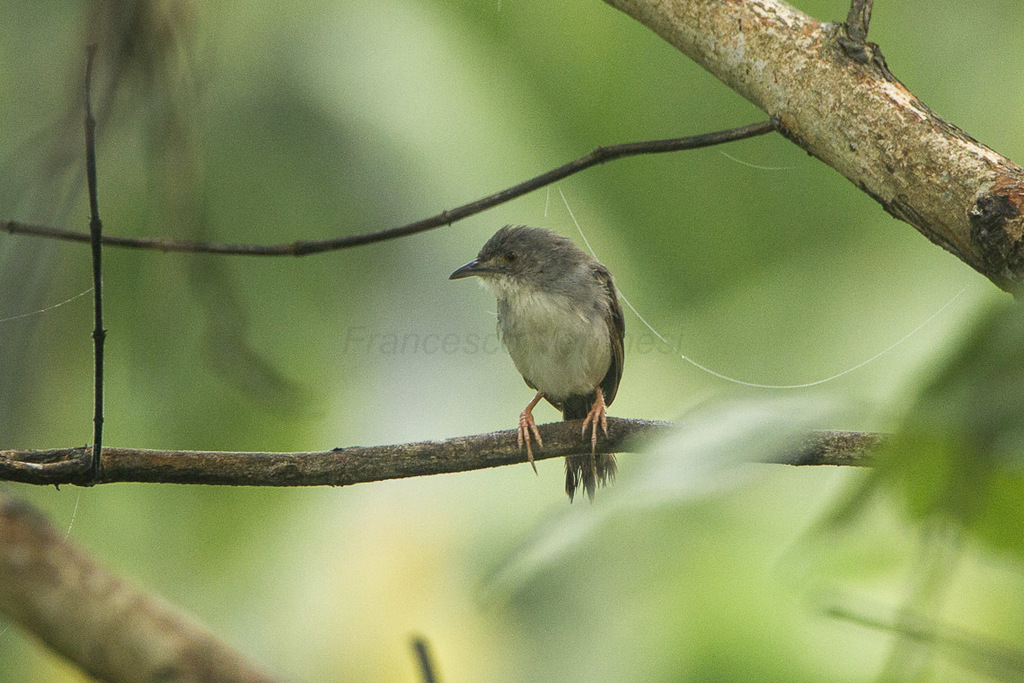
The whistling cisticola (Cisticola lateralis) is a species of bird in the family Cisticolidae. It is found in Angola, Benin, Burundi, Cameroon, Central African Republic, Republic of the Congo, Democratic Republic of the Congo, Ivory Coast, Gabon, Gambia, Ghana, Guinea, Guinea-Bissau, Kenya, Liberia, Mali, Nigeria, Senegal, Sierra Leone, South Sudan, Togo, Uganda, and Zambia. Its natural habitats are subtropical or tropical dry forests, dry savanna, and moist savanna.
From the article Whistling cisticola on Wikipedia (CC BY-SA), quoted section by section
Description
The whistling cisticola is a mid-sized bird that has a body length of 13–16 cm with a male weight of 14-21 grams, and female weight of 12-19 grams. A breeding, male cisticola is described to have gray-brown cheeks and a sooty-brown crown and underparts. Its tail is also a gray-brown color with the main body being mostly dark brown, with hints of reddish-brown. Also, the majority of males consist of a white colored throat, black bill, and dull pink legs. When male cisticolas are non-breeding, they appear a more reddish-brown color, have a richer buff below, and a gray color on their breast. Female cisticolas often have paler feathers, a more brownish bill, and have a more slender body shape than males. Juveniles are more slender than adults and are washed yellow below. Their bills are brown with bits of yellow and some have bright red underparts. The antinorii race is a paler brown with a fluffier build, and no seasonal plumage changes. The modestus race is smaller in size and more red throughout its feathers, along with a gray-brown crown.
Range & habitat
This species has a large range and its population trend appears to be stable, hence it does not approach the thresholds for vulnerable under the range size or population trend criterion. The antinorii subspecies can be found from the Central African Republic to West Kenya, the lateralis from Senegambia to Nigeria and Cameroon, and the modestus from Gabon to North Angola and South Democratic Republic of Congo.
Wikipedia: “Distribution and habitat”
What it does
The diet of whistling cisticolas mainly consists of different insects and vertebrates.These include termites (Isoptera), beetles (Coleoptera), grasshoppers (Orthoptera), bugs (Hemiptera), and spiders (Araneae). They usually hunt and forage in families and groups, rarely alone. These groups will extract nutrients from various vegetation on or close to the ground.
Wikipedia: “Food and feeding”
Listen
Looking for field recordings…
Where it lives
Recorded sightings
—
geo-referenced records in GBIF, from museums, herbaria and field observers.
Drag the globe to turn it. Dots are where records exist, not a range map; darker means more records.
In the stacks
Searching the stacks…
Every page naming Cisticola lateralis in the Biodiversity Heritage Library →
This page is assembled live from iNaturalist, GBIF, Wikipedia, the Source Library and the Internet Archive. It is not yet part of the hand-edited codex. iNaturalist taxon 7654.