- Animals
- ›Chordates
- ›Vertebrates
- ›Mammals
- ›Therians
- ›Placental Mammals
- ›Ungulates, Carnivorans, and Allies
- ›Bats
- ›Yangochiroptera
- ›Noctilionoid Bats
- ›Disc-winged Bats
- ›Thyroptera
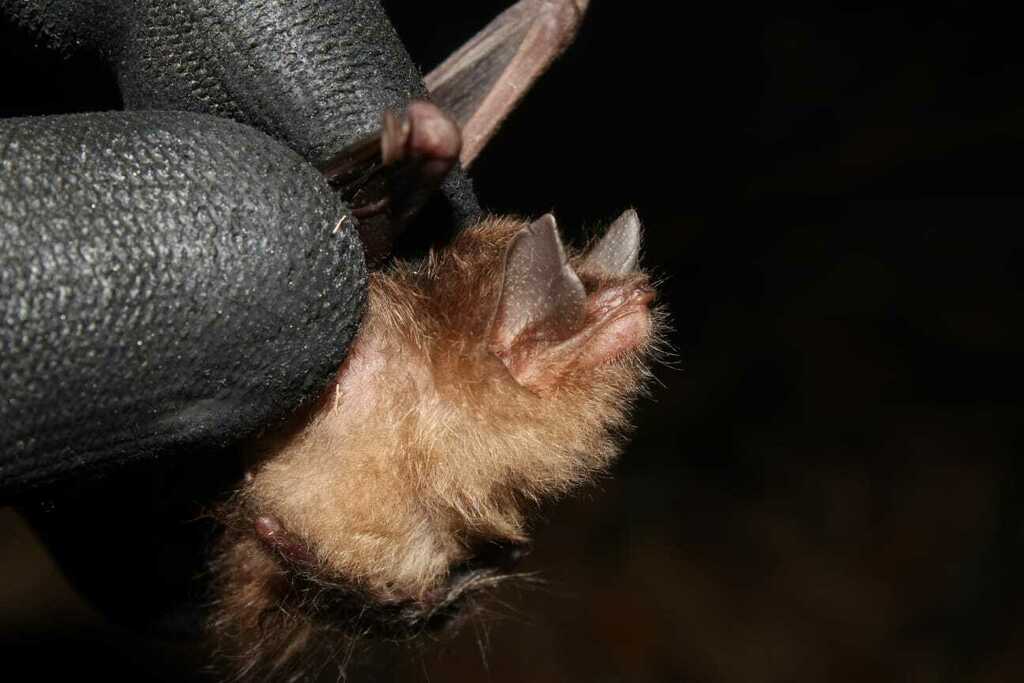
Patricia's Disk-winged Bat
Thyroptera wynneae
Patricia's disk-winged bat (Thyroptera wynneae) is a species of disk-winged bat found in South America.
From the article Patricia's disk-winged bat on Wikipedia (CC BY-SA), quoted section by section
Description
Patricia's disk-winged bat has a short and narrow snout, and its braincase is globular. Its fur is light brown, long, and woolly and the flight membranes are dark brown. It has oblong adhesive disks on its thumbs and feet. It has a dental formula of 2.1.3.33.1.3.3 for a total of 38 teeth. It inhabits lowland areas from 55–300 m (180–984 ft) in Peru and Brazil. As of 2016, it was evaluated as data deficient by the IUCN.
== References ==
In human culture
It was described as a new species in 2014. The holotype was collected in 2012 in Peru. The eponym for the species name "wynneae" is Patricia J. Wynne, an artist-in-residence for the American Museum of Natural History's Department of Mammalogy. Of Wynne, the authors wrote, "Exceptional for clarity, elegant rendering, and meticulous attention to relevant detail, Patricia's work is immediately recognizable and inimitable."
Wikipedia: “Taxonomy and etymology”
Listen
Looking for field recordings…
Where it lives
Recorded sightings
—
geo-referenced records in GBIF, from museums, herbaria and field observers.
Drag the globe to turn it. Dots are where records exist, not a range map; darker means more records.
In the stacks
Searching the stacks…
Every page naming Thyroptera wynneae in the Biodiversity Heritage Library →
This page is assembled live from iNaturalist, GBIF, Wikipedia, the Source Library and the Internet Archive. It is not yet part of the hand-edited codex. iNaturalist taxon 765500.