On eBird ↗
Golden-headed Cisticola
Live sightings near you, the range map, bar charts of when it is seen, and Macaulay Library photos and recordings.
Golden-headed Cisticola
Cisticola exilis
The golden-headed cisticola (Cisticola exilis), also known as the bright-capped cisticola, is a species of warbler in the family Cisticolidae, found in Australia and thirteen Asian countries. Growing to 9–11.5 cm (3.5–4.5 in) long, it is usually brown and cream in colour, but has a different appearance during the mating season, with a gold-coloured body and a much shorter tail. It is an omnivore and frequently makes a variety of vocalizations. Known as the "finest tailor of all birds", it constructs nests out of plants and spider threads. It mates in the rainy season. It has a very large range and population, which is thought to be increasing.
From the article Golden-headed cisticola on Wikipedia (CC BY-SA), quoted section by section
Description
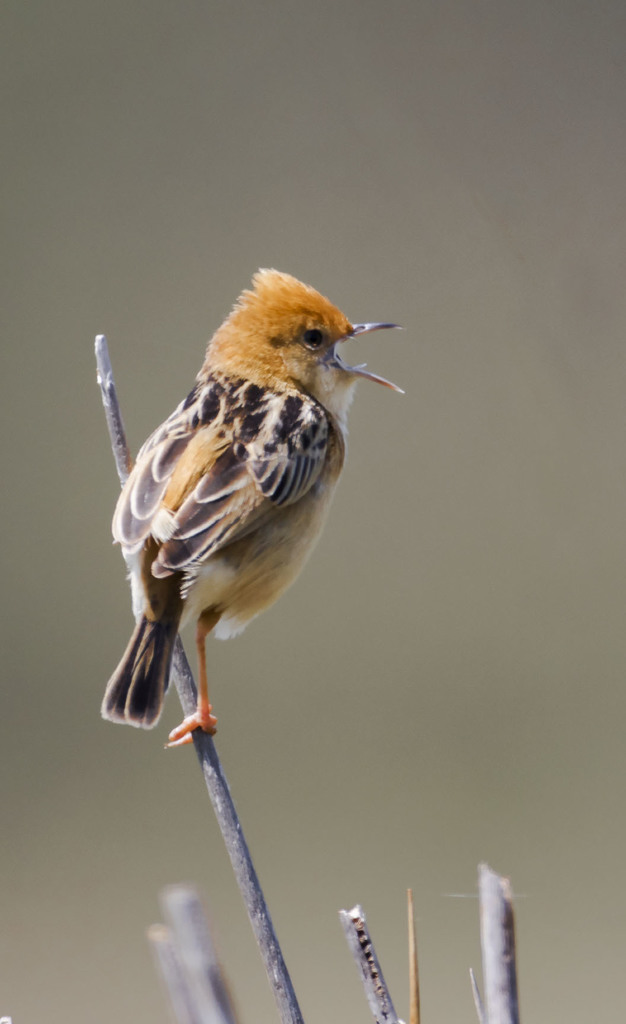
The golden-headed cisticola is a small species, growing to 9–11.5 cm (3.5–4.5 in) long and weighing 6–10 g (0.21–0.35 oz), with males slightly heavier than females. Although its appearance is similar to the black-backed cisticola (Cisticola eximius), the golden-headed cisticola has a shorter tail during the breeding season. The zitting cisticola (Cisticola juncidis) is also similar, but does not have the "rich golden" head of the golden-headed cisticola. The male has several characteristics that are only present during the breeding season, including a golden body colour, a golden-orange head, and a dull chin. It also has a shorter tail; this may be a result of sexual selection as a shorter tail has been shown to improve male reproductive success. Females and males outside of the breeding season are similar in appearance, characterized by a cream-coloured underside and a brown upperside. They have streaks of black or dark brown on the upper part of their body, with black wings edged in buff, and a golden head. Their throat is white and the back of their neck is a dull shade of gold. Aside from being lighter in colour, juveniles are similar in appearance to adults. It produces a variety of sounds distinct from other birds, which, according to the Sunshine Coast Council, range from a "teewip" to a "wheezz, whit-whit". When vocalizing the species exhibits a crest on its head.
Range & habitat
The golden-headed cisticola has a very large range and population, covering Australia, Cambodia, China, India, Indonesia, Lao People's Democratic Republic, Myanmar, Nepal, Papua New Guinea, Philippines, Taiwan, Thailand, Timor-Leste, and Vietnam. Its extent of occurrence is estimated to be 36,800,000 km2 (14,200,000 mi2), and it is the most common species of cisticola in Australia and from India to the Philippines. The species' habitat can be grassy hills, savannas, woodlands, scrublands, rivers, wetlands, or irrigated farmland, in areas where the grass is tall and thick. With the exception of the breeding season, the species mostly prefers to be near the ground. In Northern Australia, fires can occur in grasslands, causing it to sometimes live in forest edge habitats. According to the scientific journal BioLife, it lives at altitudes of 1,200 m (3,900 ft) or less, although the Handbook of the Birds of the World says that it can live up to 1,500 m (4,900 ft) in China and 1,800 m (5,900 ft) on the island of Lombok.
Wikipedia: “Distribution and habitat”
What it does
The golden-headed cisticola is omnivorous, primarily eating invertebrates such as insects and small slugs, but also eating grass seeds. It typically forages on the ground for food, hiding from its prey among various plants, such as grass, and moving slowly. It usually inhabits a single place throughout its life, but habitat changes sometimes cause it to move to a different location. Records from New Guinea and Tasmania have shown it to be a wandering bird, and it possibly undergoes partial migration in China. It is often difficult to detect in the non-breeding season, which has made it difficult to analyse when it travels to different areas. It is most often found single or in small flocks, but outside of the breeding season groups can be larger.
Breeding. The golden-headed cisticola typically mates during the rainy season, which varies across countries. In Asia, the breeding season is in May–July in China, April–August in India, September–March in Moluccas and Sulawesi, December–March in New Guinea, and April–September in southeast Asia. It can breed any time of the year in north Australia, while it breeds from January to May in west Australia and October to April in east Australia. In southeast Australia, breeding usually occurs there in September–October, and its breeding plumage appears earlier, in July or August. …
Wikipedia: “Behaviour”
Listen
Looking for field recordings…
Where it lives
Recorded sightings
—
geo-referenced records in GBIF, from museums, herbaria and field observers.
Drag the globe to turn it. Dots are where records exist, not a range map; darker means more records.
In the stacks
Searching the stacks…
Every page naming Cisticola exilis in the Biodiversity Heritage Library →
This page is assembled live from iNaturalist, GBIF, Wikipedia, the Source Library and the Internet Archive. It is not yet part of the hand-edited codex. iNaturalist taxon 7657.