On eBird ↗
Black-chested Prinia
Live sightings near you, the range map, bar charts of when it is seen, and Macaulay Library photos and recordings.
Black-chested Prinia
Prinia flavicans
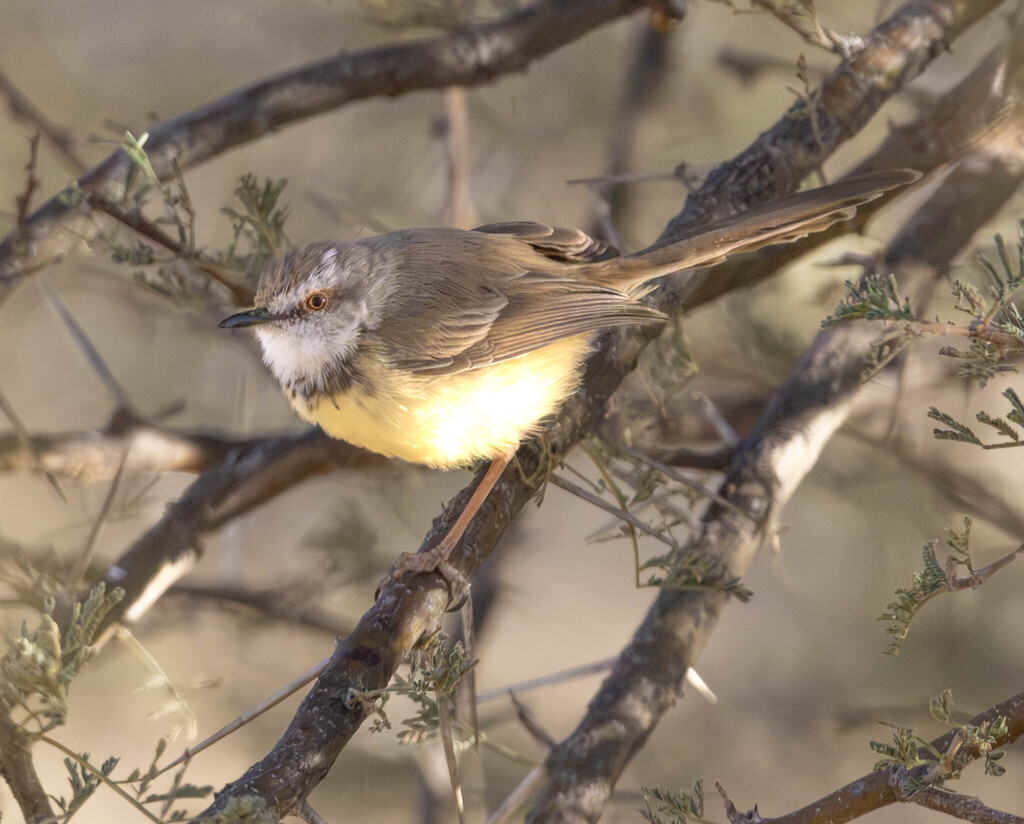
The black-chested prinia (Prinia flavicans) is a species of bird in the Cisticolidae family. It is found in Angola, Botswana, Lesotho, Namibia, South Africa, Zambia, and Zimbabwe. Its natural habitat is dry savanna.
From the article Black-chested prinia on Wikipedia (CC BY-SA), quoted section by section
Description
Black-chested prinias are small, long-tailed warblers whose body sizes range from 13 to 15 centimeters. They are a pale golden-brown on their dorsal side and during the non-breeding season they have pale yellow dorsal plumage. In their alternate plumage (breeding season), they develop a black breast-band and their underparts become white or a buttery yellow.
Wikipedia: “Appearance”
Range & habitat
This species is near-endemic to the southern African thornbelt. Black-chested prinias are most abundant in the Kalahari Basin, where their average densities are 0.7 ha per individual. They experience three distinct seasons within their subtropical climate range:
September – October: very hot, dry spring November – May: hot, wet summer June – August: cold, dry winter (Herremans). Along with Acacia habitats, Olea-Buddleia vegetation (within the Cymbopogon-Themeda grassveld) is important in the nesting and feeding habits of black-chested prinia.
Wikipedia: “Distribution and habitat”
What it does
Like other Prinia, insects make up a majority of black-chested prinias' diet. In a study conducted by Kopij in 2005, small beetles were found to account for one-third of this species' diet. Beetle and weevil larvae, as well as adult flies, comprised much of the birds' stomach contents in Kopij's study. Plant matter like seeds, leaves, and berries are also a non-negligible part of this species' diet. Black-chested prinias have also been observed probing unopened Aloe marlothii flowers in South Africa during the winter season.
Wikipedia: “Feeding”
Listen
Looking for field recordings…
Where it lives
Recorded sightings
—
geo-referenced records in GBIF, from museums, herbaria and field observers.
Drag the globe to turn it. Dots are where records exist, not a range map; darker means more records.
In the stacks
Searching the stacks…
Every page naming Prinia flavicans in the Biodiversity Heritage Library →
This page is assembled live from iNaturalist, GBIF, Wikipedia, the Source Library and the Internet Archive. It is not yet part of the hand-edited codex. iNaturalist taxon 7721.