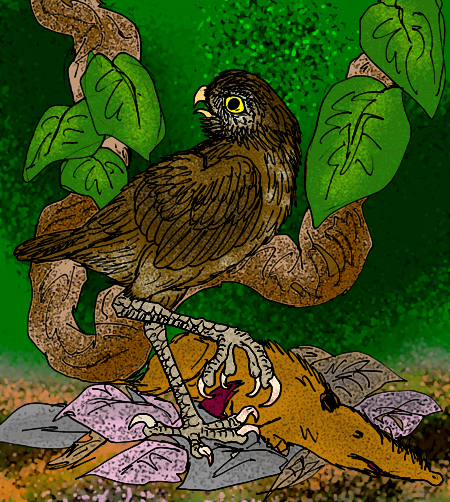
Ornimegalonyx oteroi
The Cuban giant owl or cursorial giant owl (Ornimegalonyx) is an extinct genus of giant owl that measured 1.1 metres (3 ft 7 in) in height. It is closely related to the many species of living owls of the genus Strix. It was a flightless or nearly flightless bird and it is believed to be the largest owl that ever existed. It lived on the island of Cuba.
The first fossil specimen was mistakenly described as a bird in the family Phorusrhacidae, in part because the bones were so large. In 1961, Pierce Brodkorb reviewed the findings and identified them to have belonged to an owl. Remains have been found in cave deposits from the Late Pleistocene period (126,000 to 11,700 years ago).
From the article Ornimegalonyx on Wikipedia (CC BY-SA), quoted section by section
Description
Arredondo estimated the height of Ornimegalonyx to have been 1.1 m (3 ft 7 in) tall. It had very long legs for its size, but was bulky overall and probably short-tailed. Its body mass in life is initially estimated to have been approximately 30 kg (66 lb), but later studies suggest a mass of 9 to 13.5 kg (20 to 30 lb). The modern owl that most resembles the Cuban giant owl in proportions is probably the dainty and quite small burrowing owl, the only surviving owl closely tied to the ground. This implies similar adaptations to the terrestrial lifestyle, but not a close phylogenetic relationship. The legs and feet of the Cuban giant owl appear to be very large and powerfully built. This supports the theory that they were strong runners, hence the alternate name, cursorial. The keel of the sternum was reduced and the owl may have been capable of short burst of flight. It is probable that, like a modern wild turkey, the owl only took flight when extremely pressed, more often choosing to run. The females of this owl species were larger than the males.
What it does
The Cuban giant owl is believed to have preyed principally on large hutias, including Capromys, Geocapromys, and Macrocapromys (the latter being the size of a modern nutria or capybara) and the ground sloths Cubanocnus, Miocnus, Mesocnus, and Megalocnus, some of these sloths being roughly the size of an American black bear. It possibly fed on the Cuban flightless crane, Antigone cubensis. It was probably an ambush predator that would pounce on unsuspecting prey with its crushing talons.
Wikipedia: “Diet”
Listen
Looking for field recordings…
Where it lives
Recorded sightings
—
geo-referenced records in GBIF, from museums, herbaria and field observers.
Drag the globe to turn it. Dots are where records exist, not a range map; darker means more records.
In the stacks
Searching the stacks…
Every page naming Ornimegalonyx oteroi in the Biodiversity Heritage Library →
This page is assembled live from iNaturalist, GBIF, Wikipedia, the Source Library and the Internet Archive. It is not yet part of the hand-edited codex. iNaturalist taxon 774233.