On eBird ↗
Red-breasted Partridge
Live sightings near you, the range map, bar charts of when it is seen, and Macaulay Library photos and recordings.
Red-breasted Partridge
Arborophila hyperythra
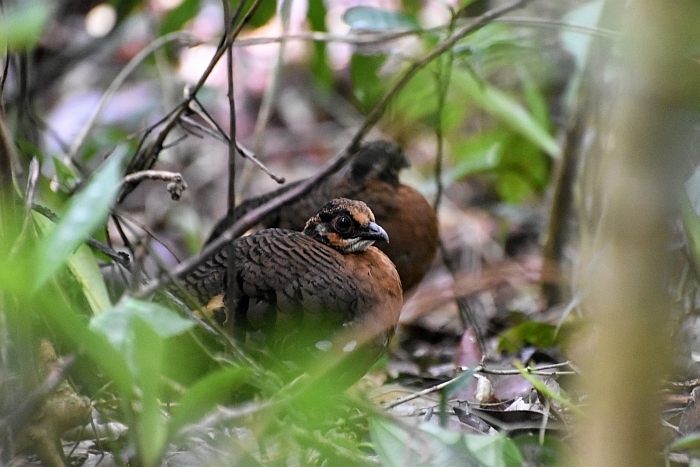
The red-breasted partridge (Arborophila hyperythra), also known as the Bornean hill-partridge, is a species of bird in the family Phasianidae. It is endemic to hill and montane forest in Borneo, preferring bamboos and thickets. The International Union for Conservation of Nature (IUCN) has assessed it as a least-concern species.
From the article Red-breasted partridge on Wikipedia (CC BY-SA), quoted section by section
Description
The red-breasted partridge is about 27 cm (11 in) long and weighs about 270 g (9.5 oz). The crown and nape are blackish, with brown spots. There is a grey or rufous supercilium, and a blackish-brown band goes through the eye. The cheeks and throat are rufous. The breast is bright chestnut, sometimes browner, and the belly is whitish. The flanks are black and white. The upperparts are brown, with blackish bars. The eyes are grey, the beak is black, and the legs are pink. There is red bare skin around the throat, usually covered by sparse feathers. The female bird's plumage is a little duller than the male's.
Range & habitat
This partridge is endemic to north-central Borneo, including parts of Sabah, Sarawak, North Kalimantan and northern Central Kalimantan. It lives in primary and secondary forests at elevations of 600–1,800 m (2,000–5,900 ft) and prefers bamboos and thickets.
Wikipedia: “Distribution and habitat”
What it does
The red-breasted partridge feeds in groups, foraging in thickets, on forest roads and near rivers. Its diet consists of seeds, fruits and insects. It roosts in bushes. Its call is a duet, one bird giving rising chu notes and the other falling cuckoo notes. Its breeding is poorly known.
Wikipedia: “Behaviour”
Listen
Looking for field recordings…
Where it lives
Recorded sightings
—
geo-referenced records in GBIF, from museums, herbaria and field observers.
Drag the globe to turn it. Dots are where records exist, not a range map; darker means more records.
In the stacks
Searching the stacks…
Every page naming Arborophila hyperythra in the Biodiversity Heritage Library →
This page is assembled live from iNaturalist, GBIF, Wikipedia, the Source Library and the Internet Archive. It is not yet part of the hand-edited codex. iNaturalist taxon 776.