On eBird ↗
Bar-backed Partridge
Live sightings near you, the range map, bar charts of when it is seen, and Macaulay Library photos and recordings.
Bar-backed Partridge
Arborophila brunneopectus
The bar-backed partridge (Arborophila brunneopectus), also known as the brown-breasted hill-partridge, is a species of partridge in the family Phasianidae. It is found in southwestern China and Southeast Asia.
From the article Bar-backed partridge on Wikipedia (CC BY-SA), quoted section by section
Description
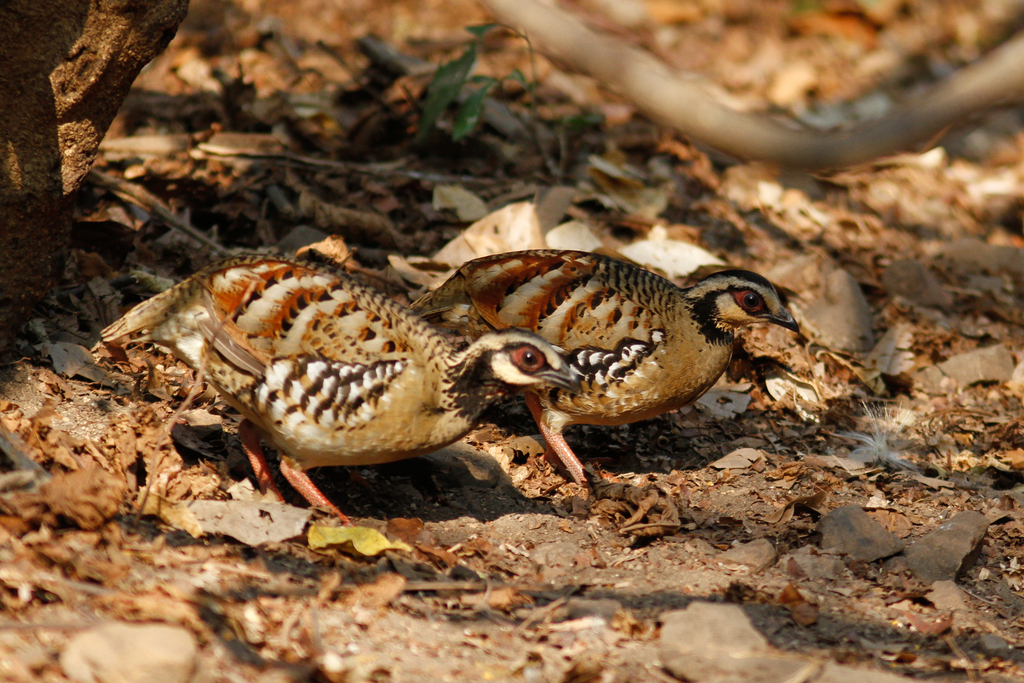
The bar-backed partridge is typically 280 mm (11 in) long in total, with an average wingspan of 144 mm (5.7 in) for males and 134 mm (5.3 in) for females of the species. They usually have 6–7 cm (2.4–2.8 in) tails, and their bills are about 20–21 mm (0.79–0.83 in) in length. On average, males have a 42 mm (1.7 in) tarsus, while females have 39 mm (1.5 in). The males are similar in color to females. It is mostly buff in color, with black running from the beak, around the eyes, and to the throat, as well as a black crown and feather tips along its back. It has red eyelids, and its wing feathers are white with black tips, adding brown near the back of the bird.
Range & habitat
The bar-backed partridge is found in Cambodia, China, Laos, Myanmar, Thailand, and Vietnam over an estimated 486,000 square kilometres (188,000 sq mi). Its natural habitats are subtropical or tropical moist lowland forests and subtropical or tropical moist montane forests. It is typically found at relatively low elevations, under 3,000 feet (910 m), but have been seen at 5,000 feet (1,500 m) and above.
Wikipedia: “Distribution and habitat”
What it does
They flock in groups of about 4–9, usually consisting of two parents and their latest offspring or sometimes two families. They feed on seeds, small shells, and insects found in leaves on the forest floor. When disturbed by humans, they quickly scatter into the underbrush. Captive male bar-backed partridges attract a mate by exposing the red feathers around their throat and calling. They breed around May to June, and their 37 by 28 mm (1.5 by 1.1 in) eggs are usually laid in a hole covered with bamboo and grass.
Wikipedia: “Behaviour”
Listen
Looking for field recordings…
Where it lives
Recorded sightings
—
geo-referenced records in GBIF, from museums, herbaria and field observers.
Drag the globe to turn it. Dots are where records exist, not a range map; darker means more records.
In the stacks
Searching the stacks…
Every page naming Arborophila brunneopectus in the Biodiversity Heritage Library →
This page is assembled live from iNaturalist, GBIF, Wikipedia, the Source Library and the Internet Archive. It is not yet part of the hand-edited codex. iNaturalist taxon 777.