On eBird ↗
Scrub Warbler
Live sightings near you, the range map, bar charts of when it is seen, and Macaulay Library photos and recordings.
Scrub Warbler
Scotocerca inquieta
The streaked scrub warbler (Scotocerca inquieta), also known simply as the scrub warbler, is a small passerine bird in the family Cettiidae. It is the only species placed in the genus Scotocerca. It is found in northern Africa and south-western Asia. It is a bird of desert fringes, frequenting scrubby areas, ravines and gorges, and is mainly resident, although local movements can occur outside the breeding season.
The genus is basal in the Cettiidae and has sometimes been separated into its own family Scotocercidae.
From the article Streaked scrub warbler on Wikipedia (CC BY-SA), quoted section by section
Description
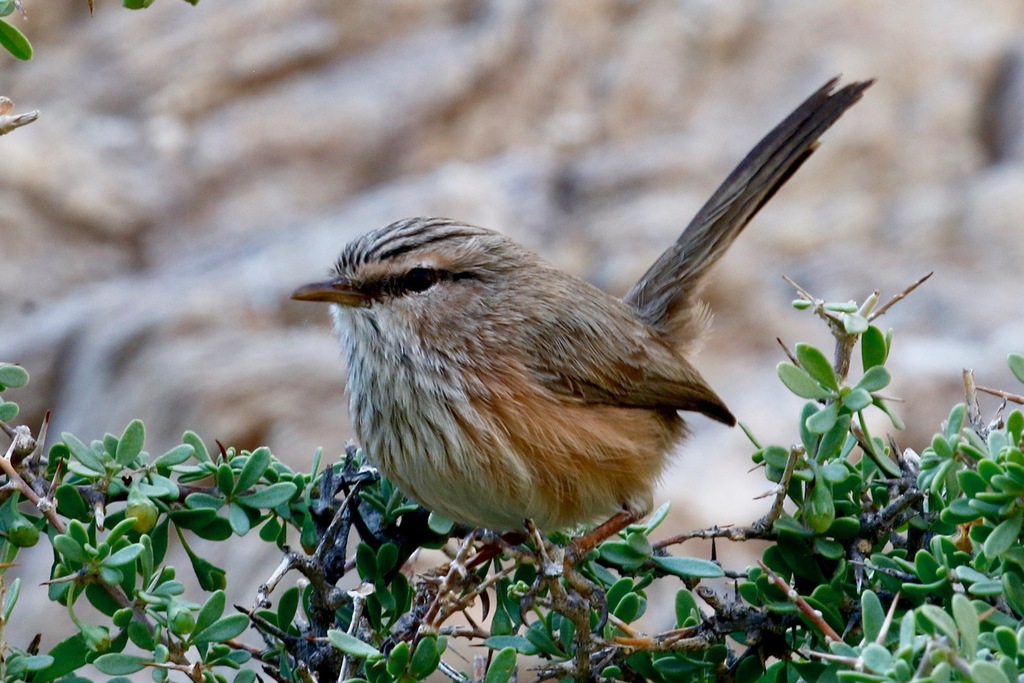
The streaked scrub warbler is a small, skulking desert warbler which cocks its tail over its back. The adults are grey brown above, finely streaked with dark brown. They have a broad pale supercilium and a thin black eyestripe. The underparts are whitish with reddish flanks and vent, the breast is finely streaked. The tail is graduated and dark brown with a white tip. Juveniles are duller. Short, fine but stout bill is mostly grey-brown with slightly paler base to lower mandible. Can appear to have almost mouse-like behaviour, keeping in cover and moving quickly and nervously. Jumps and hops rapidly on ground, and habitually feeds around tiny shrubs and stones (occasionally skulking). Flight on whirring wings is rather weak but quite direct, usually very low and over short distances. Usually encountered in very vocal groups of pairs or family parties. The song of the streaked scrub warbler is distinctive and is rendered as "zit-zit dweedle-doolredle-doleed"
Range & habitat
The streaked scrub warbler is a bird of open desert with a sparse cover of scrub, especially wadi beds with a denser cover than the surrounding desert, as well as scree areas with bushes in ravines and gorges.
Wikipedia: “Distribution and habitat”
What it does
Its main food is insects but it will also eat seeds which may be very important in winter. It forages on the ground, fossicking through leaf litter and other debris under bushes, and into cavities but will also feed up in the vegetation at times.
Wikipedia: “Food and feeding”
Listen
Looking for field recordings…
Where it lives
Recorded sightings
—
geo-referenced records in GBIF, from museums, herbaria and field observers.
Drag the globe to turn it. Dots are where records exist, not a range map; darker means more records.
In the stacks
Searching the stacks…
Every page naming Scotocerca inquieta in the Biodiversity Heritage Library →
This page is assembled live from iNaturalist, GBIF, Wikipedia, the Source Library and the Internet Archive. It is not yet part of the hand-edited codex. iNaturalist taxon 7770.