On eBird ↗
Red-winged Gray Warbler
Live sightings near you, the range map, bar charts of when it is seen, and Macaulay Library photos and recordings.
Red-winged Gray Warbler
Drymocichla incana
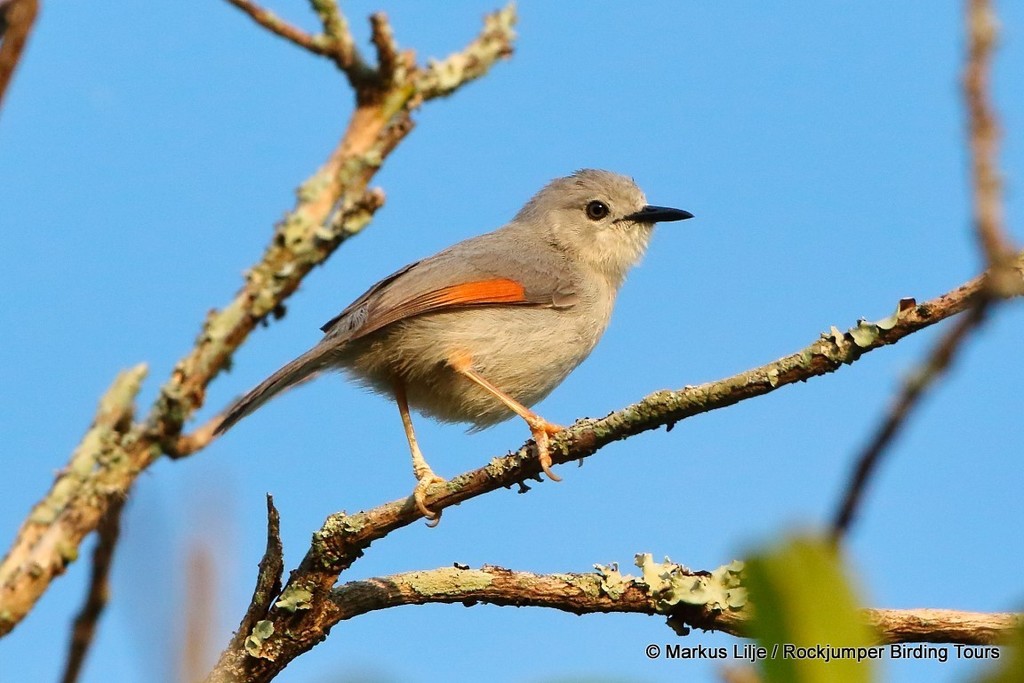
The red-winged grey warbler (Drymocichla incana) is a small to medium size bird in the family Cisticolidae that is native to Central Africa. It is the only species placed in the genus Drymocichla. It is mostly grey with a white underside, a long tail and a prominent red patch on the wing. It is commonly found in swamp and savanna-like environments where it breeds in the rainy season. The sexes are alike.
From the article Red-winged grey warbler on Wikipedia (CC BY-SA), quoted section by section
Description
The red-winged grey warbler is around 13 cm (5.1 in) in length and weighs about 10 g (0.35 oz) making this a small to medium sized bird. It has a light gray back with a white underside. When flying with the wings fanned out, brown and red feathers can be seen. The species have small pink legs and a sharp, short black beak. With white around the eyes and light gray feathers on the forehead, it is known for its distinct long grey tail. The male and female are similar in appearance. They live for around four and a half years.
Range & habitat
It is found moist in savannas and swampy tropical regions of Central Africa, particularly Cameroon, Nigeria, and Uganda. This bird often resides in areas with thick vegetation and proximity to water sources.
Wikipedia: “Distribution and habitat”
What it does
The red-winged grey warbler bird mainly eats insects especially, beetles, spiders, and tiny insect larvae. It catches its prey while flying through the vegetation or hovering mid-air. This method of hunting helps it find and target its prey accurately. Though small, the creature needs this diet to survive and maintain its ecosystem's balance.
Wikipedia: “Food and feeding”
Listen
Looking for field recordings…
Where it lives
Recorded sightings
—
geo-referenced records in GBIF, from museums, herbaria and field observers.
Drag the globe to turn it. Dots are where records exist, not a range map; darker means more records.
In the stacks
Searching the stacks…
Every page naming Drymocichla incana in the Biodiversity Heritage Library →
This page is assembled live from iNaturalist, GBIF, Wikipedia, the Source Library and the Internet Archive. It is not yet part of the hand-edited codex. iNaturalist taxon 7786.