On eBird ↗
Gray-chinned Minivet
Live sightings near you, the range map, bar charts of when it is seen, and Macaulay Library photos and recordings.
Gray-chinned Minivet
Pericrocotus solaris
The grey-chinned minivet (Pericrocotus solaris) is a species of bird in the family Campephagidae. It is found from the Himalayas to China, Taiwan and Southeast Asia. Its natural habitat is forests about 1,000–2,000 m (3,300–6,600 ft) in elevation. The International Union for Conservation of Nature (IUCN) has assessed it as a least-concern species.
From the article Grey-chinned minivet on Wikipedia (CC BY-SA), quoted section by section
Description
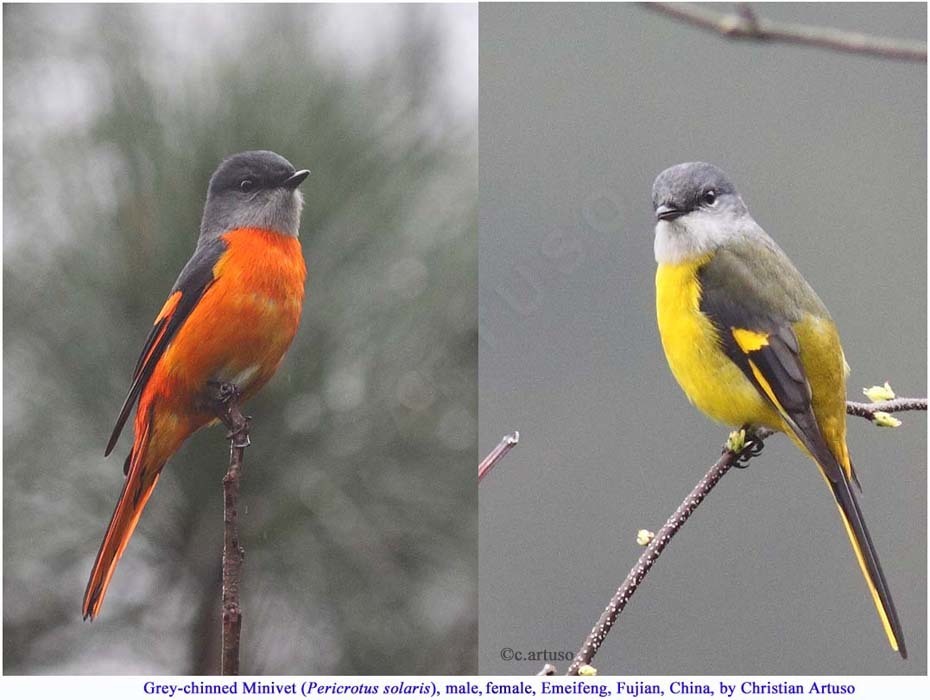
The grey-chinned minivet is 17–19 cm (6.7–7.5 in) long and weighs 11–17 g (0.39–0.60 oz). It is sexually dimorphic. The adult male has a dark grey head and mantle, a pale grey chin, an orange-yellow throat and blackish wings. The underparts, lower back and tips of the greater coverts are orange. In the female, these parts are bright yellow instead. The eyes, beak and legs are black. The immature bird is similar to the female but has yellow-olive bars on its back.
Range & habitat
This species ranges from the eastern foothills of the Himalayas through northeastern India, southern China, mainland Southeast Asia to Sumatra and Borneo. Its habitat is montane forest about 1,000–2,000 m (3,300–6,600 ft) in elevation. In Taiwan, it has been recorded down to 150 m (490 ft). It lives in the canopy of broadleaf forest and also coniferous forest, elfin forest, secondary forest, forest edges and gardens with trees. It is thought that all 12 of the minivet species adaptively radiated in mainland Asia and later dispersed to the Indonesian archipelago.
Wikipedia: “Distribution and habitat”
What it does
When not breeding, this minivet forms small parties with fewer than 15 individuals and also large flocks of dozens of birds; it sometimes joins mixed-species foraging flocks. It forages for invertebrates in the canopy, sometimes descending to tree ferns or sallying in the air. It gives a twittering call while feeding, and contact calls include a high-pitched sri-sisi and a chirit-chirit. Breeding has been recorded from February to April and has been inferred to occur in January. The male has been observed walking towards the female while holding a flower in its beak; the male swung its head, touched the female's beak and dropped the flower, and then they mated. The nest, constructed by both sexes, is built on a branch or fork of a tree. It is a steep cup made of bryophytes and covered with felt externally. Lichens are added to camouflage the nest, and the female shapes the nest by pushing against the rim with its breast. The eggs have not been described. The male and female raise the brood together, and subadults have been seen helping them. Moulting occurs from June to October.
Wikipedia: “Behaviour”
Listen
Looking for field recordings…
Where it lives
Recorded sightings
—
geo-referenced records in GBIF, from museums, herbaria and field observers.
Drag the globe to turn it. Dots are where records exist, not a range map; darker means more records.
In the stacks
Searching the stacks…
Every page naming Pericrocotus solaris in the Biodiversity Heritage Library →
This page is assembled live from iNaturalist, GBIF, Wikipedia, the Source Library and the Internet Archive. It is not yet part of the hand-edited codex. iNaturalist taxon 7850.