- Animals
- ›Chordates
- ›Vertebrates
- ›Amphibians
- ›Frogs and Toads
- ›Poison Frogs
- ›Poison Dart Frogs
- ›Hyloxalinae
- ›Hyloxalus
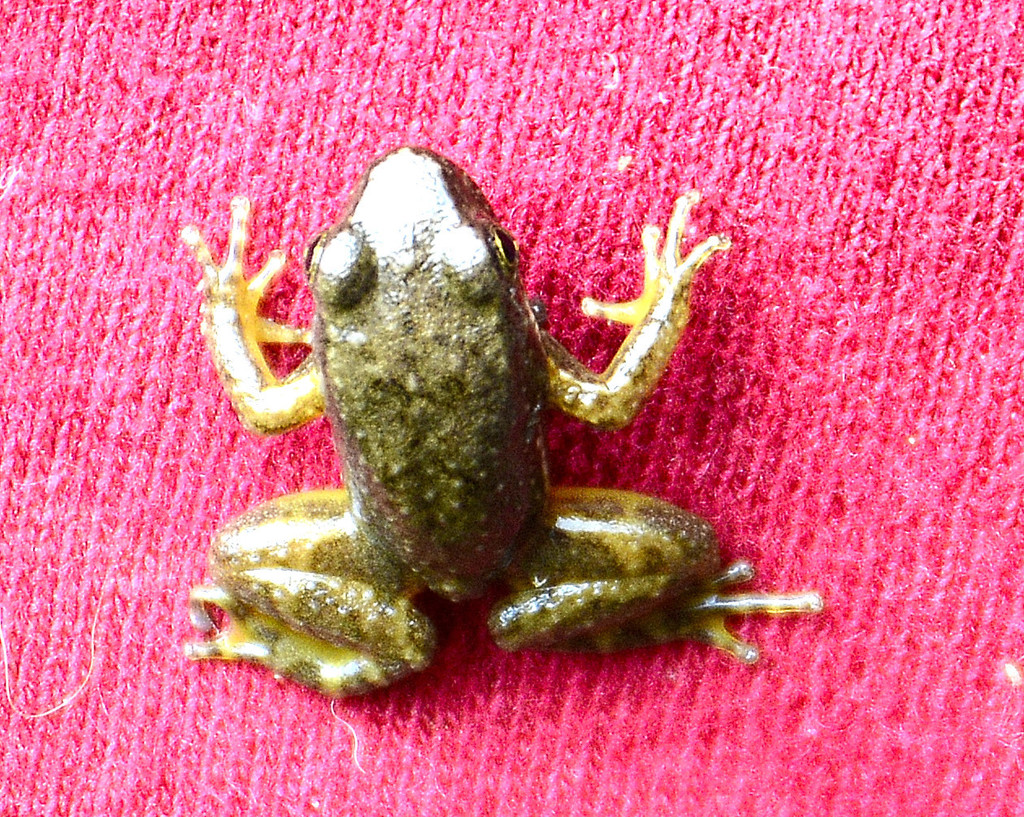
Hyloxalus felixcoperari
Hyloxalus felixcoperari is a species of frog in the family Dendrobatidae. It is endemic to Colombia.
From the article Hyloxalus felixcoperari on Wikipedia (CC BY-SA), quoted section by section
Description
Scientists found three adult male frogs, which measured between 20.3 and 20.8 mm long in snout-vent length and three adult female frogs, which were 21.4 to 23.8 mm long. The skin of the frog's upper lip is light brown or cream-white in color with small dark brown spots near the edges. The skin of the dorsum is light brown in color with darker brown spots and reticulations. The skin of the frog's forelegs is red-brown in color with spots and reticulations. The flanks are dark brown with white spots. The sides of the hind legs are red-brown in color with some dark brown stripes. The rear portions of the back legs are yellow in color and sometimes have dark brown marks or patterns. The cloacal area is dark in color with white spots. This species shows sexual dimorphism in its coloration: The adult male frog has a dark brown chest and throat and the adult female frog has a white chest, throat, and belly. The frog has a dark black stripe down each side of its body to its groin.
Range & habitat
Scientists know this frog solely from the type locality, between 2500 and 2577 meters above sea level in the Cordillera Oriental. They observed the frog in a cloud forest in the mountains. This area, Las Nubes Private Natural Reserve, is a protected park.
Wikipedia: “Habitat”
What it does
This frog is awake during the warmest part of the day. The male frog chooses a territory about 1–4 m away from other males. He sits in the leaf litter and calls to the female frogs. Scientists observed one female frog carrying three tadpoles on her back. The tadpoles have oval-shaped bodies. At stage 26, the few specimens observed were about 3.8 to 4.4 mm long not counting the tail and 8.6 to 9.7 mm in total.
Wikipedia: “Reproduction”
Listen
Looking for field recordings…
Where it lives
Recorded sightings
—
geo-referenced records in GBIF, from museums, herbaria and field observers.
Drag the globe to turn it. Dots are where records exist, not a range map; darker means more records.
In the stacks
Searching the stacks…
Every page naming Hyloxalus felixcoperari in the Biodiversity Heritage Library →
This page is assembled live from iNaturalist, GBIF, Wikipedia, the Source Library and the Internet Archive. It is not yet part of the hand-edited codex. iNaturalist taxon 787623.