- Animals
- ›Echinoderms
- ›Sea Stars and Brittle Stars
- ›Sea Stars
- ›Forcipulatacean Sea Stars
- ›Forcipulatidan Sea Stars
- ›Asteriid Sea Stars
- ›Asterias
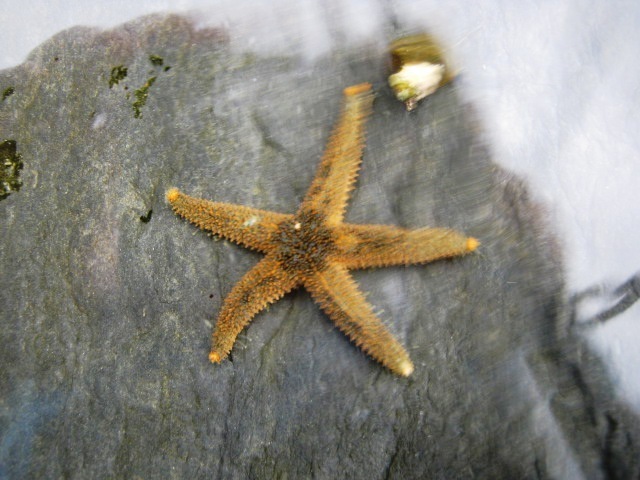
Asterias rollestoni
Asterias rollestoni is a common starfish native to the seas of China and Japan, and not known from the far north or the American coasts of the eastern Pacific.
From the article Asterias rollestoni on Wikipedia (CC BY-SA), quoted section by section
Description
It has five arms and a moderately-sized central disc. The arm length is up to 12 cm; the ratio between the length of the arm and the radius of its disc is usually 4:1 to 4.5:1. It has planktonic larvae. In 1914 Verrill found it most resembling A. rathbuni, from which it differs by virtue of less dense spines near the mouth, but longer and larger spines dorsally and marginally, and larger and more numerous pedicellaria. He states it is to a lesser degree similar to A. versicolor, differing from this species by having more spines and longer and sharper pedicellaria, but at the same time also considered Allasterias forficulosa, a taxon he created in 1914 but now considered a synonym of Asterias rollestoni, closer resembling to A. versicolor. In 1930 Fisher stated that Asterias rollestoni might well intergrade with A. versicolor to the south of its range, and in 1940 Hayashi also found it to be most closely related to A. versicolor.
Range & habitat
According to Djakonov it has been collected at depths of 5-96m. It is found in the littoral zone from the east in the seas around Japan, west to the Sea of Japan and further to the Yellow Sea, and north through the Peter the Great Gulf (Primorsky Krai) to off the coast of De-Kastri in Khabarovsk Krai. It is among the most common starfish of Chinese seawaters.
Wikipedia: “Distribution and habitat”
What it does
Asterias rollestoni can grow back its limbs should it lose them. This begins four days after amputation, when cells near the end of the stump de-differentiate and migrate to the wound where they form a thickened skin which gradually re-differentiates into mature tissue.
Wikipedia: “Behaviour”
At the table
It is considered useful in traditional medicine in China and is in the 2015 Pharmacopoeia of the People's Republic of China.
Wikipedia: “Uses”
Where it lives
Recorded sightings
—
geo-referenced records in GBIF, from museums, herbaria and field observers.
Drag the globe to turn it. Dots are where records exist, not a range map; darker means more records.
In the stacks
Searching the stacks…
Every page naming Asterias rollestoni in the Biodiversity Heritage Library →
This page is assembled live from iNaturalist, GBIF, Wikipedia, the Source Library and the Internet Archive. It is not yet part of the hand-edited codex. iNaturalist taxon 789687.