On eBird ↗
Crow-billed Drongo
Live sightings near you, the range map, bar charts of when it is seen, and Macaulay Library photos and recordings.
Crow-billed Drongo
Dicrurus annectens
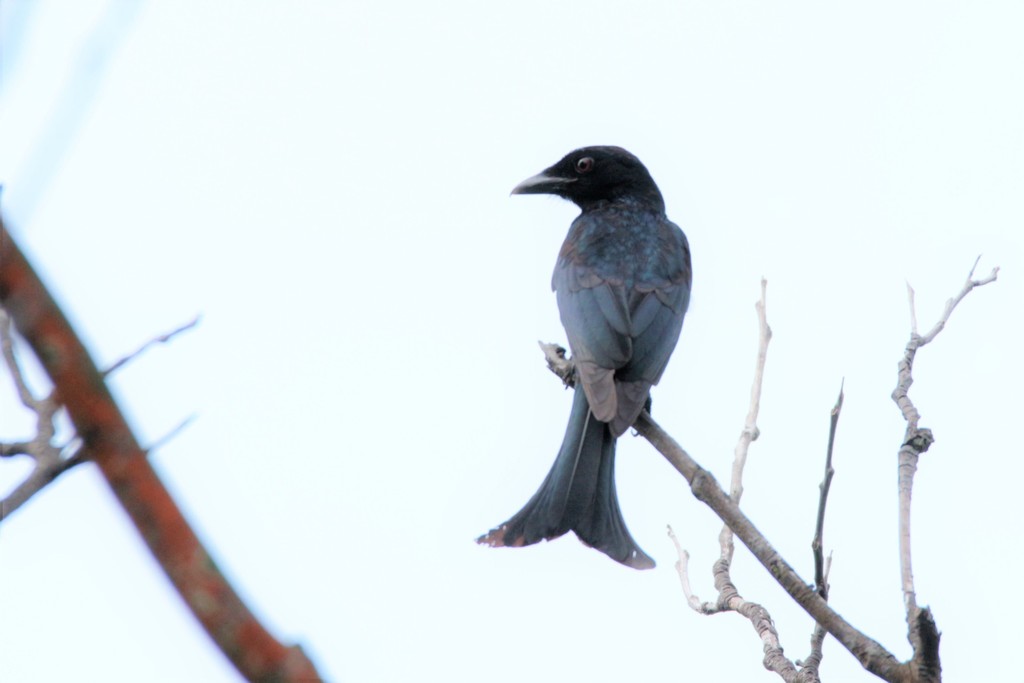
The crow-billed drongo (Dicrurus annectens) is a species of bird in the family Dicruridae. It is native to moist tropical forests of southeastern Asia where its range extends from India to the Philippines and Indonesia. It is a completely black bird with a shallowly forked tail and is similar in appearance to the black drongo. It breeds between April and June, the cup-shaped nest being built in the fork of a branch by both birds, the female afterwards incubating the eggs. It is a common bird and the IUCN has listed it as "least concern".
From the article Crow-billed drongo on Wikipedia (CC BY-SA), quoted section by section
Description
This bird, which is similar to the black drongo, is jet-black in color and has a stout bill. It has a forked tail.
Range & habitat
It is found in: Bangladesh, Bhutan, Brunei, Cambodia, China, India, Indonesia, Laos, Malaysia, Myanmar, Nepal, Philippines, Singapore, Thailand, and Vietnam. Its natural habitats are subtropical or tropical moist lowland forests and subtropical or tropical mangrove forests.
Wikipedia: “Distribution and habitat”
What it does
This species inhabits dense evergreen forests and moist-deciduous forests. The nesting season is from April to June. The nest is usually a small cup made of grass that is held together by cobwebs. The nests can be found in the fork of a slender branch. The female incubates the eggs. However, both the male and female birds build the nest.
Wikipedia: “Behavior”
Listen
Looking for field recordings…
Where it lives
Recorded sightings
—
geo-referenced records in GBIF, from museums, herbaria and field observers.
Drag the globe to turn it. Dots are where records exist, not a range map; darker means more records.
In the stacks
Searching the stacks…
Every page naming Dicrurus annectens in the Biodiversity Heritage Library →
This page is assembled live from iNaturalist, GBIF, Wikipedia, the Source Library and the Internet Archive. It is not yet part of the hand-edited codex. iNaturalist taxon 793142.