On eBird ↗
Red-breasted Meadowlark
Live sightings near you, the range map, bar charts of when it is seen, and Macaulay Library photos and recordings.
Red-breasted Meadowlark
Leistes militaris
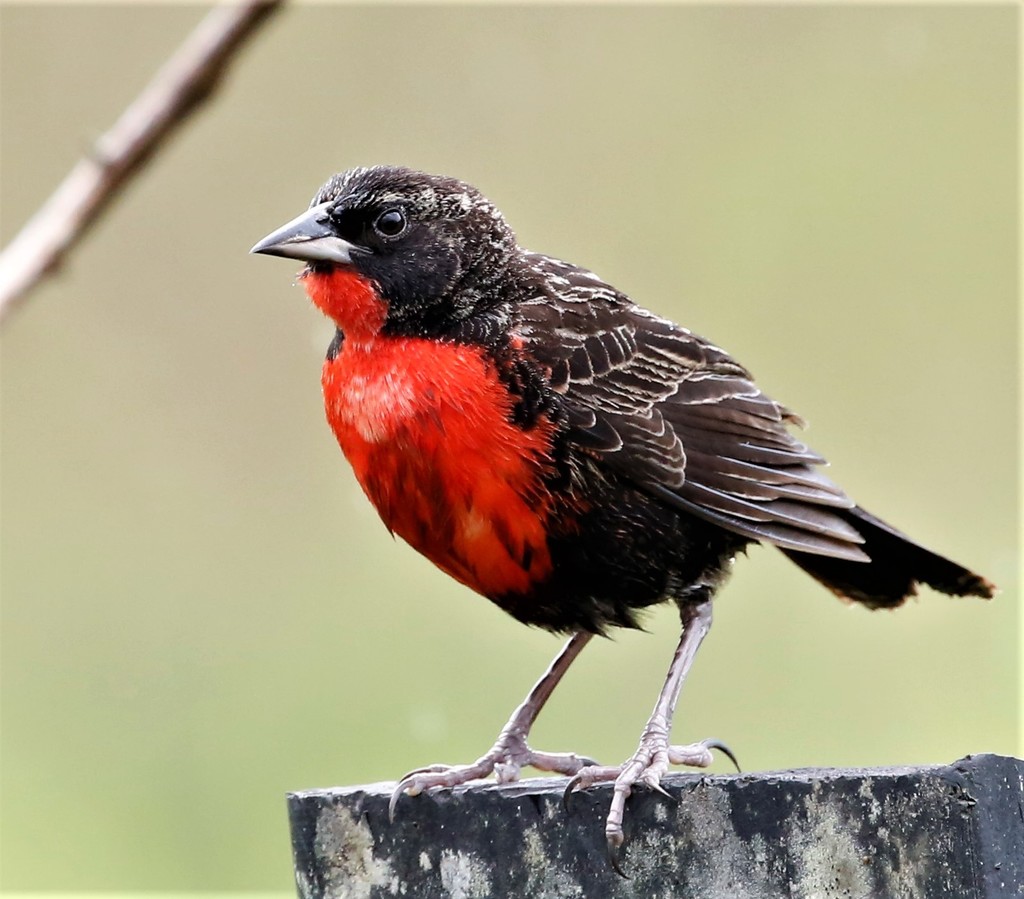
The red-breasted meadowlark (Leistes militaris) is a passerine bird in the New World family Icteridae. It was formerly named red-breasted blackbird but is not closely related to the red-winged blackbird group.
From the article Red-breasted meadowlark on Wikipedia (CC BY-SA), quoted section by section
Description
The red-breasted meadowlark is a small icterid, 19 cm (7.5 in) long and weighing 40–48 g (1.4–1.7 oz). Males are larger than females. The male has mainly black plumage, apart from a bright red throat, belly and wing epaulets. This striking "redcoat" plumage gives rise to the specific name militaris and the Trinidadian name "soldier bird". The female has buff edged dark brown upperpart feathers, buff underparts with a reddish tinge, and pale streaks through the crown and eye. Juveniles resemble the female, but are paler and lack the reddish tint to the underparts. This species is very closely related to the white-browed meadowlark, S. superciliaris which breeds further south, and was formerly considered to be subspecies of red-breasted meadowlark. The male white-browed is easily distinguished by his bright white supercilium, but females of the two species are almost identical. Female red-breasted meadowlarks are longer billed, smaller, and shorter winged than their relative, with more red and less streaking on the underparts.
Range & habitat
The red-breasted meadowlark is resident from south-western Costa Rica, which it has recently colonised, and Trinidad, south to north-eastern Peru and central Brazil. In 2008, it was sighted for the first time in Nicaragua. Like other meadowlarks, it is a bird associated with open country, including moist grasslands, pasture and cultivation, preferably with the odd bush or fence post for males to use as a songpost. It has benefited from the more open habitat created by forest clearance and ranching, and is extending its range. It is uncertain whether sightings on Tobago represent a small breeding population or wanderers from Trinidad or South America.
Wikipedia: “Distribution and habitat”
What it does
This gregarious bird feeds mainly on insects and some seeds, including rice, and forages on the ground like a bobolink.
Wikipedia: “Food and feeding”
Listen
Looking for field recordings…
Where it lives
Recorded sightings
—
geo-referenced records in GBIF, from museums, herbaria and field observers.
Drag the globe to turn it. Dots are where records exist, not a range map; darker means more records.
In the stacks
Searching the stacks…
Every page naming Leistes militaris in the Biodiversity Heritage Library →
This page is assembled live from iNaturalist, GBIF, Wikipedia, the Source Library and the Internet Archive. It is not yet part of the hand-edited codex. iNaturalist taxon 793308.