- Animals
- ›Chordates
- ›Vertebrates
- ›Reptiles
- ›Snakes and Lizards
- ›Lizards
- ›Iguanas and Allies
- ›Dragons and Chameleons
- ›Dragons
- ›Flying Dragons and Allies
- ›Diploderma
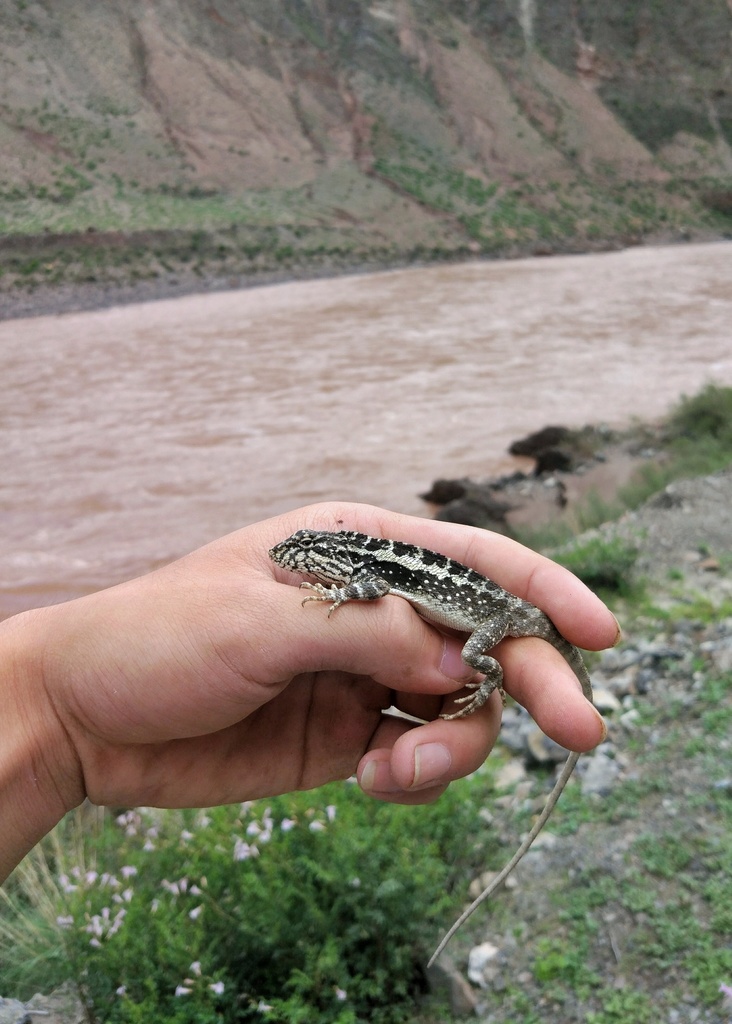
Quzika Mountain Agama
Diploderma vela
Diploderma vela, also known as sail mountain lizard, the mountain dragon or sail japalura, is a species of lizard endemic to China. It is named after its distinct sail, with 'Vela' in Latin meaning sail. It can be found in Tibet and Yunnan at elevations of 2,370 meters.
It was previously considered a member of the genus Japalura.
From the article Diploderma vela on Wikipedia (CC BY-SA), quoted section by section
Description
The sail mountain lizard is a small lizard (5.6 to 6.9 cm). It has moderately-sized hind limbs, a long and flat head and a long and slender cylindrical tail. It can be distinguished by its irregular scales, gular sac, a lateral fold of skin in the axilla–groin region as well as a transverse gular fold and a gular pouch and a concealed tympanum. In males it displays a pronounced sail-like vertebral crest along the length of the body and a dorsally black and ventrally white colouration. There is also jagged yellow-white dorsolateral stripes displayed in males. In females there is no sail and it is medium to dark brown in colouration. There is also faint reddish dorsolateral lines in the anterior half of the axilla-groin region in females. It displays white transverse streaks on the head as well as black radiated markings around the eyes. Ventrally, the head is patterned with prominent black stripes.
What it does
Sail mountain lizards are often found in rocky mountain areas or in steppe-shrubs. Adult males are territorial and can often be seen basking on the top of rocks while females and juveniles tend to stay near the bottoms of the rocks. When another male invades a territory, the territory holder will nod at the invader, displaying his gular pouch. If the invader refuses to leave the two males will fight.
Wikipedia: “Behaviour”
Where it lives
Recorded sightings
—
geo-referenced records in GBIF, from museums, herbaria and field observers.
Drag the globe to turn it. Dots are where records exist, not a range map; darker means more records.
In the stacks
Searching the stacks…
Every page naming Diploderma vela in the Biodiversity Heritage Library →
This page is assembled live from iNaturalist, GBIF, Wikipedia, the Source Library and the Internet Archive. It is not yet part of the hand-edited codex. iNaturalist taxon 797640.