On eBird ↗
Fish Crow
Live sightings near you, the range map, bar charts of when it is seen, and Macaulay Library photos and recordings.
Fish Crow
Corvus ossifragus
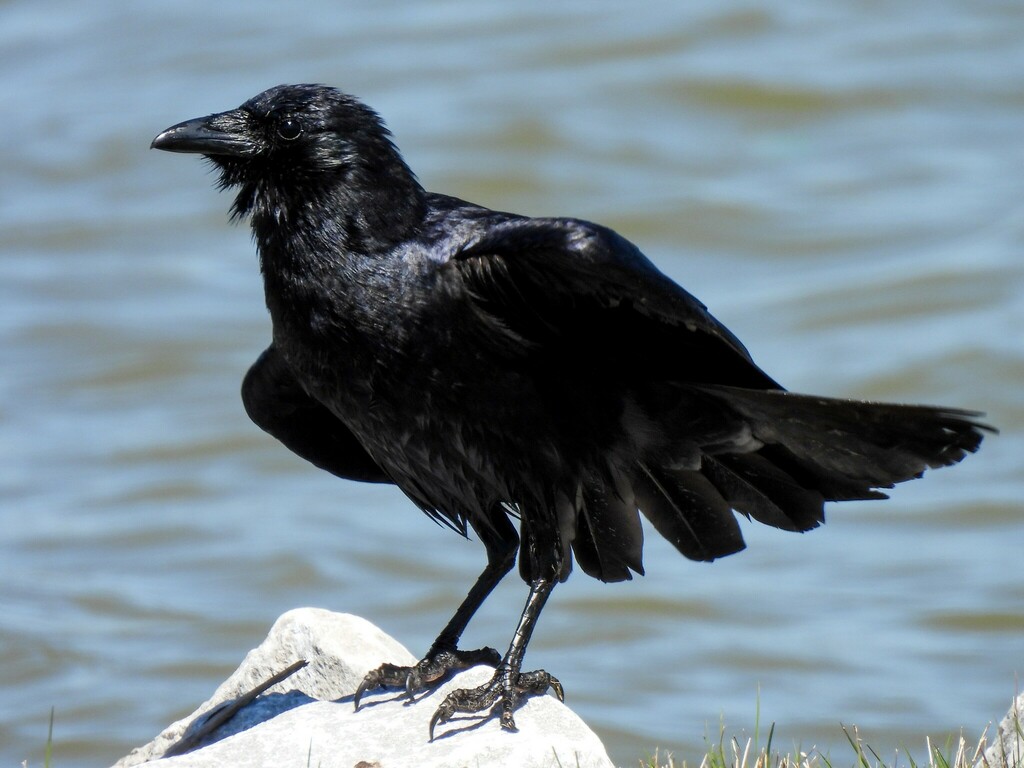
The fish crow (Corvus ossifragus) is a species of crow associated with wetland habitats in the eastern and southeastern United States.
From the article Fish crow on Wikipedia (CC BY-SA), quoted section by section
Description
The fish crow is a medium-large bird, with an average adult weight of 280–320 grams (9.9–11.3 oz) in males and 247–293 grams (8.7–10.3 oz) in females. The wingspan is approximately 36 inches (90 cm), while the total body length is between 36–40 centimetres (14–16 in). The fish crow is superficially similar to the American crow, but is smaller and has a silkier, smoother plumage by comparison, and the bill is usually somewhat slimmer. The upperparts have a blue or blue-green sheen, while the underparts have a more greenish tint to the black. The eyes are dark brown. The differences are often only really apparent between the two species when seen side by side or when heard calling. Visual differentiation from the American crow is extremely difficult and often inaccurate. Nonetheless, differences apart from size do exist. Fish crows tend to have more slender bills and feet. There may also be a small sharp hook at the end of the upper bill. Fish crows also appear as if they have shorter legs when walking. More dramatically, when calling, fish crows tend to hunch and fluff their throat feathers. The voice is the most outwardly differing characteristic for this species and other American crow species. The call of the fish crow has been described as a nasal "ark-ark-ark" or a begging "waw-waw". …
Range & habitat
This species occurs on the eastern seaboard of the United States from Maine south to Key West, and west along the northern coastline of the Gulf of Mexico. Coastal marshes and beaches, rivers, inland lakes and marshes, river banks, and the land immediately surrounding all are frequented. Fish crows are also found along many river systems inland for quite some distance, having expanded their range along rivers since the early 1900s. Since 2012, fish crows have rapidly expanded into Canada, with breeding populations along Lake Ontario. They have also been documented to be vagrant to the Bahamas, with populations in islands like Grand Bahama and Abaco.
Wikipedia: “Distribution and habitat”
What it does
Food is taken mainly from the ground or shallow water where the bird hovers and plucks food items out of the water with its feet. The fish crow is omnivorous. It feeds on small crustaceans, such as crabs and shrimps, other invertebrates, stranded fish, and live fish if the situation favors their capture, eggs and nestlings of birds, small reptiles, the fruits of many trees, peanuts, and grains, as well as human scraps where available.
Wikipedia: “Diet”
In human culture
The fish crow was given its binomial name by the Scottish ornithologist Alexander Wilson in 1812, in the fifth volume of his American Ornithology. The binomial is from Latin; Corvus means "raven", while ossifragus means "bone-breaker". It is derived from os or ossis, meaning "bone", and frangere, meaning "to break". The English-language common name fish crow also derives from Wilson, who ascribed the name to the crow's aquatic diet, as described to him by local fishermen. He distinguished the fish crow from John Bartram's great seaside crow by the former's diminutive size when compared to the American crow. The fish crow's taxonomic relation to other species of the Corvus genus is still poorly understood, but DNA sequencing indicates that it is most closely related to the Hispaniolan palm crow (C. palmarum) and the Jamaican crow (C. jamaicensis), with the three species forming a Nearctic clade. The Sinaloa crow (C. sinaloae) and Tamaulipas crow (C. imparatus) bear morphological similarities to and were once considered conspecific subspecies of the fish crow, but have since been recognized as distinct species.
Wikipedia: “Taxonomy and etymology”
Listen
Looking for field recordings…
Where it lives
Recorded sightings
—
geo-referenced records in GBIF, from museums, herbaria and field observers.
Drag the globe to turn it. Dots are where records exist, not a range map; darker means more records.
In the stacks
Searching the stacks…
Every page naming Corvus ossifragus in the Biodiversity Heritage Library →
This page is assembled live from iNaturalist, GBIF, Wikipedia, the Source Library and the Internet Archive. It is not yet part of the hand-edited codex. iNaturalist taxon 8001.