On eBird ↗
Mariana Crow
Live sightings near you, the range map, bar charts of when it is seen, and Macaulay Library photos and recordings.
Mariana Crow
Corvus kubaryi
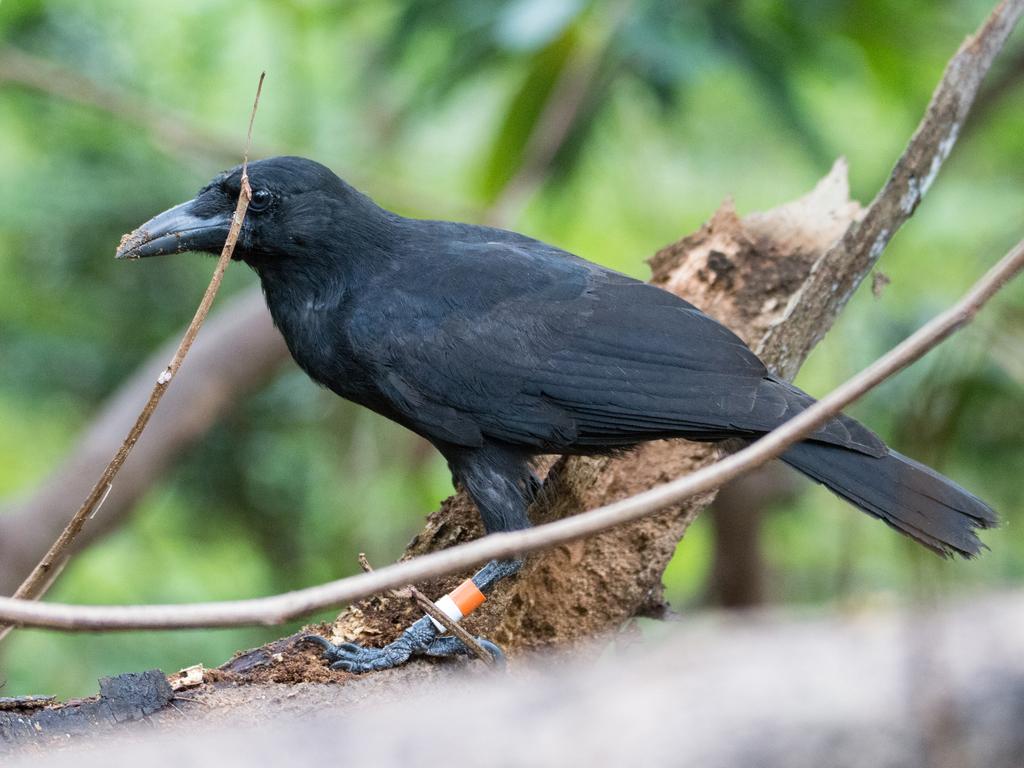
The Mariana crow (Corvus kubaryi) (Chamorro: åga) is a species of the crow family from the tropical Western Pacific. It is a glossy black bird about 15 inches (38 cm) long and known only from the islands of Guam and Rota.
It is a rare bird which has steadily declined in numbers since the 1960s. On Guam there are no remaining native Mariana crows, the population having been wiped out by the introduction of the brown tree snake. On Rota the population has declined to fewer than 200 individuals, the main threats here being the reduction of suitable habitat because of development and predation. Despite translocations from Rota to the Guam National Wildlife Refuge in the late 1990s and early 2000s, by 2011 the Mariana Crow was extirpated from Guam. Current conservation efforts on Rota include habitat protection, and a captive rear-and-release program. The International Union for Conservation of Nature has rated the bird as being "critically endangered".
From the article Mariana crow on Wikipedia (CC BY-SA), quoted section by section
Description
The Mariana crow is a small black crow with a bluish-black gloss on its tail, and a greenish-black gloss on its back, underparts, head, and wings. In general, females are smaller than males. An adult weighs about 9 ounces (260 g) and is about 15 inches (38 cm) long. The Mariana crow has a variety of vocalizations, including two locational calls used to maintain contact between pairs, family members and flock mates. These locational calls are either a high-pitched series of one to three caw or hi sounds, or a series of longer caw sounds with a nasal aaa element to the call; the latter call may be used exclusively between mated pairs. Alarm calls are a rapid series of sharp caws. The birds also make a variety of squalling, guttural sounds, which may be done either quietly or excitedly.
Range & habitat
The Mariana crow inhabits second growth and mature forests, as well as coastal strand vegetation, but nests only in native limestone forest. It preferentially nests in the crowns of two canopy-emergent tree species: yoga tree (Elaeocarpus joga) and the fig Ficus prolixa. The crow currently is only found on the island of Rota. It disappeared from southern Guam in the 1960s and from central Guam in the 1970s, mostly inhabiting Andersen Air Force Base. Its population on Rota has also decreased.
Diet. Extremely versatile, the Mariana crow is an opportunistic omnivore, feeding on insects, lizards, other birds' eggs, hermit crabs, fruits, and seeds.
Nesting. The Mariana crow begins nesting as early as July and as late as May. The nest is a large, cupped platform of small sticks, lined with leaf fibers. Clutch size varies from 1 to 4 eggs, and both parents incubate the eggs, brood the chicks, and care for the juveniles even after they fledge. Parental care has been known to range from 5 to 18 months, and juveniles may take as long as 3 years before entering the adult breeding cycle.
Wikipedia: “Distribution and ecology”
Listen
Looking for field recordings…
Where it lives
Recorded sightings
—
geo-referenced records in GBIF, from museums, herbaria and field observers.
Drag the globe to turn it. Dots are where records exist, not a range map; darker means more records.
In the stacks
Searching the stacks…
Every page naming Corvus kubaryi in the Biodiversity Heritage Library →
This page is assembled live from iNaturalist, GBIF, Wikipedia, the Source Library and the Internet Archive. It is not yet part of the hand-edited codex. iNaturalist taxon 8007.