On eBird ↗
Australian Raven
Live sightings near you, the range map, bar charts of when it is seen, and Macaulay Library photos and recordings.
Australian Raven
Corvus coronoides
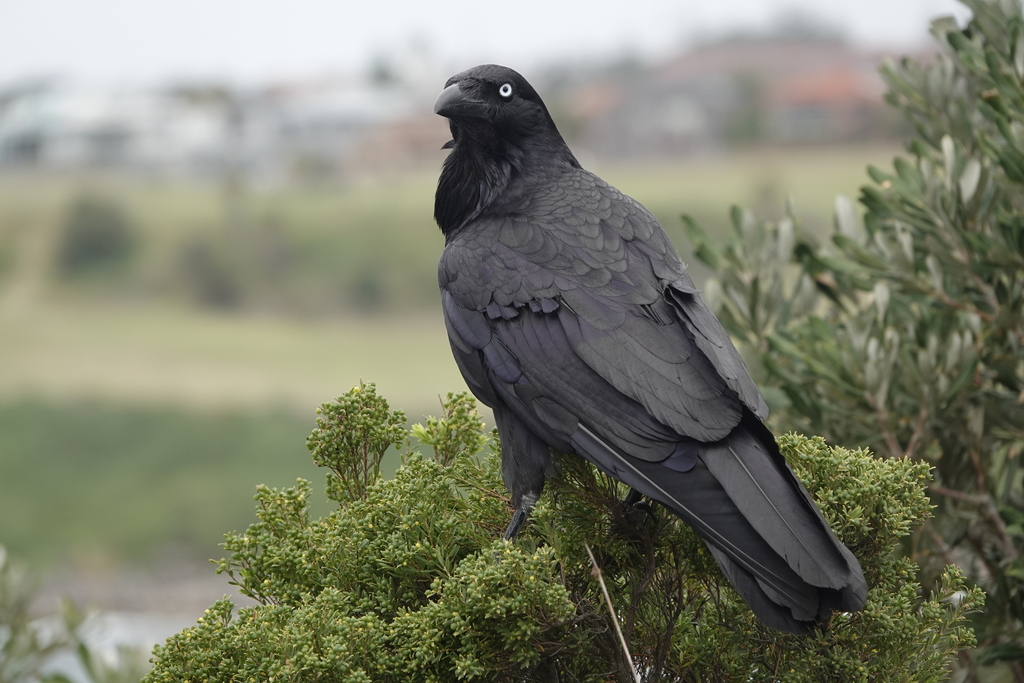
The Australian raven (Corvus coronoides) is a passerine corvid bird native to Australia. Measuring 46–53 centimetres (18–21 in) in length, it has an all-black plumage, beak and mouth, as well as strong, greyish-black legs and feet. The upperparts of its body are glossy, with a purple-blue, greenish sheen; its black feathers have grey bases. The Australian raven is distinguished from the Australian crow, and other related corvids, by its long chest feathers, or throat hackles, which are prominent in mature birds. Older individuals and subadults have white irises, while the younger birds' eyes display blue inner rims; hatchlings and young birds have brown, dark irises until about fifteen months of age, at which point their irises become hazel-coloured, with an inner blue rim around each pupil, this lasting until they are roughly 2.5 to 3 years of age. Nicholas Aylward Vigors and Thomas Horsfield described the Australian raven in 1827, its species name coronoides highlighting its similarity with the carrion crow (C. corone). Two subspecies are recognised, which differ slightly in their vocalisations, and are quite divergent, genetically.
The preferred habitat of the Australian raven includes open woodlands and transitional zones, in addition to cities and towns; it has adapted well to human settlements and other urban environments, and is a commonly sighted bird in several major cities, including Sydney, Canberra, Perth, Adelaide and Brisbane. The Australian raven is territorial, with pairs generally bonding for life.
From the article Australian raven on Wikipedia (CC BY-SA), quoted section by section
Description
Measuring 46–53 cm (18–21 in) in length with a 100 cm (39 in) wingspan and weighing around the 650 g (1+7⁄16 lb), the Australian raven is Australia's largest species of corvid. The adult Australian raven is an all black-bird with a black beak, mouth and tongue and sturdy black or grey-black legs and feet. The tibia is fully feathered and the tarsus is long, and the feet large and strong. It has white irises. The plumage is glossy with a blue-purple to a blue-green sheen, greenish over the ear coverts, depending on the light. The underparts are not glossy. The Australian raven has throat feathers (hackles) that are lanceolate with rounded tips, while the other four species of Australian corvids have bifurcate tips, though this can be difficult to see in the field. The hackles are also longer than those of the other four species; when they are raised (such as when the bird is calling), they give the bird an unusual bearded appearance. The upper third of the upper mandible, including the nares and nasal groove, is covered with bristles, which can be up to 3 cm (1+1⁄4 in) long. The heavy-set beak is tipped with a slight hook, and is longer than the bird's head. The wings are long and broad, with the longest of its ten primary feathers (usually the seventh but occasionally the eighth) almost reaching the end of the tail when the bird is at rest. The tail is rounded or wedge-shaped. …
Range & habitat
The Australian raven is common throughout eastern Australia, and southern Western Australia (the populations being connected by a narrow strip across the Nullarbor Plain), but it is rarer and more scattered in the north, with isolated sightings in Cape York at Coen, Windmill Creek and the Mitchell River, and becoming more common south of Rockhampton in central Queensland. It is found throughout New South Wales, though is uncommon in the northeast of the state. It is rare in the Australian Alps, being replaced there by the little raven. It occurs across Victoria and eastern South Australia, through the Eyre Peninsula and Nullarbor Plain into Western Australia, across the state north to the Wooramel River. It is found on some offshore islands such as Rottnest Island and Kangaroo Island. It is a rare vagrant to Lord Howe Island. The Australian raven can be found in a wide range of natural and modified habitats. It requires available water and trees (or buildings) to roost in or perch on. Preferred habitats include eucalypt-dominated sclerophyll forest, and farmland adjacent to trees. It is also found in heath and mangroves. In areas where it occurs with the little raven, namely over much of central New South Wales, Victoria and into South Australia, the Australian raven is restricted to more forested areas while the latter species prefers more open areas. …
Wikipedia: “Distribution and habitat”
What it does
Difficulties in distinguishing Australian corvids has hampered understanding of seasonal movements. The Australian raven is thought to be largely sedentary, with most movement of over 16 km (9.9 mi) due to flocks of non-breeding subadult birds. Juvenile birds leave their parents and join flocks when they are four or five months old. Smaller flocks of 8–30 birds stay within an area of around 260 square kilometres, while larger flocks of up to 300 birds may travel hundreds of kilometres seeking food. A single breeding pair and their brood can occupy a territory of up to around 120 hectares (300 acres) and remains there year-round, though groups of ravens may enter this area to forage. Australian ravens will defend their territory by chasing, dive-bombing and occasionally striking the backs of birds of prey, foxes or even people. They generally mate for life, though occasionally one male has been found to be mated with two females in adjacent territories. If the female dies, the male Australian raven maintains the territory and finds another mate, while if the male bird is lost, the female abandons the territory. No courtship behaviour has been observed, and species that mate for life often lack elaborate courting displays. Once they begin breeding at three years of age, they live another four to five years on average. …
Wikipedia: “Behaviour”
In human culture
In Australian Aboriginal mythology, Crow is a trickster, culture hero and ancestral being. In the Kulin nation in central Victoria he was known as Waa (also Wahn or Waang) and was regarded as one of two moiety ancestors, the other being the more sombre eaglehawk Bunjil. Legends relating to Crow have been observed in various Aboriginal language groups and cultures across Australia. The Gamilaraay and Yuwaalaraay people of northern New South Wales use the name waan to refer to this species. To the Noongar people of southwestern Australia, the Australian raven was Waardar, "the Watcher" and was wily and unpredictable. Noongar people were socially divided into two moieties or kinships: waardarng-maat and marrnetj-maat, or members of the Australian raven and western corella (Cacatua pastinator) respectively.
Wikipedia: “In Indigenous culture”
Listen
Looking for field recordings…
Where it lives
Recorded sightings
—
geo-referenced records in GBIF, from museums, herbaria and field observers.
Drag the globe to turn it. Dots are where records exist, not a range map; darker means more records.
In the stacks
Searching the stacks…
Every page naming Corvus coronoides in the Biodiversity Heritage Library →
This page is assembled live from iNaturalist, GBIF, Wikipedia, the Source Library and the Internet Archive. It is not yet part of the hand-edited codex. iNaturalist taxon 8040.