On eBird ↗
Little Raven
Live sightings near you, the range map, bar charts of when it is seen, and Macaulay Library photos and recordings.
Little Raven
Corvus mellori
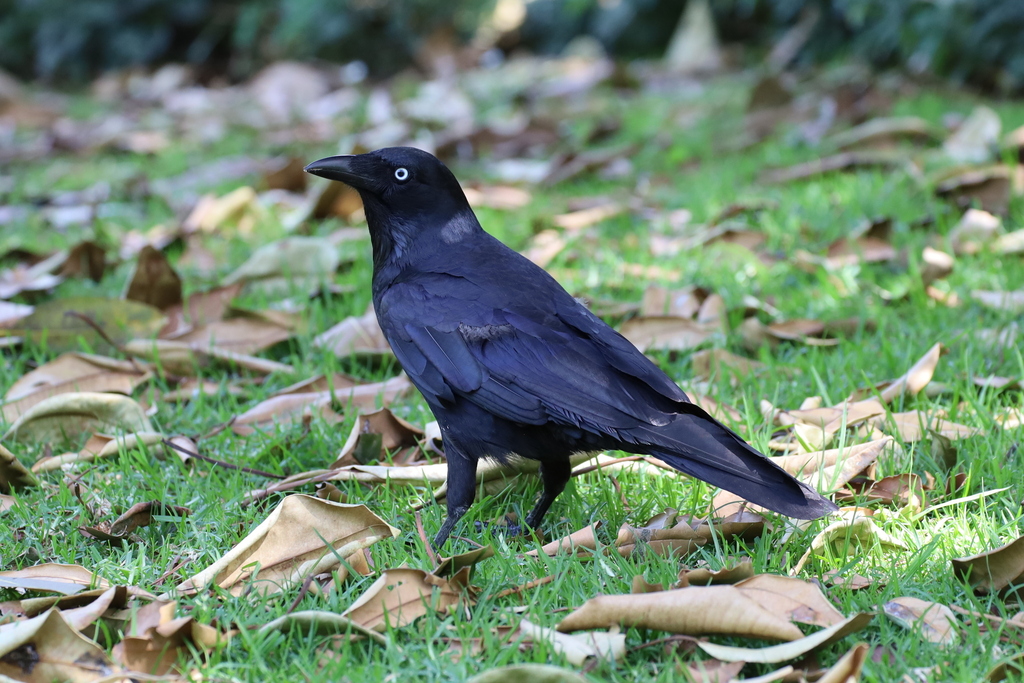
The little raven (Corvus mellori) is a species of the family Corvidae that is native to southeastern Australia. An adult individual is about 48–50 cm (19–19.5 in) in length, with completely black plumage, beak, and legs; as with all Australian species of Corvus, the black feathers have a grey base, and the iris of the adult bird is white (typical also of some related species from islands to the north of Australia). Although the little raven was first named by Gregory Mathews in 1912, it was only in 1967 that there was consensus to separate it from the Australian raven (C. coronoides) as a distinct species.
From the article Little raven on Wikipedia (CC BY-SA), quoted section by section
Description
The little raven is, at about 48–50 cm in length on average, somewhat smaller than the Australian raven (though sizes do overlap between both species), the little raven's beak is slightly smaller. The little raven is a somewhat more sociable species than the Australian raven, often forming large flocks that roam freely over wide areas in search of food. Eye colour varies with age: nestlings up to three months old have blue-grey eyes, juveniles aged from three to eleven months have brown eyes, and immature birds have hazel eyes with blue eyerings around the pupil until age one year and eleven months. The eyes turn white when the birds mature into adults.
Vocalisations. Its call is a harsh, guttural "kar-kar-kar-karrr" or "ark-ark-ark-arrk" with a similarly drawn-out call to the Australian and forest raven. Like all species of raven in Australia (with the exception of the forest raven) the little raven sometimes stretches or flicks its wings outward slightly when calling. Like all corvids, the little raven is capable of vocal mimicry, but this behavior is mostly recorded in captivity and only rarely in the wild.
Range & habitat
The little raven ranges over southeastern Australia from southern South Australia, Victoria and New South Wales. Also in Kangaroo Island (S.A) and King Island (Bass Strait). Living within scrub, agricultural areas, grazing pasture, woodlands to treeless plains, coasts, and suburbs. Little ravens are absent from west Gippsland, where the land is dominated by forest ravens. Its large range, abundance and stable population mean it is classified as least concern on the IUCN Red List. The little raven appears to have become more abundant and widespread in Melbourne since the 1980s, spreading northwards and westwards, adapting well to its urban surrounds. Meanwhile, the Australian raven has only been rarely recorded in the city's outer fringes. The opposite phenomenon has taken place in Canberra and Sydney, where it is the Australian raven that has adapted and become common, while the little raven has remained uncommon.
Wikipedia: “Distribution and habitat”
What it does
Little ravens eat more insects than C. coronoides and feed mainly on the ground, but they are probably omnivorous to a similar extent to other Corvus species when opportunity arises. Common invertebrates eaten include spiders, millipedes, centipedes (which ravens behead before eating), grasshoppers, cicadas and caterpillars (especially of the family Noctuidae), which are important in feeding nestlings. Little Ravens have also been observed predating upon little penguin nests on Phillip Island, where large individual little ravens were found to be more capable of raiding the penguin nests. Little ravens are intelligent birds, and have been recorded using tools as well as having innovative methods of seeking out food.
Wikipedia: “Feeding”
Listen
Looking for field recordings…
Where it lives
Recorded sightings
—
geo-referenced records in GBIF, from museums, herbaria and field observers.
Drag the globe to turn it. Dots are where records exist, not a range map; darker means more records.
In the stacks
Searching the stacks…
Every page naming Corvus mellori in the Biodiversity Heritage Library →
This page is assembled live from iNaturalist, GBIF, Wikipedia, the Source Library and the Internet Archive. It is not yet part of the hand-edited codex. iNaturalist taxon 8042.