On eBird ↗
Hispaniolan Palm-Crow
Live sightings near you, the range map, bar charts of when it is seen, and Macaulay Library photos and recordings.
Palm Crow
Corvus palmarum
The palm crow (Corvus palmarum) is a relatively small black bird in the crow family that occurs mostly on the large Caribbean island of Hispaniola, itself divided into the two countries of Haiti and the Dominican Republic. It was formerly quite frequent on Cuba but has become severely reduced in number and may be almost extinct there. This form is slightly smaller and is usually separated as a sub-species called Corvus palmarum minutus. Both forms are...
From the article Hispaniolan palm crow on Wikipedia (CC BY-SA), quoted section by section
Description
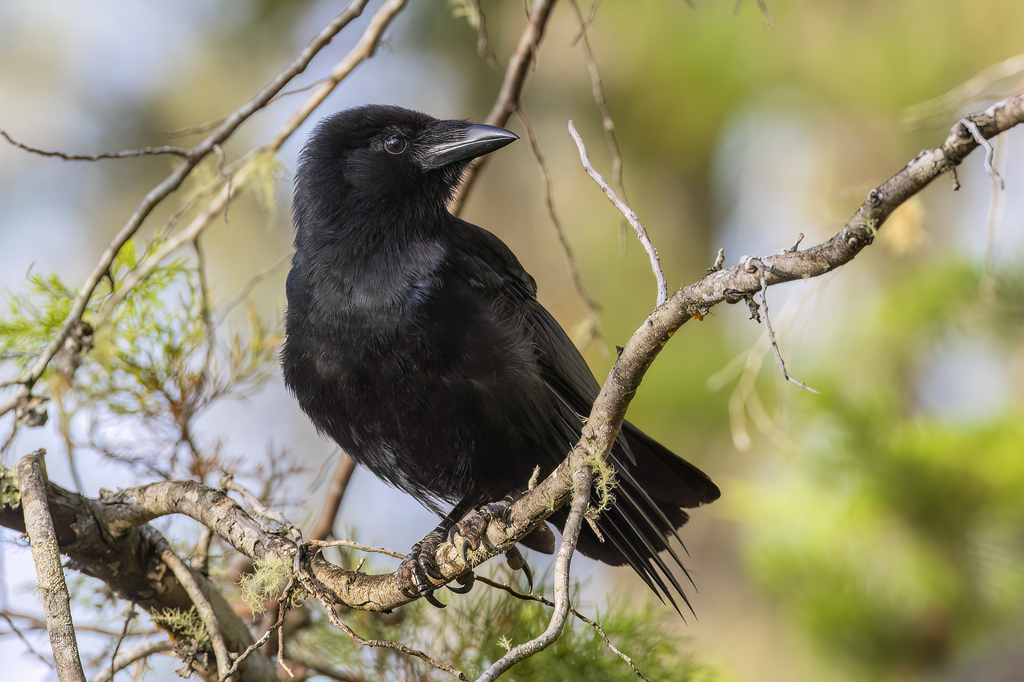
The Hispaniolan palm crow is 34 to 43 cm (13 to 17 in) long; two individuals weighed 229 and 258 g (8.1 and 9.1 oz). The sexes have the same plumage; males are slightly larger than females. Adults are entirely black with much purple-blue iridescence on the mantle and wing coverts when fresh and which becomes dull brownish black when worn. They have a dark brown iris, a black or blackish bill, and black or blackish legs and feet. Juveniles are overall duller than adults.
Range & habitat
The Hispaniolan palm crow is found in several areas in Haiti and the western half of the Dominican Republic. It primarily inhabits pine forest in the island's mountains but also occurs in evergreen forest in the lowlands of Haiti and in dry to humid deciduous forest in both countries. In elevation it ranges from sea level to 3,000 m (9,800 ft) but is most common between 750 and 2,000 m (2,500 and 6,600 ft).
Wikipedia: “Distribution and habitat”
What it does
The Hispaniolan palm crow is omnivorous. Though no detailed studies of its diet have been made, it is known to eat invertebrates like insects and snails, small vertebrates such as lizards, fruits, and seeds. It typically forages in pairs or in flocks of up to about 20 individuals, and uses all levels of its habitat.
Wikipedia: “Feeding”
Listen
Looking for field recordings…
Where it lives
Recorded sightings
—
geo-referenced records in GBIF, from museums, herbaria and field observers.
Drag the globe to turn it. Dots are where records exist, not a range map; darker means more records.
In the stacks
Searching the stacks…
Every page naming Corvus palmarum in the Biodiversity Heritage Library →
This page is assembled live from iNaturalist, GBIF, Wikipedia, the Source Library and the Internet Archive. It is not yet part of the hand-edited codex. iNaturalist taxon 8051.