On eBird ↗
Jamaican Crow
Live sightings near you, the range map, bar charts of when it is seen, and Macaulay Library photos and recordings.
Jamaican Crow
Corvus jamaicensis
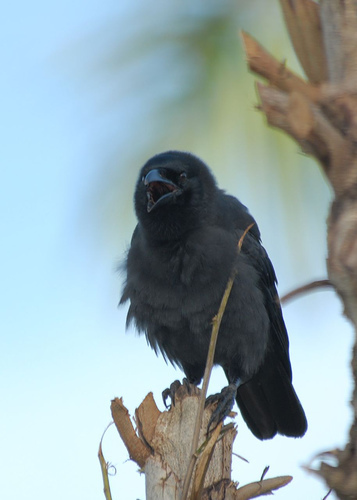
The Jamaican crow (Corvus jamaicensis) is a comparatively small crow species (35–38 cm in length). It shares several key morphological features with two further West Indian species, the Cuban crow, Corvus nasicus and the white-necked crow, Corvus leucognaphalus of Hispaniola which are almost certainly very closely related to it.
From the article Jamaican crow on Wikipedia (CC BY-SA), quoted section by section
Description
The overall appearance is sooty-grey, not at all glossy, like its relatives; though it does possess a similar dark grey patch of naked skin just behind the eye, and a smaller naked patch at the base of the bill. The bill itself is slate-grey and quite deep, tapering to a sharp point. The nasal bristles are relatively sparse usually leaving the nostrils on view. The iris is either grey-brown or red-brown, possibly depending on age. The legs and feet are black. The voice, like its two nearest relatives, is very distinctive and consists of various jabbering and bubbling sounds (thus its common Jamaican Patois name, jabbering crow), but also a more leisurely "craaa-aa" and variations thereof, and somewhat of a musical burbling.
Range & habitat
As its name suggests, this species is found on the island of Jamaica, where it inhabits woodland mixed with cleared areas, and can be frequently found in larger gardens. Though primarily a bird of hill and mountain forest, it comes down to lower elevations during the dry season, where it is more likely to be seen.
Wikipedia: “Distribution and habitat”
What it does
A forest crow by nature, its food requirements contain a significant proportion of fruit taken from trees, either in pairs or small groups. It also probes under bark and leaf litter for small invertebrates and lizards, and it is known to raid other birds nests of both eggs and nestlings.
Wikipedia: “Food and feeding”
Listen
Looking for field recordings…
Where it lives
Recorded sightings
—
geo-referenced records in GBIF, from museums, herbaria and field observers.
Drag the globe to turn it. Dots are where records exist, not a range map; darker means more records.
In the stacks
Searching the stacks…
Every page naming Corvus jamaicensis in the Biodiversity Heritage Library →
This page is assembled live from iNaturalist, GBIF, Wikipedia, the Source Library and the Internet Archive. It is not yet part of the hand-edited codex. iNaturalist taxon 8053.