- Animals
- ›Chordates
- ›Vertebrates
- ›Birds
- ›Perching Birds
- ›Woodswallows, Butcherbirds, and Currawongs
- ›Artamus
On eBird ↗
Ashy Woodswallow
Live sightings near you, the range map, bar charts of when it is seen, and Macaulay Library photos and recordings.
Ashy Woodswallow
Artamus fuscus
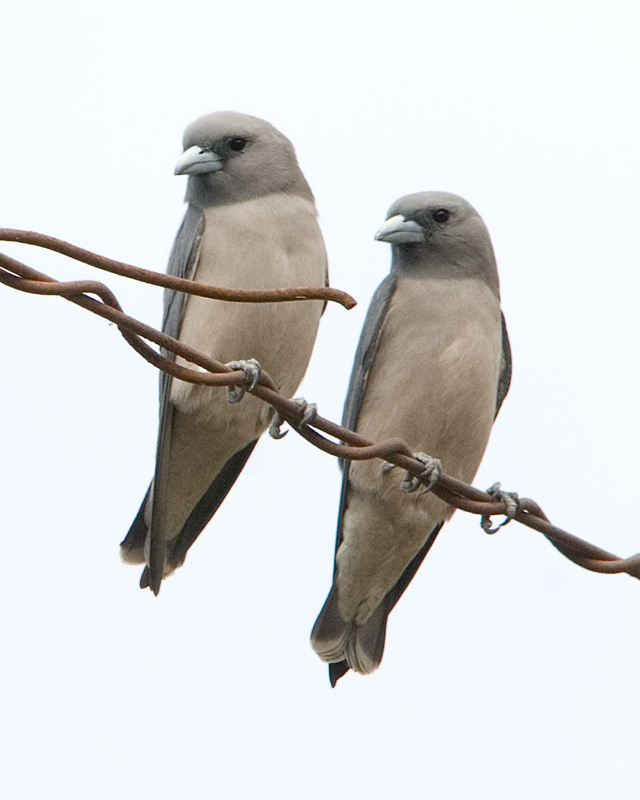
The ashy woodswallow (Artamus fuscus) sometimes also called the ashy swallow-shrike is a woodswallow which is found in south Asia. Like other woodswallows, it has a short curve bill and a short square tail and long wings. It is usually seen perched in groups, high on powerlines, tall bare trees and most often in areas with a predominance of tall palm trees.
From the article Ashy woodswallow on Wikipedia (CC BY-SA), quoted section by section
Description
This stocky woodswallow has an ashy grey upperparts with a darker head and a narrow pale band on the rump. The underside is pinkish grey and the short slaty black tail is tipped in white. The finch-like bill is silvery. In flight the long wing looks very broad at the base giving it a very triangular outline. The first primary is very short. The legs are short and the birds usually perch on high vantage points from which they make aerial sallies. There are no geographic variations in plumage and no subspecies have been designated. Males and females are indistinguishable in the field, however an old report suggests that the sexes differ in the colour of the inside of the mouth. Young birds appear barred on the underside.
Range & habitat
Woodswallows are found in a range of habitats from the plains to about 2,000 metres (6,600 ft), over cultivated areas, in forest clearings and often in areas with tall palm trees. The species is widely distributed across Bangladesh, India, Nepal, Sri Lanka, Thailand, Myanmar, Laos, Malaysia and China. They are absent in the very arid regions of western India. They have been recorded on the island of Maldives.
Wikipedia: “Habitat and distribution”
What it does
Ashy woodswallows are usually seen in small groups. Several birds may sit huddled side-by-side on the bare branches of a tall tree, sometimes preening each other. They also perch on high vantage points such as powerlines and pylons. From their perches, they make aerial sallies, flapping and gliding to capture insects in the air. Insects may be caught in the beak, transferred and held in their feet, torn up with their bill and swallowed without returning to the perch. They may also return to the perch with prey to feed and will sometimes sit on the ground and have been known to visit bird baths. Although mainly feeding on insects, they may take nectar from flowers of trees such as Erythrina. They have been recorded feeding on toxic butterflies of the family Danaiidae such as Euploea core which are avoided by other birds. The breeding season in India is March to June, the nest is a shallow cup placed at some height such as at the base of the frond of a tall palm or a hollow atop a street lighting post. The usual clutch consists of 2–3 greenish white eggs with brown spots. Both parents take part in nest building, incubation and feeding the young. They will mob larger birds such as crows and birds of prey that approach too close to the nesting birds. The song consists of a varied combination of wheezy notes that may include imitations of the calls of other birds. …
Wikipedia: “Behaviour and ecology”
Listen
Looking for field recordings…
Where it lives
Recorded sightings
—
geo-referenced records in GBIF, from museums, herbaria and field observers.
Drag the globe to turn it. Dots are where records exist, not a range map; darker means more records.
In the stacks
Searching the stacks…
Every page naming Artamus fuscus in the Biodiversity Heritage Library →
This page is assembled live from iNaturalist, GBIF, Wikipedia, the Source Library and the Internet Archive. It is not yet part of the hand-edited codex. iNaturalist taxon 8079.