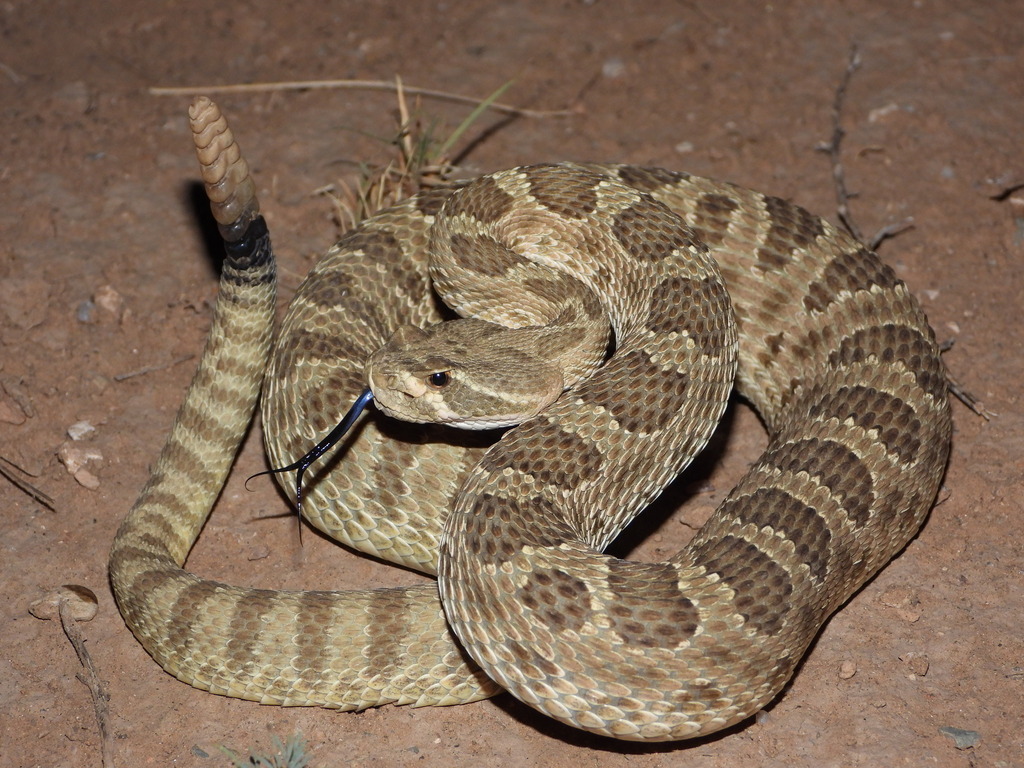
Prairie Rattlesnake
Crotalus viridis
The prairie rattlesnake or Great Plains rattlesnake (Crotalus viridis) is a venomous pit viper species native to the western United States, southwestern Canada, and northern Mexico. Currently, two subspecies are recognized, including the prairie rattlesnake (C. v. viridis), the nominate subspecies, and the Hopi rattlesnake (C. v. nuntius).
From the article Crotalus viridis on Wikipedia (CC BY-SA), quoted section by section
Description
This species commonly grows to more than 100 cm (3.3 ft) in length. The maximum recorded size is 151.5 cm (4.97 ft). In Montana, specimens occasionally exceed 120 cm (3.9 ft) in length; the species reaches its maximum size in this region. One of the most characteristic features is the presence of three or more, usually four, internasal scales. Identification characteristics vary depending on which subspecies is encountered. Generally, prairie rattlesnakes are usually lightly colored in hues of brown. Patches of dark brown are often distributed in a dorsal pattern. A color band may be seen at the back of the eye. The prairie rattlesnake group carries the distinctive triangle-shaped head and pit sensory organs on either side of the head. A key characteristic that can help differentiate a prairie rattlesnake from other rattlesnakes is the presence of two internasals contacting the rostral.
Range & habitat
Prairie rattlesnakes are found in North America over much of the Great Plains, the eastern foothills and some intermontane valleys of the Rocky Mountains, and from southwestern Canada through the United States to northern Mexico. In Canada, they occur in Alberta and Saskatchewan; in the US, they are found in eastern Idaho, most of Montana, North Dakota, South Dakota, Wyoming, Nebraska, Colorado, Kansas, Oklahoma, Texas, New Mexico, northeastern Arizona, and extreme western Iowa, and in Mexico in northern Coahuila and northwestern Chihuahua. Its vertical range is from 100 m (330 ft) near the Rio Grande to over 2,775 m (9,104 ft) in elevation in Wyoming. Wright and Wright (1957) and Klauber (1997) both mention Utah as within the range of this species, including maps showing it confined to the extreme southeastern part of the state. The type locality is described as "the Upper Missouri [Valley, USA]". An emendation was proposed by H.M. Smith and Taylor (1950) to "Gross, Boyd County, Nebraska." Habitat characteristics can vary depending on subspecies and range. Generally, western rattlesnakes occupy areas with an abundant prey base. Many subspecies occupy somewhat rocky areas with outcrops serving as den sites. Prairie rattlesnakes have been known to occupy burrows of other animals. …
Wikipedia: “Distribution and habitat”
What it does
Prairie rattlesnakes are primarily terrestrial, but occasionally climb in trees or bushes. Some even rest in crevices or caves. They are typically active diurnally in cooler weather and nocturnally during hot weather. This species complex is equipped with powerful venom, using about 20-55% of venom in one bite, and will defend themselves if threatened or injured. As with other rattlesnake species, prairie rattlesnakes rapidly vibrate their tails, which produces a unique rasping sound (rattle) to warn intruders. Prairie rattlesnakes prefer a straight migration path while migrating even in human-dominated environments because it leads to a higher chance of survival and better body condition throughout and after migration. The venom of the prairie rattlesnake is a complexly structured mixture of different proteins with enzymes such as proteases and peptidases found among them. Besides the hemotoxin and its tissue-destructive effect, the venom also has neurotoxic properties.
Diet. Prairie rattlesnakes, because of their expansive distribution, have a wide array of prey. Generally, this species prefers small mammals, such as ground squirrels, ground-nesting birds, mice, rats, small rabbits, and prairie dogs. They occasionally feed on amphibians and reptiles, and sometimes even other snakes, more commonly seen in juveniles.
Reproduction. …
Wikipedia: “Behavior”
Where it lives
Recorded sightings
—
geo-referenced records in GBIF, from museums, herbaria and field observers.
Drag the globe to turn it. Dots are where records exist, not a range map; darker means more records.
In the stacks
Searching the stacks…
Every page naming Crotalus viridis in the Biodiversity Heritage Library →
This page is assembled live from iNaturalist, GBIF, Wikipedia, the Source Library and the Internet Archive. It is not yet part of the hand-edited codex. iNaturalist taxon 81526.