- Animals
- ›Chordates
- ›Vertebrates
- ›Jawless Fishes
- ›Lampreys
- ›Lampreys
- ›Northern Lampreys
- ›Petromyzontinae
- ›Ichthyomyzon
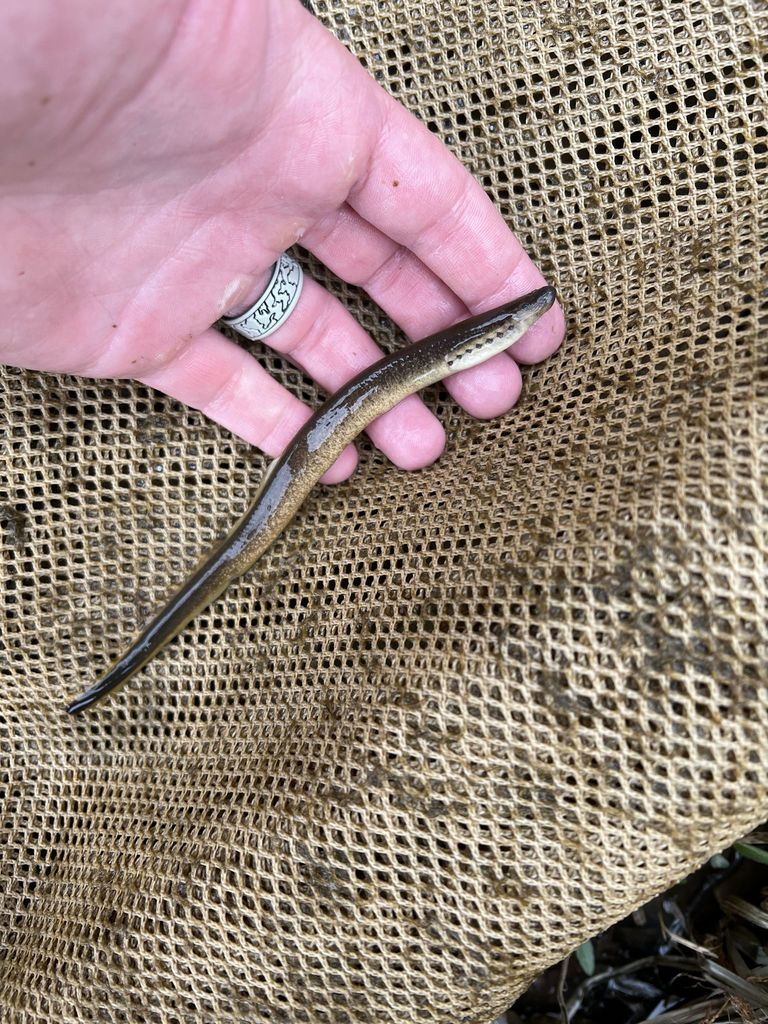
Northern Brook Lamprey
Ichthyomyzon fossor
The northern brook lamprey (Ichthyomyzon fossor) is a jawless freshwater fish in the family Petromyzontidae. It is closely related to the Silver lamprey (I. unicuspis) and may represent an ecotype of a single species with I. unicuspis.
From the article Northern brook lamprey on Wikipedia (CC BY-SA), quoted section by section
Description
Northern brook lampreys are jawless fishes, also known as cyclostomes. The species is also considered a non-parasitic lamprey. They have poorly developed "teeth" and a round, disc-like, subterminal mouth, called an oral-disc, and feed via suction. Northern brook lampreys have a single dorsal fin that continues along their entire length until it connects with the caudal fin. This dorsal fin can be notched as well. Their coloration is gray-brown dorsally with a light line down the back and an even lighter ventral side. The length of adult northern brook lampreys does not typically exceed 16 cm and the body is attenuate. While the ammocoetes look similar to the adult lampreys the ammocoetes have a hooded mouth instead of an oral-disc and no eyes.
Range & habitat
Northern brook lampreys can be found in most of the Midwest and northeast regions of the United States. They inhabit the Mississippi drainage basin in Wisconsin and the Lake Erie tributary in New York. They can be found in parts of Canada as well.
Wikipedia: “Geographic range”
What it does
As larve (ammocoetes), the northern brook lamprey are filter feeders; feeding primarily on detritus, zooplankton, algae, diatoms, bacteria, pollen and a host of other microorganisms as they remain burrowed in fine substrate in calm waters. The juveniles and adults have non-functional intestines and do not feed; juveniles drift for 4–6 months and the adults spawn and die shortly after spawning.
Wikipedia: “Diet”
Where it lives
Recorded sightings
—
geo-referenced records in GBIF, from museums, herbaria and field observers.
Drag the globe to turn it. Dots are where records exist, not a range map; darker means more records.
In the stacks
Searching the stacks…
Every page naming Ichthyomyzon fossor in the Biodiversity Heritage Library →
This page is assembled live from iNaturalist, GBIF, Wikipedia, the Source Library and the Internet Archive. It is not yet part of the hand-edited codex. iNaturalist taxon 81550.