On eBird ↗
White-throated Jay
Live sightings near you, the range map, bar charts of when it is seen, and Macaulay Library photos and recordings.
White-throated Jay
Cyanolyca mirabilis
The white-throated jay (Cyanolyca mirabilis), also known as the Omiltemi jay, is a Vulnerable species of bird in the family Corvidae, the crows and jays. It is endemic to Mexico.
From the article White-throated jay on Wikipedia (CC BY-SA), quoted section by section
Description
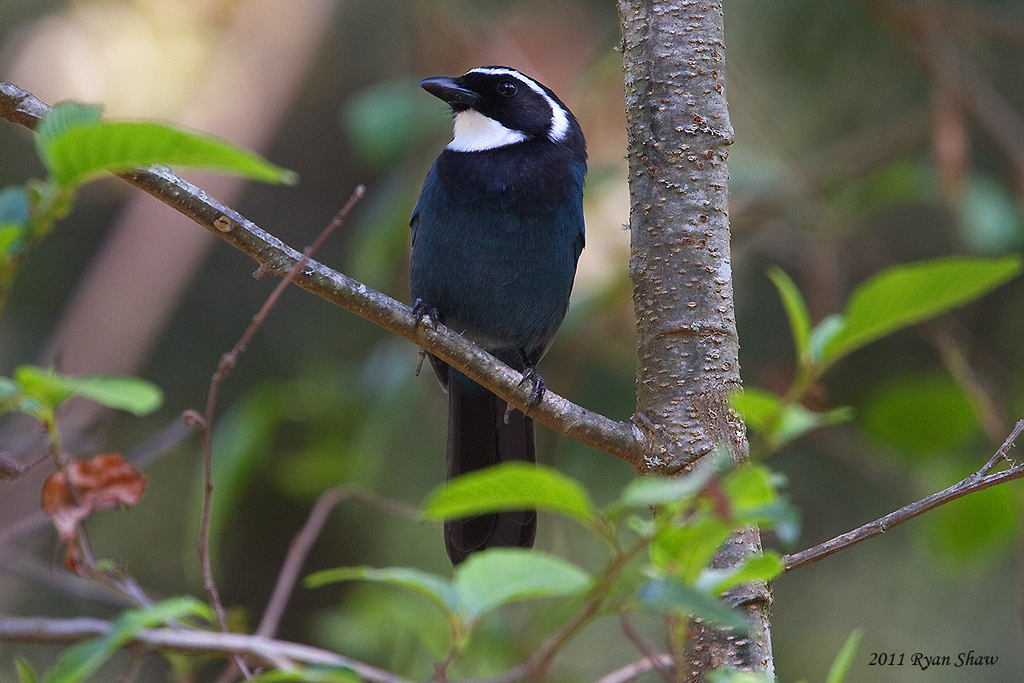
The white-throated jay is "the handsomest and most strikingly marked" member of genus Cyanolyca. It is 23 to 25 cm (9.1 to 9.8 in) long; three males weighed 50 to 54 g (1.8 to 1.9 oz). The sexes have the same plumage. Adults have a mostly black head, neck, and upper breast with a white throat and a thin white supercilium that continues around the back of the ear coverts almost to, but not joining, the white throat. The rest of their plumage is slate-blue with a greenish cast. The undersides of their wings are dark gray. They are believed to have a dark brown iris and known to have a black bill and black legs and feet. Immatures are duller overall than adults, with a greenish or bluish crown and nape and a shorter supercilium.
Range & habitat
The white-throated jay has a disjunct distribution in southwestern Mexico. Its larger range is in the Sierra Madre del Sur and Sierra de Yucuyacua in Guerrero and northwestern Oaxaca states. A smaller range is in the Sierra de Miahuatlán in south-central Oaxaca. The species inhabits humid pine-oak forest and montane evergreen forest in the upper subtropical and temperate zones. It also occurs in coniferous forest. Overall its elevational range is about 1,800 to 3,500 m (5,900 to 11,500 ft) though in Oaxaca it is found mostly between 1,825 and 2,450 m (6,000 and 8,000 ft).
Wikipedia: “Distribution and habitat”
What it does
The white-throated jay apparently forages at all levels of the forest, and often in mixed-species feeding flocks of up to about eight individuals. Its diet and details of its foraging behavior are not known.
Wikipedia: “Feeding”
Listen
Looking for field recordings…
Where it lives
Recorded sightings
—
geo-referenced records in GBIF, from museums, herbaria and field observers.
Drag the globe to turn it. Dots are where records exist, not a range map; darker means more records.
In the stacks
Searching the stacks…
Every page naming Cyanolyca mirabilis in the Biodiversity Heritage Library →
This page is assembled live from iNaturalist, GBIF, Wikipedia, the Source Library and the Internet Archive. It is not yet part of the hand-edited codex. iNaturalist taxon 8174.