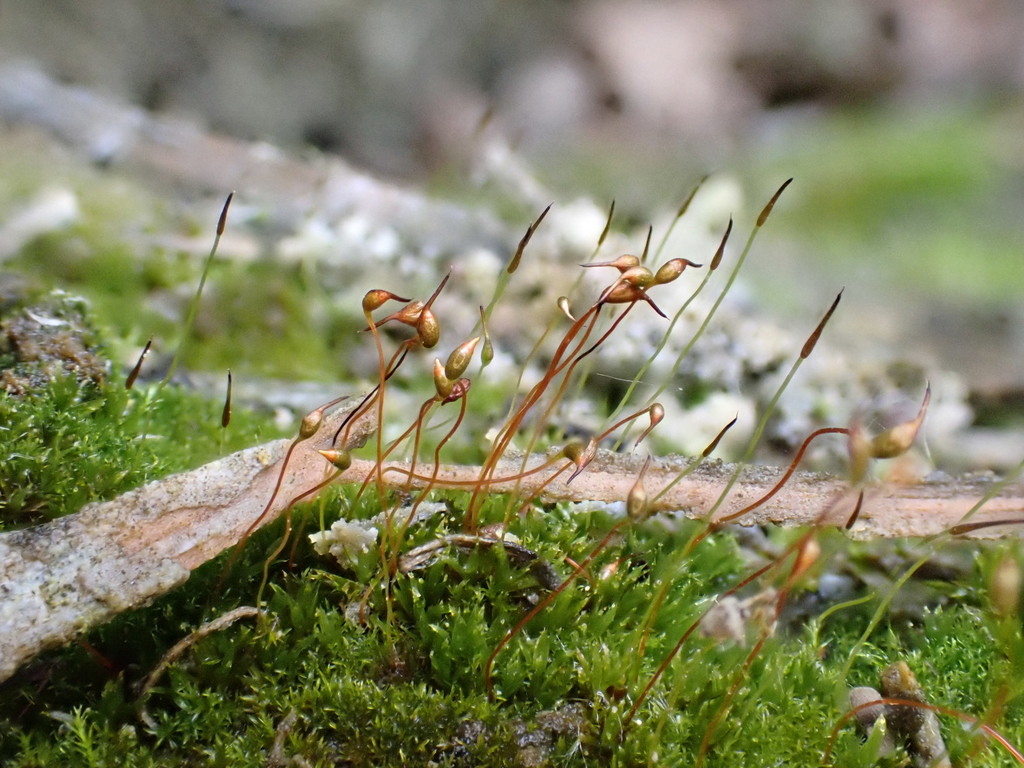
Tortula cernua
Tortula cernua, also known as narrowleaf screw moss and flamingo moss, is a widely-distributed species of moss in the family Pottiaceae. First described in 1833, it is characterised by elliptical leaves with distinctive bordered margins and spore capsules that bend downward at an angle. The species exhibits an unusual reproductive strategy involving springtails that may assist in fertilisation by transferring sperm between plants. While found across Europe, North and South America, and Asia, it is considered rare in many areas, including Britain where it is classified as endangered. It grows primarily on calcareous substrates, particularly on lime-rich waste from historical industrial sites, and requires specific chemical and environmental conditions to grow, making it vulnerable to habitat loss.
From the article Tortula cernua on Wikipedia (CC BY-SA), quoted section by section
Description
Tortula cernua is characterised by its distinctive leaf and reproductive structures. The leaves are elliptical in shape, with tips that range from broadly pointed to rounded, often ending in a small point or sharp projection. The leaf margins curl under in the middle portion and are bordered by 2–3 rows of specialised cells that are narrower and more rectangular than the surrounding tissue. These border cells have thicker walls and can be layered in one or two levels. Running through the centre of each leaf is a prominent vein (costa) that either reaches the tip or extends slightly beyond it. The vein is notably narrow near the tip, showing 3–4 cells across its curved upper surface. The cells of the leaf blade (lamina) near the tip are either hexagonal or rectangular in shape, measuring about 16–24 micrometres (μm) in width (though ranging from 13–28), and are typically smooth or rarely showing very slight surface bumps. The species is autoicous, meaning male and female reproductive structures occur on the same plant but in different locations. Field observations have documented a relationship between this moss and springtails (Collembola). In northern Norway, masses of the springtail species Xenylla humicola have been observed moving among the apical leaves of fertile shoots, apparently attracted by sex-specific volatile compounds produced by the plants. …
Range & habitat
The species has a wide global distribution, occurring in North and South America, Europe, and Asia. In Europe, while it is found across the continent, records are typically sparse and isolated. In Switzerland, where it was last observed in 1942, it historically occurred in the eastern Central Alps and Ticino regions from hillside areas up to subalpine elevations at 200–1,500 m (660–4,920 ft). In these areas, it grew on old, damp walls and rocks, preferring calcareous stone substrates like mortar and clay, as well as sandy-loamy soils. In Britain, T. cernua is classified as endangered in the Bryophyte Red List and is protected under Schedule 8 of the Wildlife and Countryside Act 1981. The UK population is restricted to a small area spanning South Yorkshire, north Nottinghamshire and north-east Derbyshire. In these locations, the species grows specifically on fine lime waste with high pH values (typically between 8.7 and 9.2), primarily found as a by-product of historical lime kilns. This substrate has distinctive chemical properties that make it inhospitable to most other plant species: it contains concentrated levels of magnesium from the burning process, has a high magnesium:calcium ratio that limits potassium uptake in plants, and has severely limited phosphorus availability and very low iron content. …
Wikipedia: “Distribution and habitat”
Where it lives
Recorded sightings
—
geo-referenced records in GBIF, from museums, herbaria and field observers.
Drag the globe to turn it. Dots are where records exist, not a range map; darker means more records.
In the stacks
Searching the stacks…
Every page naming Tortula cernua in the Biodiversity Heritage Library →
This page is assembled live from iNaturalist, GBIF, Wikipedia, the Source Library and the Internet Archive. It is not yet part of the hand-edited codex. iNaturalist taxon 818541.