On eBird ↗
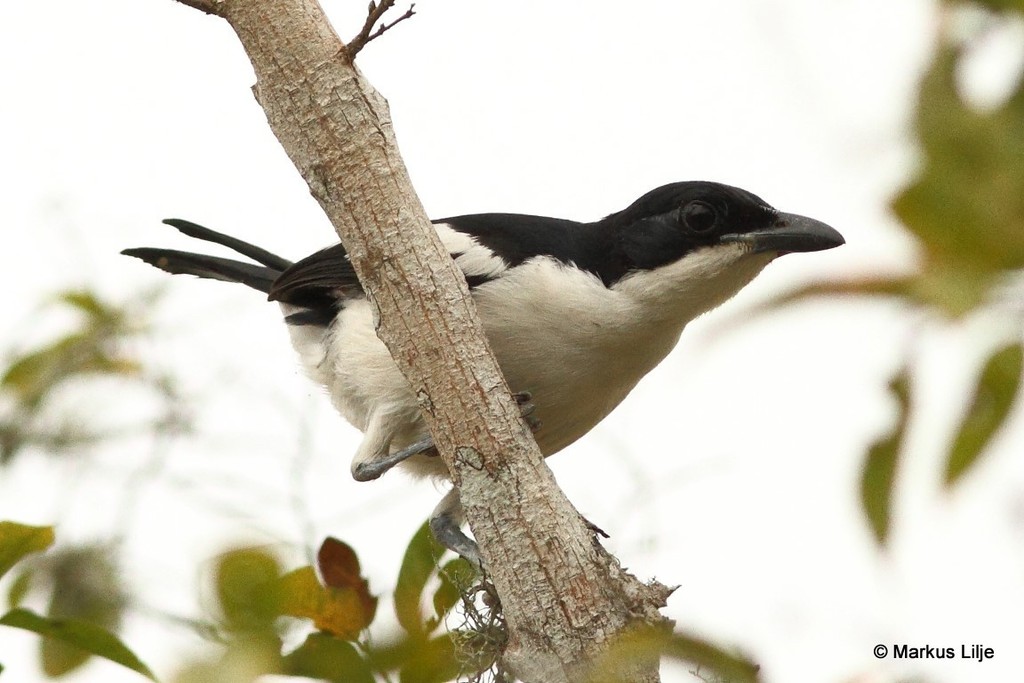
Gabon Boubou
Live sightings near you, the range map, bar charts of when it is seen, and Macaulay Library photos and recordings.
Swamp Boubou
Laniarius bicolor
The swamp boubou (Laniarius bicolor), also known as the Gabon boubou, is a species of bird in the Malaconotidae or bushshrike family. It is native to western and southern Central Africa. In the north of their range, savannah thickets constitute an important part of their habitat, while in the south they are strongly associated with river systems and marshes, for which they are named. The pair bond appears to be maintained by duetting, which in the south is generally synchronous or overlapping. It is most similar to L. major major, with which it perhaps hybridizes, but the underpart plumage is immaculate white, while the female contributes a ratchet-like note to the duet.
From the article Swamp boubou on Wikipedia (CC BY-SA), quoted section by section
Description
The sexes are similar in appearance. They are large passerines that measure 23 to 25 cm in length. The upperparts are deep blue-black with a slight luster. The long, fluffy rump feathers have concealed white spots, giving the rump a pale appearance. The wings are black with white wing-stripes, and the underparts are pure white. The iris is dark brown, the bill and palate are black, and the legs and feet slate-blue. Juvenile birds have light dusky barring on the underside, and buffy-tipped and barred upperpart plumage. Immatures are duller than adults with buff-tipped wing-coverts and browner bills. Their larger size, more slender bill, immaculate white underparts, and vocals distinguish them from the tropical boubou where they locally occur together. In those locations the southern race behaves as good species, but somewhat less so with the northern races which are sometimes merged with L. major.
Wikipedia: “Description and identification”
Range & habitat
It is found in Angola, Botswana, Cameroon, Republic of the Congo, DRC, Gabon, Namibia, Zambia, and Zimbabwe. Its natural habitats are regenerating forest, moist to seasonally dry savannah thicket, coastal scrubland and mangroves, and ravine forests of the Angolan escarpment. In the south of its range it is confined to floodplain systems. Along these rivers and swamps they frequent dense, tangled riparian vegetation, edges of reedbeds, papyrus stands or clumps of water fig on islands.
Wikipedia: “Range and habitat”
Listen
Looking for field recordings…
Where it lives
Recorded sightings
—
geo-referenced records in GBIF, from museums, herbaria and field observers.
Drag the globe to turn it. Dots are where records exist, not a range map; darker means more records.
In the stacks
Searching the stacks…
Every page naming Laniarius bicolor in the Biodiversity Heritage Library →
This page is assembled live from iNaturalist, GBIF, Wikipedia, the Source Library and the Internet Archive. It is not yet part of the hand-edited codex. iNaturalist taxon 8217.